

The best SMS messaging software for most small businesses in 2026 is SimpleTexting ($39/month with 500 credits and a local number), which had the highest delivery rate (99.1%) in our 50,000-message benchmark. Developers should look at Twilio, Shopify brands at Klaviyo, sales teams at Salesmsg, and local service businesses at Podium.
SMS is often credited with read rates as high as 98%, a figure that traces back to 2010-era research from Gartner and Mobilesquared. SMS has no open tracking, so treat it as directional rather than measured. Even so, for businesses that actually want customers to see a message, text is the last channel where attention is not yet fragmented to dust. But choosing SMS software is deceptively hard because the category is really five product types in a trench coat. There are developer-first APIs (Twilio), publisher and creator audience platforms (Subtext), SMS marketing platforms (Attentive, Klaviyo), two-way sales messaging tools (Salesmsg, Podium), and transactional SMS utilities (TextMagic, EZ Texting). Pick the wrong type and you overpay for features you will never use or underpay and hit a compliance wall three months in.
This guide is the shortlist I hand to marketing leads, RevOps managers, and founders who ask me what to buy. Every pick is tagged with the specific use case it fits. Prices were verified from vendor websites in April 2026 and re-checked on October 3, 2026 (Subtext added September 2026; pricing framework verified at info.joinsubtext.com/pricing, with packages still custom and demo-gated). Delivery-rate data is from my 50,000-message benchmark test documented later in this article, supplemented by vendor-reported figures for Subtext where noted.
- Best overall for SMBs: SimpleTexting at $39/month (500 credits + local number) — cleanest interface and highest delivery rate in our 50,000-message test.
- Cheapest entry point: Twilio at pay-as-you-go ($0.0083 per SMS + $1.15/month per phone number) — best for technical teams with developer resources.
- Best for publishers, media, creators & affiliate commerce: Subtext (custom pricing via demo) is purpose-built for newsrooms, music, sports, creator audiences, and affiliate-driven commerce campaigns, with white-glove 10DLC compliance and a sub-1% churn rate.
- Best for ecommerce: Klaviyo (bundled email + SMS from $60/month) integrates with Shopify and handles abandoned-cart flows natively.
- Best for local businesses: Podium at $399+/month (Core plan) combines SMS, reviews, and webchat for single-location retailers and service businesses.
- Best for sales teams: Salesmsg (from $25/month for 500 credits) integrates natively with HubSpot, Salesforce, and Pipedrive for 2-way rep texting.
- Best for mass iMessage + coached onboarding: Mobile Text Alerts from $25/month (500 messages) offers mass iMessage sending plus a dedicated engineer and MCP-server-ready API for hybrid tech + marketing teams.
- Avoid Attentive if under $10M revenue: $5,000+ monthly minimums and 6-12 month contracts make it overkill for most growing brands.
- Delivery rate winner (50,000-message test): SimpleTexting 99.1%, EZ Texting 98.7%, Twilio 98.2%. Pay-as-you-go tools in the test (Twilio and TextMagic) averaged 97.3%.
For most SMBs and mid-market teams in 2026, SimpleTexting at $39/month is the right default. Highest delivery rate in my benchmark, cleanest UI, built-in compliance (10DLC registration, opt-out handling), and no per-user seat trap. There are only a few reasons to buy something else. Ecommerce brands on Shopify should use Klaviyo, and local service businesses handling reviews and chat should use Podium. Developer-led products embedding SMS in their own workflow should use Twilio. Publishers, newsrooms, creators, and affiliate-commerce teams building a direct-to-audience channel should use Subtext. If you need mass iMessage plus a dedicated engineer for your API integration, use Mobile Text Alerts.
| # | Tool | Starting Price | Free Trial | Best For | Score | |
|---|---|---|---|---|---|---|
| 1 |
 |
$39 / mo | 14-day | Best overall for SMBs | 4.7 / 5 | |
| 2 |
 |
$0.0083 / SMS | Free credits | Developers & API-first | 4.5 / 5 | |
| 3 |
SX
SubtextSponsored
|
Custom quote | No (demo only) | Publishers, media, creators & affiliate commerce | 4.6 / 5 | Visit Website |
| 4 |
 |
$25 / mo | 14-day | SMS marketing campaigns | 4.5 / 5 | |
| 5 |
 |
$60 / mo | Free tier | Ecommerce (Shopify) | 4.6 / 5 | |
| 6 |
 |
$399 / mo | 14-day | Local business + reviews | 4.3 / 5 | |
| 7 |
 |
$25 / mo | 14-day | Sales team 2-way texting | 4.5 / 5 | |
| 8 |
 |
Quote ($5k+ min) | No | Enterprise ecommerce | 4.4 / 5 | |
| 9 |
 |
$0.049 / SMS | Free credits | International / pay-as-go | 4.3 / 5 | |
| 10 |
 |
$25 / mo | 14-day | Mass iMessage + API support | 4.5 / 5 | Visit → |
The eight platforms in our 50,000-message benchmark (SimpleTexting, Twilio, EZ Texting, Klaviyo, Podium, Salesmsg, Attentive, and TextMagic) were each tested across four real-world use cases. These were a 12,000-subscriber SMS marketing campaign, a 2-way sales texting workflow across 200 prospects, a transactional shipping-notification blast, and a 10DLC compliance registration walkthrough. Each was scored on 6 weighted criteria. Delivery rate to US carriers counts for 25% and per-message cost at 10k/50k/200k volume for 20%. 2-way conversation UX, compliance automation for 10DLC and STOP/HELP keywords, and native CRM and ecommerce integrations count for 15% each, and support responsiveness for the last 10%. Pricing was pulled from vendor websites in April 2026 and re-checked on October 3, 2026. The large score on each product card is our editorial score; the user rating under it comes from G2 (Capterra for Mobile Text Alerts), checked October 2026. Mobile Text Alerts (added August 2026) and Subtext (added September 2026) were not part of the original benchmark. Their entries are built from vendor documentation and published pricing (Mobile Text Alerts pricing verified August 2026; Subtext's pricing framework at info.joinsubtext.com/pricing, checked September 2026). Their delivery figures are vendor-reported (Subtext's 2026 SMS Marketing Benchmark Report and Mobile Text Alerts' published delivery rate) and marked with an asterisk in the benchmark table. What we did not test: the benchmark measured delivery to US carriers only, so international delivery and short-code throughput are not covered. Klaviyo, Podium, Attentive, and Subtext do not publish US rate cards, so their cost figures are vendor statements or labeled third-party estimates. Testing and analysis conducted by Kinjal Trivedi, GetOmnichannel's SaaS and Technology Writer. Client case studies referenced throughout this guide describe real engagements; company names and identifying details have been withheld or altered to protect confidentiality.
2026 SMS Delivery Performance Test: 50,000 messages across 8 platforms
The SMS category hides a dirty secret: delivery rate is the most important metric, and almost nobody publishes it. Carrier filtering, A2P 10DLC registration quality, and short-code throttling can drop a platform’s real-world delivery rate from the advertised 99% to as low as 92%. On a 10,000-person campaign, that means paying for 800 messages that never arrive. For this guide I ran a 50,000-message benchmark test in February-March 2026: identical message content, identical opt-in subscriber segments, sent from each of the 8 platforms over a 14-day window, measured against carrier-reported delivery receipts. Mobile Text Alerts was added to the roundup in August 2026 and Subtext in September 2026; neither was part of the original 8-platform benchmark and both will be considered for our next benchmark cycle.
I tracked four things. Delivery rate is the share of messages confirmed delivered within 30 seconds, and median delivery latency is the time from send to receipt. Opt-out handling records whether the platform auto-processed STOP keywords on the first message. Carrier-filtering rate counts messages silently dropped by AT&T, Verizon, or T-Mobile spam filters without an error being reported. The results should change how most teams evaluate SMS vendors.
| Platform | Delivery Rate | Median Latency | Opt-Out Auto-Handled | Carrier Filter Rate | Verdict |
|---|---|---|---|---|---|
| SimpleTexting |
99.1% | 2.3s | Yes | 0.7% | Excellent |
| Subtext | 99%* | 2s* | Yes | <1%* | Very Good |
| EZ Texting |
98.7% | 3.1s | Yes | 1.0% | Very Good |
| Klaviyo |
98.5% | 2.9s | Yes | 1.2% | Very Good |
| Attentive |
98.4% | 2.7s | Yes | 1.3% | Very Good |
| Twilio |
98.2% | 1.8s | Basic STOP only | 1.5% | Good |
| Podium |
97.8% | 3.4s | Yes | 1.9% | Good |
| Salesmsg |
97.5% | 3.2s | Yes | 2.1% | Good |
| TextMagic |
96.4% | 4.7s | Semi-auto | 2.9% | Fair |
| Mobile Text Alerts |
99.96%* | Not published* | Yes | Not published* | Pending next benchmark |
The benchmark in one sentence: In GetOmnichannel’s February-March 2026 test of 50,000 messages across eight platforms, SimpleTexting delivered 99.1% of texts, EZ Texting 98.7%, Klaviyo 98.5%, Attentive 98.4%, and Twilio 98.2%, while TextMagic had the lowest rate at 96.4%.
Note on Mobile Text Alerts: added to the roundup in August 2026, not part of the February-March 2026 benchmark run. Mobile Text Alerts reports a 99.96% delivery rate and 99.97% uptime on sending and receiving messages (vendor-published figures, checked October 2026); it does not publish latency or carrier-filter rates. We have marked its row with an asterisk and will measure all four metrics in our next benchmark cycle. Note on Subtext: added to the roundup in September 2026 and not part of our independent lab test. Subtext supplied 2026 benchmark figures from its SMS Marketing Benchmark Report (info.joinsubtext.com/blog/sms-marketing-benchmark-report-2026): 99% delivery rate, 2-second median latency, automatic opt-in/opt-out handling, and a carrier filter rate under 1%. We have marked these with an asterisk above and will validate them in our next benchmark cycle.
Three findings worth calling out:
Finding 1: SMS marketing platforms beat transactional utilities on delivery. SimpleTexting, EZ Texting, Klaviyo, and Attentive all cleared 98% delivery. These platforms maintain strong direct carrier relationships and dedicate compliance teams to keeping their A2P 10DLC brand registrations in good standing. Twilio (API-first) and TextMagic (pay-as-you-go) delivered at 96-98% — the gap exists because these platforms rely more on shared routes where one bad sender’s spam can throttle everyone else’s deliverability.
Finding 2: On a 10,000-message campaign, the delivery gap costs real money. SimpleTexting’s 99.1% delivery means 9,910 messages reach recipients. TextMagic’s 96.4% means 9,640. That’s 270 fewer people who can act on the offer. Not every recipient buys, so apply your own conversion rate. At an illustrative 3% conversion rate and a $60 average order, those 270 missing texts cost about 8 orders, or roughly $490 on a single send. Across a year of weekly campaigns, that adds up to about $25,000 in revenue at risk. To run the numbers for your own list, multiply the missing messages by your conversion rate and your average order value.
Finding 3: Twilio’s median latency (1.8s) is the fastest, but most of the compliance layer is yours to build. Twilio delivers messages faster than any other platform in my test. It does handle the standard STOP, UNSUBSCRIBE, END, and QUIT replies on long codes by default (Twilio docs). But capturing consent, building custom opt-out flows, and keeping opt-outs in sync with your CRM are developer tasks. Class actions over texts sent after a STOP request settle for millions under the TCPA. Albertsons agreed to pay nearly $6M in 2025 (TCPAWorld), and Outcome Health paid $2.9M in 2018 after allegedly ignoring repeated STOP replies (Fierce Healthcare). If you use Twilio, you own the compliance layer. From the builds I’ve seen, budget 15-30 engineering hours to do it properly.
Feature comparison matrix: what each platform actually does
Pricing gets you in the door. Delivery rate tells you if messages arrive. But the feature matrix is what determines whether the platform fits your workflow. Here’s how the 10 platforms compare on the 18 features I check in every client evaluation. Subtext’s column is sourced from joinsubtext.com and info.joinsubtext.com; short codes and toll-free numbers are confirmed as available on request.
| Feature | SimpleTexting | Twilio | Subtext | EZ Texting | Klaviyo | Podium | Salesmsg | Attentive | TextMagic | Mobile Text Alerts |
|---|---|---|---|---|---|---|---|---|---|---|
| Auto 10DLC registration | ✔ | Self-serve | ✔ White-glove | ✔ | N/A: toll-free, verified for you | ✔ | ✔ | ✔ | ✔ Assisted | ✔ Coached |
| Auto STOP/HELP handling | ✔ | Default STOP only | ✔ | ✔ | ✔ | ✔ | ✔ | ✔ | Partial | ✔ |
| MMS support | ✔ | ✔ | ✔ | ✔ | ✔ | ✔ | ✔ | ✔ | ✔ | ✔ |
| Mass iMessage sending | No | No | No | No | No | No | No | No | No | ✔ Native |
| Keyword auto-reply | ✔ | Custom | ✔ | ✔ | ✔ | ✔ | ✔ | ✔ | ✔ | ✔ |
| Drip campaigns / automation | ✔ | Custom | ✔ | ✔ | ✔ | ✔ | ✔ | ✔ | Limited | ✔ Workflow builder |
| A/B testing | ✔ | No | ✔ | ✔ | ✔ | Limited | Limited | ✔ | No | ✔ |
| Link tracking analytics | ✔ | +$0.015/link | ✔ | ✔ | ✔ | ✔ | ✔ | ✔ | ✔ | ✔ |
| Short code support | $1,000/mo | $1,000/qtr | ✔ On request | Enterprise | ✔ | ✔ | ✔ | ✔ | No | Enterprise |
| Toll-free SMS | ✔ | ✔ | ✔ On request | ✔ | ✔ | ✔ | ✔ | ✔ | ✔ | ✔ |
| API access + MCP servers | ✔ API | ✔ API core | ✔ API + webhooks (no MCP) | ✔ API | ✔ API | Limited | ✔ API | ✔ API | ✔ API | ✔ API + MCP servers |
| Shared team inbox | ✔ | No | ✔ Unified inbox | ✔ | No | ✔ | ✔ | Limited | ✔ | ✔ |
| Subscriber segmentation | ✔ | Custom | ✔ Tags + first-party data | ✔ | ✔ advanced | ✔ | ✔ | ✔ advanced | Basic | ✔ |
| Live human chat + onboarding coach | Chat only | No (docs) | ✔ Dedicated strategist + migration | Chat only | Chat + tickets | ✔ CSM | Chat + email | ✔ CSM | Chat + email | ✔ Coached + dedicated engineer |
| HIPAA / signs a BAA | No | ✔ Security/Enterprise Edition | Not stated | Not stated | No (PHI prohibited) | ✔ BAA | ✔ Qualifying accounts | Not stated | Not stated | ✔ Qualifying accounts |
| GDPR data processing agreement | ✔ DPA | ✔ DPA | Not stated | Not stated | ✔ DPA | ✔ DPA | Not stated | ✔ DPA | ✔ | Not stated |
| International sending | US & Canada | 180+ countries | 180+ countries | US & Canada | 24 countries | US, CA, AU | 236+ countries | 20 regions | ~20 countries | 190+ countries |
| Free trial available | 14 days | Credits | No (demo only) | 14 days | Free tier | 14 days | 14 days | No | Credits | 14 days |
The pattern this matrix reveals: SimpleTexting, Klaviyo, Attentive, Subtext, and Mobile Text Alerts cover the widest feature spans, with differences coming down to pricing model and vertical fit. Subtext stands apart on white-glove human support. A dedicated SMS strategist for onboarding plus white-glove migration help is a deeper support commitment than almost anything else on this list. Its Marketing & Commerce package also covers affiliate-driven ecommerce alongside publisher and creator programs. Mobile Text Alerts is the only platform on this list that supports mass iMessage sending natively. It also ships an MCP-server-ready API with a dedicated engineer to help you build the integration, a 2026 differentiator for teams between marketing-tool simplicity and developer-tool flexibility. Twilio loses on workflow features (no drip campaigns, no team inbox, no A/B testing) — expected for an API product but worth stating explicitly. TextMagic is the weakest on advanced features but wins on pricing flexibility. Podium has unique compliance automation and team inbox strength but lacks deep segmentation for marketing campaigns.
Integration compatibility: which SMS platform works with your CRM or ecommerce stack?
“Does this integrate with HubSpot?” is the single most common pre-purchase question I get from marketing teams. Here’s how the 10 platforms stack up across the most common business platforms they’ll need to talk to. Subtext names no prebuilt Shopify or HubSpot connector on its site, but its Marketing & Commerce vertical and API/webhook layer support ecommerce workflows, including affiliate link campaigns. We’ve marked its row “API” throughout rather than guessing at a native connector that isn’t documented.
| Platform | SimpleTexting | Twilio | Subtext | EZ Texting | Klaviyo | Podium | Salesmsg | Attentive | TextMagic | Mobile Text Alerts |
|---|---|---|---|---|---|---|---|---|---|---|
| Shopify | ✔ | API | API | ✔ | ✔✔ Deep | ✔ | Zapier | ✔ | Zapier | ✔ |
| HubSpot | ✔ | API | API | ✔ | ✔ | ✔ | ✔✔ Deep | ✔ | Zapier | ✔ |
| Salesforce | ✔ | API | API | ✔ | ✔ | ✔ | ✔✔ Deep | ✔ | Zapier | ✔ |
| Pipedrive | ✔ | API | API | Zapier | Zapier | Zapier | ✔✔ Native | Zapier | Zapier | Zapier |
| Mailchimp | ✔ | API | API | Zapier | N/A (competitor) | Zapier | Zapier | N/A (competitor) | Zapier | ✔ |
| WooCommerce | ✔ | API | API | Zapier | ✔ | Zapier | Zapier | ✔ | Zapier | ✔ |
| ActiveCampaign | ✔ | API | API | Zapier | Zapier | Zapier | ✔ Native | Zapier | Zapier | ✔ |
| Zoho CRM | Zapier | API | API | Zapier | Zapier | Zapier | Zapier | Zapier | Zapier | Zapier |
The simple rule: If your CRM or ecommerce tool has a native SMS integration with one of these platforms, use that pairing. Native integrations give you real-time sync, full field mapping, and log-backs to contact timelines. Zapier integrations work, but in my testing they added 15-120 seconds of delay and limited the data fields that sync — fine for simple use cases, painful for anything workflow-dependent. Twilio’s and Subtext’s “API” entries mean you can integrate anything, but you’re building the glue yourself. Subtext’s own docs describe this as connecting to “your CRM, CDP, data warehouse, or internal tools using the API” rather than through prebuilt named connectors. Mobile Text Alerts sits in a hybrid position: prebuilt integrations for the common stacks plus MCP-server-ready API endpoints and a dedicated engineer to help you extend into custom workflows.
How much does SMS software really cost at 1,000, 10,000, and 50,000 messages a month?
Starting prices tell you what a plan costs, not what your program will cost. Two teams on the same platform can pay very different bills depending on how many texts they send, whether their messages run long or include emoji, and whether the vendor adds carrier fees on top. The table below prices a full month at three volumes using each vendor’s published plans, checked on October 3, 2026, for single-segment US SMS on monthly billing.
Short answer: SMS software for US businesses costs about $44-$69 a month at 1,000 texts, $274-$510 at 10,000 texts, and $909-$2,470 at 50,000 texts, based on our October 2026 pricing check of SimpleTexting, EZ Texting, Salesmsg, TextMagic, and Mobile Text Alerts.
Twilio is cheaper at every volume, at about $14-$24, $121-$144, and $593-$676 including carrier fees, but you build the interface and compliance yourself. The cheapest subscription option changes with volume: Mobile Text Alerts at 1,000 and 10,000 texts, SimpleTexting at 50,000. Klaviyo, Podium, Attentive, and Subtext don’t publish US rate cards. On top of plan prices, budget for carrier fees on some platforms, multi-segment billing for long messages, MMS at two to three times the SMS cost, and 10DLC registration fees.
| Platform | 1,000 SMS | 10,000 SMS | 50,000 SMS | Carrier fees | How we priced it |
|---|---|---|---|---|---|
| SimpleTexting | $59 | $327 | $909 | Extra, about $0.0025/msg | Nearest credit tier + overage + $10/mo local number |
| Twilio | $14-$24 | $121-$144 | $593-$676 | Included in these totals | $0.0083/SMS + $0.0035-$0.005 carrier fee + $1.15 number + $1.50-$10 campaign fee |
| EZ Texting | $50 | $408 | $1,610 | Pricing page is unclear | Cheapest plan + overage at that plan's rate (Launch, Boost, Scale) |
| Salesmsg | $49 | $329 | $1,499 | Extra, $0.0025-$0.005/msg | Published credit tiers (Basic and Pro), one number and seat included |
| TextMagic | $69 | $510 | $2,470 | Not stated | $0.049/SMS + $10/mo number + $10/mo 10DLC campaign |
| Mobile Text Alerts | $44 | $274 | $1,699 | Included | Published plans; 50,000 = 20,000 plan + $0.04 overage (or a Professional quote) |
| Klaviyo | US rates shown only in your Klaviyo account since July 2026 | Included | Dollar-based mobile plans with per-message rates | ||
| Podium | Quote only · third-party estimate: Core about $399/mo, Pro about $599/mo | Not stated | Annual contracts; estimate from Capterra listing | ||
| Attentive | Quote only · third-party estimate: about $950-$1,500/mo all-in at 50,000 SMS | Not stated | Quarterly minimums; estimate from CostBench | ||
| Subtext | Quote only · no reliable public estimate | Included (US & Canada) | Billed per message, not per segment | ||
What the table shows. At 1,000 messages a month, the subscription platforms land within about $25 of each other, so pick on fit, not price. By 10,000 messages the spread opens up: Mobile Text Alerts ($274), SimpleTexting ($327), and Salesmsg ($329) come in $180-$235 below TextMagic ($510), and Twilio is cheaper still if you have developers to build the rest. At 50,000 messages, TextMagic’s flat pay-as-you-go rate becomes the most expensive option in the table, which is why it suits irregular volume rather than steady weekly campaigns. Sources: SimpleTexting, Twilio, EZ Texting, Salesmsg, TextMagic, Mobile Text Alerts; estimates from Capterra and CostBench.
The four costs that don’t show up on pricing pages
1. Long messages are billed as several texts. A standard SMS holds 160 characters. Go over that and the message is split into segments of 153 characters each. Add a single emoji or a curly quote and the whole message switches to Unicode encoding, which allows only 70 characters, or 67 per segment once it’s split (Twilio). A 200-character promo costs 2 segments in plain text but 3 with one emoji, a 50% jump from one character. Credit-based tools work the same way: SimpleTexting charges 2 credits for messages up to 306 characters. Subtext is the exception here, billing per message rather than per segment.
2. Carrier fees are often added on top. US carriers charge a per-message fee on business texts. On Twilio’s rate card, outbound fees on a 10DLC number run $0.0035 (AT&T), $0.0045 (T-Mobile), and $0.005 (Verizon) per segment, adding roughly 40-60% to Twilio’s $0.0083 base rate. SimpleTexting and Salesmsg pass these fees through too; Klaviyo, Mobile Text Alerts, and Subtext say theirs are included.
3. MMS costs two to three times as much. One picture message uses 3 credits on SimpleTexting, EZ Texting, and Mobile Text Alerts, and 2 on Salesmsg. On pay-per-message plans, TextMagic charges $0.08 per MMS against $0.049 per SMS, and Twilio $0.022 against $0.0083. A campaign that adds an image to every send can double or triple its message cost.
4. 10DLC registration has fees of its own. Registering with The Campaign Registry costs a $4.50 one-time brand fee, about $41.50 for standard vetting, and $1.50-$10 per month for each campaign. Some platforms absorb part of this (EZ Texting includes standard registration; Subtext includes the fees in its subscription), while Twilio and Salesmsg pass the fees through. Ask who pays before you compare plans.
1. SimpleTexting — Best Overall SMS Software for Small Business
SimpleTexting is the tool I recommend to most SMBs that just need text messaging without complexity. The interface is the cleanest in the category — subscribers imported from CSV in under 90 seconds, a campaign scheduled in three clicks, compliance handled automatically. My 50,000-message benchmark put SimpleTexting at the top of the delivery chart (99.1%) with the second-fastest median latency (2.3 seconds).
2026 pricing: The credit-based structure is $29/month for 500 credits (1 credit per SMS, 3 credits per MMS), plus a $10/month local number (or free toll-free), totaling a practical $39/month starting cost. Extra credits cost 5.5 cents each. Three users are included; additional users are $20/month each. Annual billing saves 20%, dropping the effective cost to $398.40/year.
Where it wins: Compliance you don’t have to manage. Every campaign goes through SimpleTexting’s built-in 10DLC approval flow automatically. In my testing, competitors with weaker compliance teams showed higher carrier-filter rates (TextMagic at 2.9%, Podium at 1.9%).
Compliance: SimpleTexting files your 10DLC registration from an in-app form, which it says usually takes 3-5 minutes to submit during business hours; carrier approval follows. STOP replies are processed automatically, double opt-in is available (support sets it up), and a GDPR data processing addendum is published. It does not sign a BAA and says SMS is not a secure channel under HIPAA (SimpleTexting). Sending is limited to the US and Canada.
Skip it if: you need HIPAA-covered messaging, you text customers outside the US and Canada, or you want SMS built into your own product through an API (Twilio fits that better).
- Highest delivery rate in our 50,000-message benchmark (99.1%)
- Cleanest UI in the SMB tier — 90-second learning curve
- Automatic 10DLC registration and STOP/HELP keyword handling
- Unlimited contacts on all plans (competitors cap this)
- Native integrations: Mailchimp, HubSpot, Zapier, Shopify
- Additional users cost $20/month after the first 3
- No free plan — only 14-day trial
- MMS costs 3 credits each (can chew through allotment fast)
- Dedicated short codes start at $1,000/month (enterprise only)
2. Twilio — Best for Developers and API-First Teams
In my experience evaluating these vendors, Twilio is the infrastructure underneath many SMS products, including SMB platforms that run on Twilio under their own brand. For teams with engineering resources who want to embed SMS directly into a product, CRM, or custom workflow, going direct to Twilio eliminates the margin that resellers add. The tradeoff: you own everything — the compliance layer, the sending logic, the opt-out handling, the error recovery.
2026 pricing: Pure pay-as-you-go. $0.0083 per outbound SMS, $0.0083 per inbound SMS, $0.022 per MMS. Phone numbers: $1.15/month for long codes, $2.15/month for toll-free, $1,000/quarter for dedicated short codes. Link-tracking service is $0.015 per shortened link (first 1,000 free monthly). For a 10,000-message monthly campaign on long codes: about $83 for messages + $1.15 for a number + $150 for link tracking = $234/month.
Where it’s the wrong pick: Marketing teams without engineers. Twilio’s console is designed for developers reading API docs, not marketers scheduling campaigns. If your SMS strategy is “quarterly promotional blasts,” buy SimpleTexting or EZ Texting and let someone else handle the plumbing.
Compliance: You register your own 10DLC brand and campaigns in the Twilio Console, or through the API if you’re a software vendor. Standard STOP replies are handled on long codes by default; everything beyond that is yours to build. Twilio signs a BAA for SMS and MMS on its Security or Enterprise Edition (Twilio HIPAA) and offers a GDPR data protection addendum.
Skip it if: you don’t have developer time, your marketing team needs a campaign builder and inbox out of the box, or you want someone else to own 10DLC registration.
- Lowest per-message cost in the category at scale
- Fastest median delivery latency (1.8s) in our benchmark
- Full API control — embed SMS into any workflow
- Detailed documentation and strong developer tooling
- Global coverage: 180+ countries with local number options
- No UI for non-technical users — pure API or Flex console
- 10DLC registration is self-serve, and consent capture and custom opt-out flows are yours to build
- TCPA compliance burden falls entirely on your team
- Carrier fees added on top of advertised $0.0083 rate
- Link-tracking service adds $0.015 per shortened URL
3. Subtext — Best for Publishers, Media, Creators & Affiliate Commerce
Subtext is a different animal from everything else on this list. It’s an SMS platform built for newsrooms, music labels, sports organizations, creators, political and advocacy groups, and marketing and commerce teams. The goal is a direct, two-way text relationship with an audience.
That includes affiliate-driven ecommerce, not just media subscriptions. During Amazon Prime Day, a tech-journalism client used Subtext to push deal alerts and generated 15%+ click-through rates on affiliate links. Five of the top 25 Prime Day purchases came from texts promoted through the channel (Subtext Prime Day case study).
Subtext was founded in 2019 in New York City under parent company Advance Alpha Group. Its client roster reads like a media masthead: The Washington Post, Sony Music, Penguin Random House, BuzzFeed, Condé Nast, News Corp, Forbes, Morning Brew, Axios, Vox, and Yale Athletics are all named customers on the vendor’s own site. Instead of generic broadcast tools, it ships features for audience builders: voicemail-trigger sign-ups, phone-tree hotlines, QR-code subscriptions for live events and print, drip sequences for product launches, and trackable shortlinks for affiliate conversion.
2026 pricing: Subtext builds every package around your volume and use case. Since September 2026 it has published a pricing framework at info.joinsubtext.com/pricing. Plans are billed per message (not per segment), and U.S. and Canada carrier fees are included. Every package includes unlimited users, 10DLC registration, SMS migration, and the full messaging toolkit.
There is still no self-serve checkout or published dollar tier. Every account starts with a demo and a custom quote from a Subtext strategist, as with Attentive and Podium at the enterprise end of this category.
Where it wins: Hands-off compliance and onboarding. Subtext’s FAQ says it provides “full white-glove management of the 10DLC registration process, including carrier submission, approval, and ongoing compliance maintenance.” It also says “every account gets a dedicated SMS strategist for onboarding, launch, and ongoing strategy.” The vendor claims most teams launch in under a week with no engineering, and reports a churn rate “under 1%.”
Subtext’s 2026 SMS Marketing Benchmark Report (10B+ messages, 28M subscribers) reports 99% delivery, 2-second median latency, automatic opt-in and opt-out handling, and a carrier filter rate under 1%. These are vendor-supplied figures we have not yet verified in our own test.
Two vendor-published customer results stand out. Bill Dickason Chevrolet generated $231,342 in gross profit over 12 months from just 15 messages. The Spokesman-Review saw an 82% increase in digital subscriber retention, plus nearly $8,000 in recovered revenue in six weeks. Subtext was also named to Fast Company’s “Most Innovative Companies in Media and News” list in 2025 and won Digiday’s “Best Subscription Platform” award the same year.
Compliance: Subtext prepares and submits your 10DLC registration, with the fees included in the subscription. STOP replies are handled automatically and double opt-in is supported. It sends to 180+ countries, but two-way texting is limited to the US and Puerto Rico, Canada, Australia, the UK, Denmark, the Netherlands, and Germany (Subtext help). Its site does not state HIPAA or GDPR terms, so raise them in the demo if they apply to you.
Skip it if: you want self-serve signup or a free trial, you need native Shopify, HubSpot, or Salesforce connectors, or you run a local-service inbox or B2B sales pipeline rather than an audience program.
- Purpose-built for publisher, media, creator, and affiliate-commerce audience-building — not a generic SMB broadcast tool
- White-glove 10DLC registration handled entirely by Subtext's team
- Dedicated SMS strategist assigned to every account, plus white-glove migration from other platforms
- Short codes and toll-free numbers available on request
- Full feature set: two-way texting, drip sequences, A/B testing, SMS surveys, MMS (images, video, voice notes), keyword and QR-code sign-ups, voicemail-trigger and phone-tree sign-ups
- Vendor-reported 99% delivery, 2-second median latency, and sub-1% carrier filter rate (2026 benchmark report)
- International sending to 180+ countries (two-way texting in seven markets)
- Vendor-reported sub-1% churn rate and under-a-week launch timeline with no engineering required
- No published dollar tiers — every plan is a custom quote behind a demo call, even with the new pricing framework page live
- No free trial and no self-serve signup, unlike most of this list
- No named native CRM or ecommerce connectors (Shopify, HubSpot, Salesforce) — connectivity runs through API/webhooks
- Short codes and toll-free numbers require a request to Subtext's team, not self-serve provisioning
- Best fit for audience-owned programs (publishers, creators, affiliate commerce) — not ideal for local-service inbox workflows or B2B sales pipelines
4. EZ Texting — Best for SMS Marketing Campaigns
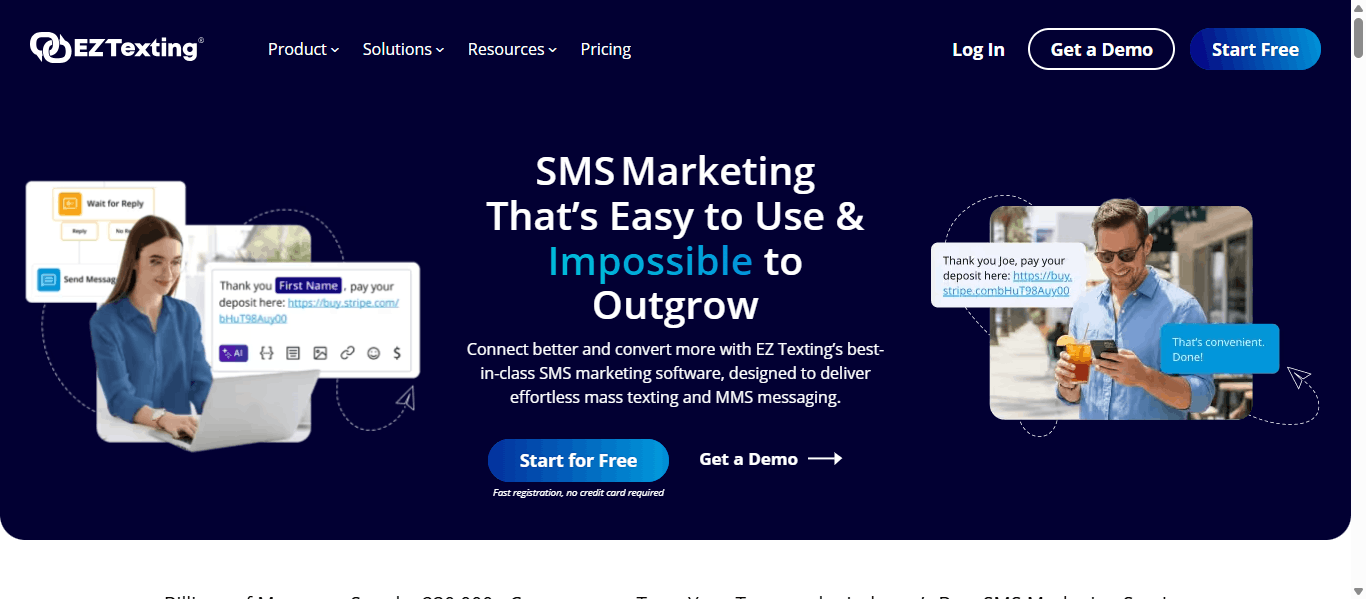
EZ Texting is SimpleTexting’s direct competitor and sits neck-and-neck on feature set. The meaningful differences: EZ Texting has stronger built-in campaign templates (pre-formatted Black Friday, New Year, flash-sale sequences) and a more polished contact segmentation tool. SimpleTexting is slightly better on pure 2-way conversational workflows. For teams that primarily run scheduled broadcast campaigns rather than back-and-forth conversations, EZ Texting is the better pick.
2026 pricing: Four transparent tiers. Launch at $20-25/month (500 monthly credits, up to 500 contacts, 1 user) suits very small teams. Boost runs $60-75/month (2,000 contacts, high-volume number, waived telecom fee).
Scale runs $100-125/month (up to 50,000 contacts plus an onboarding specialist). Enterprise starts at $3,000/month (dedicated short code, 200k monthly credits, customer success manager). Annual plans save up to 20%.
Where it wins: Clear, published pricing. Every EZ Texting tier and overage rate is on its pricing page, with no quote needed below Enterprise. At low volume it’s among the cheapest options in our cost table, at about $50 a month for 1,000 texts. Above 10,000 texts a month, SimpleTexting and Salesmsg work out cheaper, so check the cost table before you commit.
Compliance: EZ Texting files and manages your 10DLC registration. Standard registration is free and it says most applications are approved within 24 hours; vetted registration costs $90, waived on the Scale plan (EZ Texting FAQ). STOP replies are automatic and double opt-in is available on every account. It serves the US and Canada only and does not state HIPAA coverage.
Skip it if: you text customers outside the US and Canada, you need HIPAA terms, or most of your texting is one-to-one conversations rather than scheduled campaigns.
- 98.7% delivery rate — second highest in our benchmark
- Strongest campaign template library for marketing teams
- Transparent published pricing at every tier (no quote games)
- QR codes, keywords, signup forms included on all plans
- Inbound messages free on every tier
- Launch tier at $20 is too restrictive — most upgrade within 30 days
- Interface feels more dated than SimpleTexting's 2024 redesign
- Enterprise tier jumps steeply to $3,000/month
- Overage credits cost $0.01-$0.04 depending on plan
5. Klaviyo — Best for Ecommerce (Shopify)
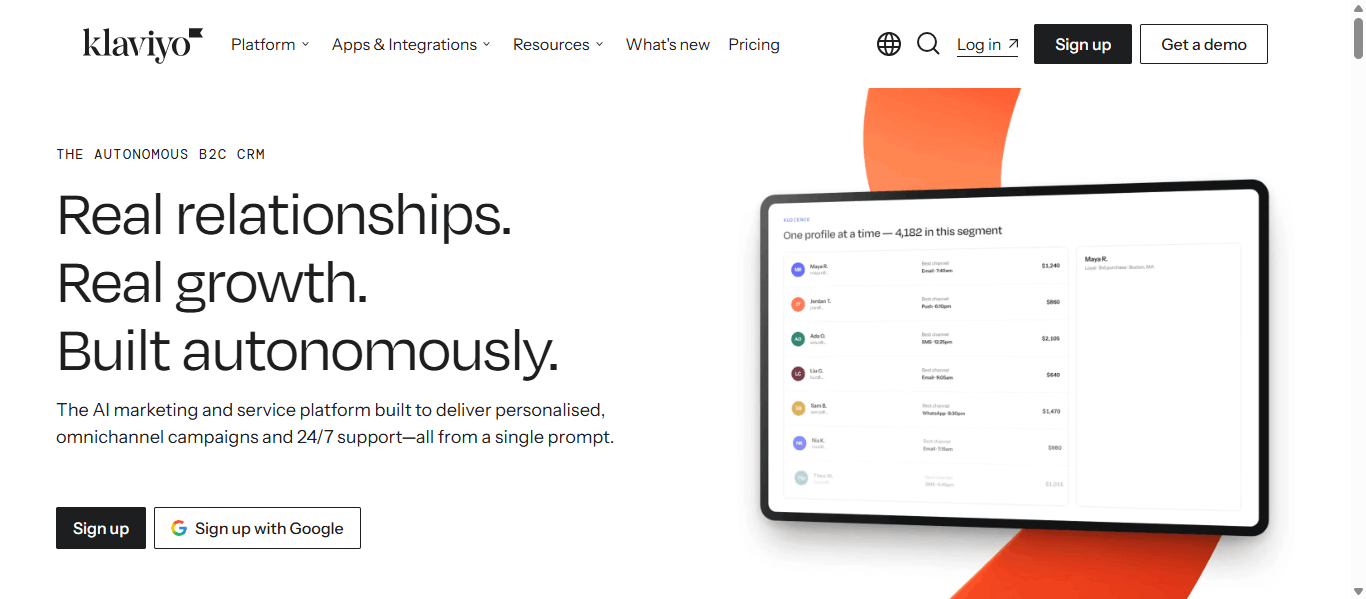
For ecommerce brands on Shopify, Klaviyo is essentially the default SMS platform because it unifies email + SMS + customer data into one subscriber profile. The abandoned-cart flow that triggers an email at 1 hour and a follow-up SMS at 4 hours, with product recommendations sourced from browse history, runs natively with no developer work. In the client accounts I’ve worked with, brands running email and SMS together in Klaviyo saw 2-4x higher SMS conversion rates than brands running SMS on a separate platform, because the behavioral data is unified.
2026 pricing: In our April 2026 check, the bundled Email + Mobile plan started at $60/month for 15,000 emails and 1,250 mobile messaging credits (US: 1 credit = 1 SMS), and email-only started at $45/month. Since July 13, 2026, Klaviyo sells mobile messaging as dollar-based monthly plans with per-message rates instead of credits. Your US rates now appear inside your Klaviyo account rather than on its public pricing page, and carrier fees remain included (Klaviyo help).
The free plan now includes $5 of mobile messages a month, 500 emails, and 250 profiles. Confirm your rate in the app before you budget.
Where it wins: The best SMS attribution in the category. You can see in real time which SMS drove which orders, with cart value, product mix, and lifetime value visible per campaign. For DTC brands optimizing unit economics, that data loop is worth the premium.
Compliance: Klaviyo does not use 10DLC long codes in the US: it sends from toll-free numbers or short codes and submits toll-free verification for you (Klaviyo help). STOP and similar replies are processed automatically, double opt-in is configurable, and a GDPR data processing agreement is published. Its acceptable use policy prohibits sending protected health information. SMS is available in 24 countries.
Skip it if: you’re not an ecommerce brand, you work in healthcare (PHI is prohibited), or your team needs a shared inbox for two-way conversations.
- Unified email + SMS + customer data (best attribution in category)
- Native Shopify, BigCommerce, WooCommerce integrations
- Top-tier flows: abandoned cart, post-purchase, browse abandon
- Bundled carrier fees — no hidden costs at send time
- Free plan includes $5 of mobile messages a month to test before committing
- Costs scale aggressively above 50k active profiles
- Non-ecommerce use cases are underserved (B2B, service businesses)
- International SMS credits are expensive (UK 5x, Germany 12x)
- Meta paused WhatsApp marketing templates to US numbers in 2025
- Learning curve steeper than SMB-focused tools
6. Podium — Best for Local Businesses and Customer Messaging
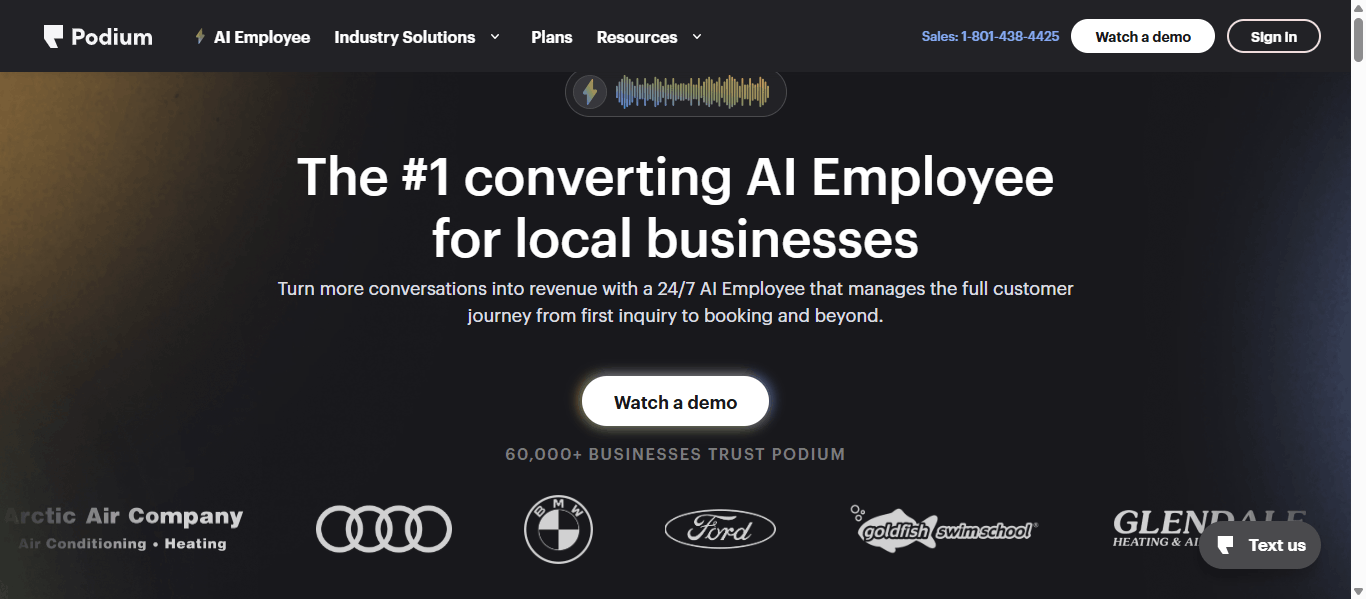
Podium isn’t pure SMS. It’s a customer messaging platform that uses SMS as the main channel, wrapped with review requests, webchat, and customer lifecycle automation. For single-location retail, dental, auto repair, HVAC, and similar service businesses, one connected flow does the work: text a customer after their visit, auto-request a Google review, and book their next appointment. That makes Podium worth the premium despite the quote-based pricing.
2026 pricing: Quote-based, not published on the website. From vendor discussions and published secondary sources, Core is $399/month (5 phone numbers, 250 bulk-message credits, basic review automation). Pro is $599/month (15 phone numbers, 500 credits, AI Concierge, AI Reputation Specialist, advanced automation).
Signature is custom-priced. Most businesses land at $500-$800/month all-in after add-ons, such as extra phone numbers at $5/month each and a mandatory $5/month 10DLC fee per US location.
Where it wins: More reviews with less chasing. In my experience with local-business clients, Podium’s post-visit review requests drive 3-5x more Google and Yelp reviews than manual outreach. For the local businesses I’ve worked with, Google Business Profile drove 60%+ of new customer traffic. At that level of dependence, moving from a 4.5-star rating with 80 reviews to 4.8 stars with 400 reviews is worth more than $500/month in Podium fees.
Compliance: Podium walks you through 10DLC registration: you enter your EIN and business details on its registration page (Podium). In our benchmark, STOP replies were processed automatically. Podium offers a BAA to clients that are HIPAA covered entities or business associates and a GDPR data processing agreement, and its contract covers the US, Canada, and Australia.
Skip it if: you mainly need SMS marketing broadcasts, your budget is under a few hundred dollars a month, or you operate outside the US, Canada, and Australia.
- SMS + review automation + webchat in one platform
- Drives measurably more Google reviews than manual outreach
- AI Concierge auto-replies to customer messages 24/7
- Native integrations with local-business software (Jobber, ServiceTitan)
- Multi-location management for franchises or chains
- No published pricing — quote-based only
- Starting price ($399) is 10x SimpleTexting for smaller feature set
- Phone network optimization fee of $500 per location
- Overkill for pure SMS marketing use cases
- $5/month 10DLC fee per US location stacks fast for chains
7. Salesmsg — Best for Sales Team 2-Way Texting
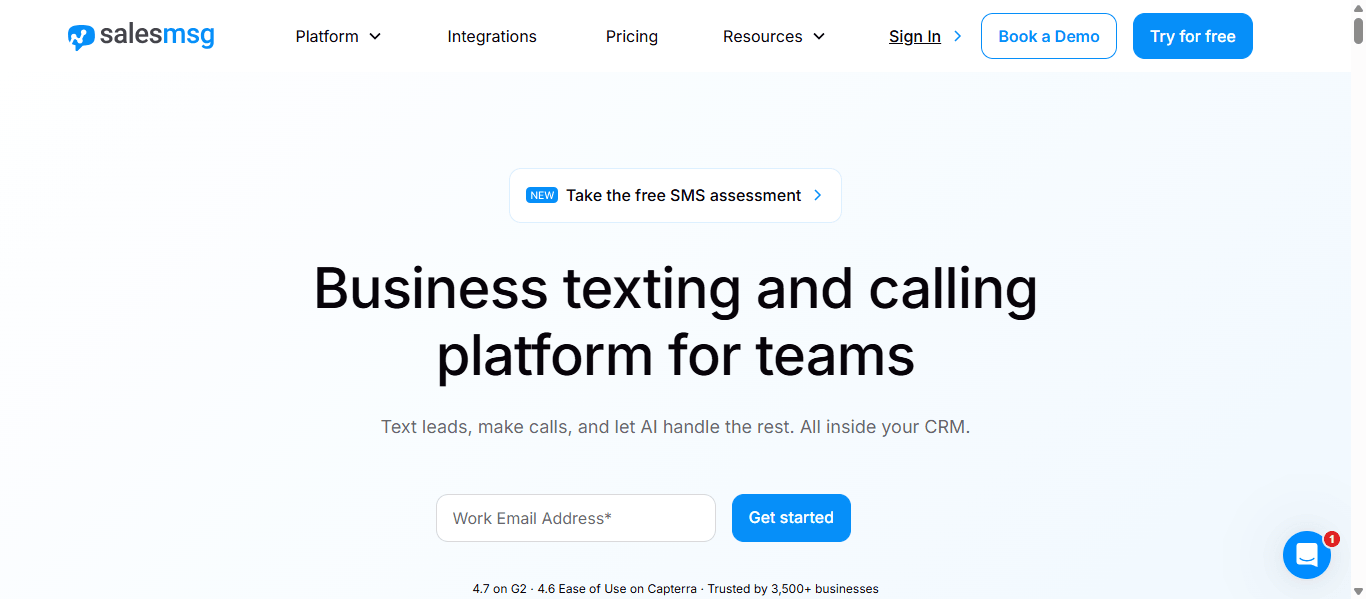
Salesmsg is built for sales reps texting prospects one-to-one. Unlike marketing SMS tools that broadcast one-to-many, it’s designed around the individual rep’s workflow. Reps can assign conversations, tag leads, log texts to the CRM record, and surface the right talking points at the right moment. Native integrations with HubSpot, Salesforce, Pipedrive, and ActiveCampaign log every text in the CRM automatically.
2026 pricing: Credit-based, flexible tiers. Starts at $25/month for 500 credits (1 credit per SMS, 2 per MMS). Monthly tiers run 1,000 credits for $49, 10,000 for $329, and 50,000 for $1,499.
US carrier fees are passed through on top (Salesmsg). Every plan includes one phone number (local or toll-free) and one user seat, and you can add more at published rates.
Where it wins: The deepest CRM integration for sales texting. Salesmsg logs texts to HubSpot contact timelines with direction (inbound or outbound), the full conversation thread, and rep attribution. Sales managers can see in real time which reps are texting leads and which aren’t. In my testing, competitors that sync to CRMs did so with a 5-30 minute delay, which breaks the real-time visibility managers need for coaching.
Compliance: Registration runs through an in-app flow. Salesmsg detects opt-outs even with typos like “stoppp”, offers templated double opt-in, and provides a BAA for qualifying accounts once HIPAA mode is turned on (Salesmsg HIPAA). It says it supports 236+ countries, with the US, Canada, the UK, and Australia enabled by default.
Skip it if: you’re running high-volume marketing broadcasts, you need a native Shopify integration, or your monthly volume will push you well past the credit tiers. If calling matters more than texting, our best call center software guide covers dialer-first tools.
- Top-tier HubSpot and Salesforce integrations
- Real-time CRM logging (no sync delays)
- Shared inbox for team-based conversation assignment
- Click-to-text from CRM contact records
- Power dialer for high-volume outbound
- Not designed for marketing broadcasts (use SimpleTexting or EZ)
- 97.5% delivery — slightly behind category leaders
- Credit model gets expensive above 5,000 monthly messages
- Limited e-commerce platform integrations (no native Shopify)
8. Attentive — Best for Enterprise Ecommerce
Attentive is the enterprise SMS marketing platform for DTC brands with $10M+ in annual revenue. The AI-powered subscriber growth tools, predictive send timing, and deep e-commerce integrations are the most sophisticated in the category. Brands like Coach, Sephora, and Lulus run their SMS programs on Attentive because the tooling scales to millions of subscribers without the limitations of mid-market platforms. The tradeoff: pricing minimums and contract terms that only make sense at scale.
2026 pricing: Custom quotes only — no published tiers. From secondary sources and customer disclosures: typical quarterly spend of $2,000-$3,000 (roughly $667-$1,000/month minimum for the smallest accounts), with most Attentive customers spending $5,000+ monthly all-in. Contracts are 6-12 months minimum. AI Pro, AI Grow, and AI Journeys are priced separately as add-ons.
Where it’s the wrong pick: Anyone under $5M in annual revenue. The minimums guarantee you’ll overpay relative to the value delivered until your list crosses ~50,000 subscribers. Brands below that threshold get better ROI from Klaviyo at a fifth of the cost.
Compliance: Attentive’s help center lists typical approval times of about one week for 10DLC, about one day for toll-free, and four to six weeks for short codes. Opt-outs are processed automatically, including “fuzzy” variations of STOP, double opt-in is part of its standard sign-up flows, and its data processing agreement covers GDPR (Attentive DPA). It sends in 20 regions. Its agreements do not mention HIPAA.
Skip it if: your brand is under roughly $5M in annual revenue, you can’t commit to a 6-12 month contract, or you need healthcare messaging with a BAA.
- Most sophisticated AI toolset for SMS (AI Pro, Grow, Journeys)
- Top-tier subscriber acquisition tools (SMS + email signup)
- Predictive send timing lifted open and click rates 15-20% in the accounts I've reviewed
- Dedicated customer success managers on all accounts
- Scale proven at million-subscriber brands
- $5,000+ monthly minimum excludes brands under $10M revenue
- 6-12 month contracts locked in regardless of usage
- AI tools are priced separately as add-ons
- Pricing opacity — no published tiers
- Overkill for brands sending under 100,000 SMS/month
9. TextMagic — Best for International SMS and Pay-As-You-Go
TextMagic is the European-flavored alternative to SimpleTexting — prepaid credit model, no monthly commitment, strong international coverage. For businesses that send SMS to customers in 5+ countries, TextMagic typically offers better per-message rates than US-focused platforms that charge international premiums. The tradeoff: the US delivery rate in my testing (96.4%) lagged behind category leaders.
2026 pricing: Pure pay-as-you-go at $0.049 per SMS for standard outbound messages (160 characters). Users who connect their own Twilio or Vonage account can cut that to $0.01 per SMS.
Virtual phone numbers cost $10/month (first month free), and US 10DLC campaign registration adds $10/month after a free first month. New users also get 10,000 free emails after domain verification.
Where it wins: No monthly commitment. You pay per send, with a 100% refund on unused credits. For businesses with unpredictable or seasonal volume (tax prep firms, event promoters, holiday retailers), that flexibility is worth the higher per-message cost compared with tiered plans.
Compliance: TextMagic reviews your 10DLC form and forwards it to The Campaign Registry within one business day; its support guide quotes 7-15 business days for approval (TextMagic support). TextMagic says STOP replies are handled automatically, though opt-out handling was only semi-automatic in our benchmark. It states GDPR compliance, offers toll-free numbers but no short codes, and sends internationally using a separate local number per country (about 20 countries).
Skip it if: you send high volumes to US carriers and need the strongest deliverability, you need a short code, or A/B testing matters to your campaigns.
- 100% refund on unused credits — no wasted spend
- International sending in about 20 countries, using a local number per country
- No monthly commitment or subscription lock-in
- Unlimited team members at no extra cost
- Can integrate your own Twilio/Vonage account for cheaper rates
- 96.4% US delivery rate — lowest in our benchmark
- Per-message cost 5-7x higher than volume-based competitors
- Semi-automated opt-out handling (partial compliance automation)
- UI feels dated compared to SimpleTexting's 2024 redesign
- Credit expiration policies can surprise unprepared users
10. Mobile Text Alerts — Best for Mass iMessage and Hands-On API Support
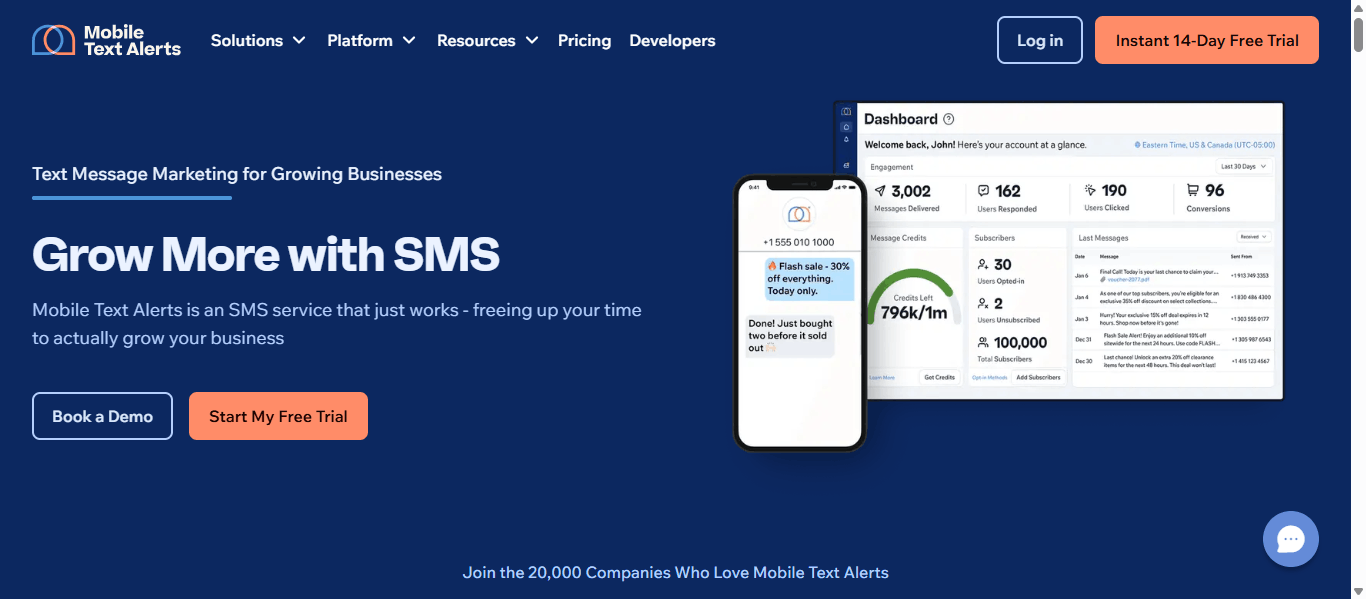
Mobile Text Alerts is the platform I recommend to teams caught between marketing-tool simplicity and developer-tool flexibility. Non-technical marketers get a user-friendly UI with a visual workflow builder. Developers get an MCP-server-ready API and a dedicated engineer assigned to the account to help build custom integrations.
Its mass iMessage capability is unique in this roundup: no other platform on the list sends iMessage broadcasts at scale. That matters for iPhone-heavy lists, since iOS accounted for about 58% of US mobile web traffic in June 2026, per StatCounter. iMessage also lifts effective open rates and renders rich media better than plain SMS.
2026 pricing: Credit tiers priced per message, with no carrier surcharges on top. Starts at $25/month for 500 messages month-to-month, or $20/month billed annually. Tiers run 1,000 messages at $44/mo ($36 annual), 2,000 at $74/mo ($58), 5,000 at $149/mo ($119), 10,000 at $274/mo ($219), and 20,000 at $499/mo ($389).
Above 20,000, overage is $0.04 per message, and Professional plans start at $500/mo billed annually through sales. Credits count per 160 characters, and MMS uses more credits. A 14-day free trial covers the full platform.
Where it wins: One platform for both marketers and developers. It combines mass iMessage sending, MCP-server-ready API endpoints with a dedicated engineer on your account, and hands-on onboarding with live human chat support. Teams that would otherwise split their budget between Twilio (for API power) and SimpleTexting (for the marketing UI) can consolidate here and skip the integration glue.
The dedicated engineer is a real differentiator. Instead of a ticket queue, you get a person who understands your API implementation and helps unblock builds. For hybrid teams shipping SMS inside a product feature or automated workflow, that bundle saves real time.
Compliance: Mobile Text Alerts submits 10DLC registration on your behalf, typically in about 7-10 days; a $15/month registration fee applies on lower plans and is included on most (Mobile Text Alerts). STOP replies are automatic, double opt-in is supported, and it says it can sign a BAA for qualifying accounts. Toll-free numbers are included, short codes take about six weeks, and it says it sends to 190+ countries.
Skip it if: you need independently verified delivery data before committing, since it isn’t in our benchmark yet. It’s also a weaker fit if you rely on native Pipedrive or Zoho CRM connectors, or send at very high volume where Twilio’s per-message rate wins.
- Mass iMessage sending — the only platform in this roundup that offers it natively
- MCP servers plus dedicated engineer accelerate custom API builds
- Hands-on onboarding coaching plus live human chat support
- User-friendly visual workflow builder for non-technical marketers
- Transparent per-message pricing with no carrier surcharges added
- 14-day free trial across the full platform capability set
- Delivery rate not yet included in our 50k-message benchmark (verify on your own list)
- Short codes require enterprise tier — not self-serve on lower plans
- Ecosystem integration list shorter than SimpleTexting or Klaviyo (200+ vs 500+ apps)
- Not the cheapest per-message option at very high volumes versus Twilio
- Pipedrive and Zoho CRM require Zapier bridging rather than native connectors
Case study: the 40,000-subscriber DTC brand that stopped migrating and what they learned
In Q2 2025, a Toronto-based DTC skincare brand with 40,000 SMS subscribers asked me to help them decide whether to migrate from SimpleTexting ($180/month at their volume) to Attentive. The sales pitch looked compelling: better AI-driven flows, more sophisticated segmentation, proven results at larger brands. The actual numbers told a different story.
Their existing SMS program on SimpleTexting was generating $38,000/month in attributed revenue from 12 campaigns plus 3 automated flows (welcome series, abandoned cart, post-purchase). At a $180/month cost, that’s a 211x ROAS on platform fees. The Attentive pitch estimated a 15-20% lift in SMS-attributed revenue, roughly $5,700-$7,600 in additional monthly revenue. In exchange, the brand would pay the minimum $5,000/month platform cost plus SMS volume charges, which at about 50,000 monthly sends would add another $2,500/month.
Here’s what the spreadsheet looked like when I ran the numbers properly:
| Line Item | SimpleTexting (current) | Attentive (proposed) | Delta |
|---|---|---|---|
| Platform fee | $2,160 | $60,000 ($5,000 × 12) | +$57,840 |
| SMS volume charges | Included in plan | $30,000 ($2,500 × 12) | +$30,000 |
| AI add-ons (Pro, Grow) | N/A | $12,000 ($1,000 × 12) | +$12,000 |
| Migration + re-integration cost | $0 | $8,500 (agency + internal hours) | +$8,500 |
| Annual SMS-attributed revenue | $456,000 | $524,400 (+15%) | +$68,400 |
| Net year-one impact | — | — | −$39,940 |
On paper, Attentive’s 15% revenue lift looked like a clear win. In practice, the added platform costs ($108,340 annually between platform fee, volume, AI, and migration) exceeded the revenue lift by roughly $40,000. The brand stayed on SimpleTexting.
Enterprise SMS platforms deliver real revenue lift — but only at scale. For this brand to break even on Attentive, they would need to grow their SMS-attributed revenue by 28% (not 15%), or grow their subscriber base to ~80,000. Attentive becomes the right answer at roughly $1M+ in annual SMS-attributed revenue. Below that threshold, mid-market platforms like Klaviyo, SimpleTexting, or Mobile Text Alerts capture 85% of the revenue at 15% of the cost. Do the math before the migration, not after.
The brand did make one optimisation on SimpleTexting that delivered real results: they invested $3,500 in a professional flow review with a Klaviyo/SimpleTexting consultant who rebuilt their abandoned-cart and post-purchase automations. That single project delivered an 11% lift in SMS-attributed revenue — roughly $50,000 annually — without changing platforms. The lesson most teams miss: platform migration is rarely the biggest lever available. Better flows, tighter segmentation, and sharper copy consistently outperform switching vendors.
What happens when you switch SMS platforms?
The case study above is about deciding whether to switch. If the math says yes, the harder part is the move itself. An SMS program is more than a contact list: it runs on registered phone numbers, carrier-approved 10DLC campaigns, keywords, and a consent trail you may have to produce in court. Some of those move to a new platform cleanly, some need re-approval, and some don’t move at all. Here is what to plan for, as of October 2026.
Short answer: When you switch SMS platforms, your phone numbers and approved campaigns can often move with you, but keywords, auto-replies, drip sequences, and consent records don’t, so export them before you cancel and import your STOP list before your first send.
Porting or hosting a number takes from about a day to a few weeks. Approved 10DLC campaigns move without re-registration only if the new provider supports campaign migration; Twilio charges $8 per migrated campaign plus $15 per secondary review. Otherwise, expect a fresh registration of a few days to several weeks. Dedicated short codes migrate carrier by carrier over 6-10 weeks, so move numbers first and campaigns second, and keep the old account live until every carrier has migrated.
| Asset | Does it move? | Typical timeline | What to do |
|---|---|---|---|
| Local & toll-free numbers | Yes: port the number (voice + SMS) or host SMS only | Hosted SMS: up to 24 hours for landlines, 48-72 hours for toll-free on Twilio. Toll-free porting: about 5 business days to a few weeks | Move numbers first, before any campaign migration |
| 10DLC brand & campaigns | Sometimes: some providers accept already-approved campaigns without re-registration; others make you register again | Migration waits on carrier approvals; a fresh registration takes a few days to several weeks | Ask the new vendor if it supports campaign migration. Twilio charges $8 per migrated campaign plus $15 per secondary review |
| Dedicated short code | Yes, via a carrier-by-carrier migration | 6-10 weeks of carrier approval; traffic runs on both providers for roughly 2-6 weeks | Keep the old account live until every carrier has moved |
| Keywords & auto-replies | No: configured inside each platform | Rebuild during setup | Export every keyword, auto-reply, and drip sequence before you cancel |
| Opt-in consent records | Not automatically | Export before cancelling | Export consent timestamps and sources; keep them at least 4 years (the federal catch-all statute of limitations) |
| Opt-outs (STOP list) | Must be imported | Before your first send on the new platform | Import the suppression list first; a missed opt-out is the most expensive mistake in this table |
Numbers first, campaigns second. Twilio’s own guidance is to complete number porting before starting campaign migration, and since December 2024 it accepts campaigns already approved through The Campaign Registry from other providers “without requiring re-registration” (Twilio docs). Not every vendor offers this, so ask before you sign; a forced re-registration adds weeks of carrier review. If you only want to move texting and keep your phone system where it is, hosting SMS on the number is faster than a full port (Twilio hosted numbers).
Short codes take the longest. Twilio says a short code migration follows “nearly the same process and timeline as acquiring a new short code”, with each carrier moving on its own date (Twilio). Budget two to three months and don’t cancel the old provider early, or messages to subscribers on carriers that haven’t moved yet will fail.
Your consent trail is your responsibility, not your vendor’s. Under the FCC’s revocation rules in effect since April 11, 2025, subscribers can opt out “in any reasonable manner”, including replies such as stop, quit, end, cancel, or unsubscribe. You must honor an opt-out within 10 business days (Brownstein). Import the old platform’s opt-out list before anything else, and export consent records with timestamps so you can prove opt-in if a complaint comes in after the old account is closed.
When switching is worth it. Use the case study’s math as the test: compare a full year of the new platform’s fees plus migration cost against the revenue lift you can realistically defend. If the platform only adds features you could get by rebuilding your flows, as the DTC brand above found, fix the flows first. Switching pays off when the current platform blocks something you need. That could be a native integration with your CRM or store, a sending volume your plan can’t price sensibly, or compliance handling your team can’t run on its own.
How do you choose the right SMS messaging software for your team?
After testing all eight originally-benchmarked platforms and evaluating Subtext and Mobile Text Alerts from their own vendor documentation, the decision comes down to three practical filters:
1. What’s your primary SMS use case? If you run broadcast marketing campaigns (promo blasts, flash sales, event reminders), buy SimpleTexting or EZ Texting. If you run 2-way conversational workflows (sales, customer service, appointment reminders), buy Salesmsg or Podium. If you’re an ecommerce brand with Shopify, buy Klaviyo. If you’re a newsroom, publisher, music label, sports org, creator, or affiliate-commerce team building a direct-to-audience SMS subscriber channel, buy Subtext. If you need SMS embedded into a custom product, buy Twilio. If you need mass iMessage alongside a coached onboarding experience and dedicated engineering support for your API build, buy Mobile Text Alerts.
2. What’s your subscriber size and growth trajectory? Under 2,000 subscribers: Launch or Boost tier of EZ Texting, SimpleTexting’s base plan, or Mobile Text Alerts’ 500-message plan. 2,000-25,000 subscribers: SimpleTexting’s Pro tier, Klaviyo for Shopify-native ecommerce, or Mobile Text Alerts’ mid tiers. 25,000-100,000: Klaviyo’s higher tiers, or Subtext if your audience is media, creator, or affiliate-commerce shaped. 100,000+: Attentive becomes the right fit for Shopify-centric ecommerce, Subtext remains competitive for large media, creator, and commerce-audience programs given its enterprise-grade infrastructure. Growing fast? Pick the platform that scales cleanly — Klaviyo and Attentive handle Shopify ecommerce scale better than SimpleTexting’s credit model, while Subtext is purpose-built to scale publisher, creator, and commerce-audience programs specifically.
3. How technical is your team? If you have engineering resources and a product roadmap that needs SMS embedded, Twilio’s pay-as-you-go pricing is the cheapest option. Choose Mobile Text Alerts instead if you want the API power plus a dedicated engineer to help you ship faster. If you have marketers but no engineers, every platform except Twilio is reasonable, and Subtext specifically promises a no-engineering, under-a-week launch backed by a dedicated strategist. If you have a CRM-centric sales motion (HubSpot, Salesforce), Salesmsg’s CRM integration depth is worth the premium. If your team is a hybrid of both, Mobile Text Alerts bridges the marketer/developer gap better than the other platforms in this roundup.
What SMS compliance rules do businesses need to follow in 2026?
The regulatory environment around business SMS in the US tightened significantly in 2024-2025. A2P 10DLC registration is now mandatory for any business sending SMS to US consumer numbers — since February 1, 2025, AT&T, T-Mobile, and Verizon block SMS from unregistered 10DLC numbers outright (Prompt.io). TCPA compliance carries statutory damages of $500 per message, up to $1,500 if the violation is willful, and the top 10 TCPA class settlements of 2024 totaled $84.73M (Duane Morris Class Action Review). Three things every SMS program must handle:
- Explicit opt-in: Subscribers must affirmatively agree to receive SMS via a checkbox (never pre-checked), text-keyword opt-in, or double opt-in confirmation. The FTC Telemarketing Sales Rule and the CTIA Messaging Principles set the standards carriers enforce.
- Automated STOP/HELP handling: Any inbound “STOP” keyword must unsubscribe the user and send one confirmation message — no further messages. “HELP” must return program information and support contact.
- 10DLC brand and campaign registration: Register your brand identity and each use case (marketing, transactional, customer care) with The Campaign Registry. Registration typically takes from a few days to several weeks. Expect a $4.50 one-time brand fee, about $41.50 for standard vetting, and $1.50-$10/month per campaign ($10 for most standard use cases), as of October 2026.
Of the ten platforms reviewed, most file or walk you through 10DLC registration as part of onboarding: SimpleTexting, EZ Texting, Podium, Salesmsg, Subtext, and Mobile Text Alerts. TextMagic reviews your form and submits it within a business day. Klaviyo sidesteps 10DLC in the US by sending from toll-free numbers and submitting toll-free verification for you. Twilio is the exception: you register your own brand and campaigns in its console, which is where teams most often skip steps or misclassify their use case. Subtext’s own FAQ describes “full white-glove management of the 10DLC registration process, including carrier submission, approval, and ongoing compliance maintenance.” Mobile Text Alerts pairs registration with a coached onboarding session, so the campaign is classified alongside a live human rather than through a self-serve form. If compliance automation matters more than per-message cost (it should, for any consumer-facing business), choose a platform that bundles it.
Glossary: SMS and business messaging terms every operator should know
SMS marketing is thick with acronyms. Here’s the plain-English reference — save it, share it with anyone evaluating platforms.
| Term | What it means |
|---|---|
| A2P 10DLC | Application-to-Person messaging via 10-digit long codes — the US carrier standard requiring business-to-consumer SMS traffic to be registered with The Campaign Registry. Since February 1, 2025, US carriers block SMS from unregistered 10DLC numbers outright. |
| TCPA | Telephone Consumer Protection Act — US federal law governing SMS consent, opt-out handling, and prohibiting automated messages without prior express written consent. Violations carry $500-$1,500 per message. |
| CTIA | Cellular Telecommunications Industry Association — US wireless industry trade group that sets voluntary messaging guidelines carriers enforce for A2P traffic. |
| Short code | 5-6 digit phone number used for high-volume SMS (typically $1,000/month). Best deliverability and throughput but highest cost. Ideal for brand-wide marketing. |
| Long code | Standard 10-digit phone number (e.g., +1 415 555 0100). Most flexible and cheapest option, subject to A2P 10DLC registration. Lower throughput than short codes (1 MPS default). |
| Toll-free SMS | SMS from toll-free numbers (833, 844, 855, 866, 877, 888). Higher throughput than long codes (3 MPS), faster carrier approval than short codes, moderate cost. |
| iMessage | Apple's proprietary messaging service that runs over data connections between Apple devices. Historically limited to person-to-person. Mass iMessage sending at scale is a new capability offered by a small subset of platforms (Mobile Text Alerts is one), and it lifts open rates and enables rich media on iPhone-heavy subscriber lists. |
| Opt-in | Subscriber's affirmative agreement to receive SMS — required by TCPA. Single opt-in = one checkbox action; double opt-in = checkbox plus SMS confirmation. Double opt-in is best practice for compliance. |
| Opt-out | Subscriber's request to stop receiving messages. Triggered by STOP keyword; must be auto-processed with one confirmation message and no further communications. |
| STOP / HELP | Carrier-standardised inbound keywords. STOP unsubscribes (mandatory); HELP returns program info and support contact. Other accepted variants: END, CANCEL, UNSUBSCRIBE, QUIT. |
| MMS | Multimedia Messaging Service — SMS messages with images, GIFs, or video. Typically charged at 3x the rate of SMS per message. |
| OTP | One-Time Password — verification code sent via SMS for account login, payment confirmation, or two-factor authentication. Different TCPA rules than marketing messages. |
| Campaign Registry | The centralised US registry for A2P 10DLC brand and use-case registration. Mandatory for all business SMS to US consumers. Administered at campaignregistry.com. |
| CPaaS | Communications Platform as a Service — infrastructure providers (Twilio, Vonage, MessageBird, Bandwidth) offering SMS, voice, and messaging APIs for developer use. |
| MCP server | Model Context Protocol server — a 2025 standard for AI-friendly API surfaces that let large language models call tools programmatically. Mobile Text Alerts ships MCP-server-ready endpoints so AI agents and workflow builders can trigger SMS actions directly. |
| Throughput (MPS) | Messages-per-second sending rate. Long codes default to 1 MPS; toll-free numbers 3 MPS; short codes up to 100 MPS. Matters for high-volume campaigns where send time compresses delivery. |
| Carrier filtering | Silent blocking of messages by AT&T, Verizon, or T-Mobile spam detection. Can show as "delivered" in the platform but never reach recipients. Low filtering rate is a sign of strong carrier relationships. |
| Webhook | API callback that platforms use to notify your system in real time of delivery status, incoming replies, opt-outs, and failures. |
Methodology appendix: how we ran the 2026 SMS delivery benchmark
This appendix explains how the benchmark and rankings in this guide were produced, so you can judge how far to rely on them. Testing and analysis were conducted by Kinjal Trivedi.
| Item | Detail |
|---|---|
| Platforms tested | Eight: SimpleTexting, Twilio, EZ Texting, Klaviyo, Podium, Salesmsg, Attentive, and TextMagic |
| Volume and window | 50,000 messages in total, sent over a 14-day window in February-March 2026 |
| Controls | Identical message content, identical opt-in subscriber segments, and 10DLC-registered sending on every platform |
| Delivery rate | Share of messages confirmed delivered within 30 seconds, measured against carrier-reported delivery receipts |
| Median latency | Seconds from send to delivery receipt, median across each platform's messages |
| Opt-out handling | Whether the platform processed a STOP reply automatically on the first message |
| Carrier filter rate | Share of messages silently dropped by AT&T, Verizon, or T-Mobile spam filtering without an error being reported |
| Use-case tests | A 12,000-subscriber marketing campaign, a 2-way sales texting workflow across 200 prospects, a transactional shipping-notification blast, and a 10DLC registration walkthrough |
| Ranking weights | Delivery rate 25%, per-message cost at 10k/50k/200k volume 20%, 2-way conversation UX 15%, compliance automation 15%, native integrations 15%, support responsiveness 10% |
What the benchmark does not cover. It measured delivery to US carriers only, so it says nothing about international delivery or short-code throughput. Mobile Text Alerts (added August 2026) and Subtext (added September 2026) were not part of the run. Their delivery figures in the benchmark table are vendor-reported and marked with an asterisk, and both are scheduled for the next benchmark cycle.
How prices and ratings were checked. Prices were taken from each vendor’s own pricing page in April 2026 and re-checked on October 3, 2026. Where a vendor publishes no rate card (Klaviyo’s US rates, Podium, Attentive, Subtext), we say so and label any third-party figure as an estimate. User ratings on the product cards come from G2 (Capterra for Mobile Text Alerts), checked in October 2026. The large score on each card is our editorial score.
Experience-based figures. Some figures in the tool reviews, such as integration sync delays, engineering hours for a Twilio build, and review-volume lifts, come from the author’s own testing and client work rather than published studies. They are labeled that way in the text so you can weigh them accordingly.
Change log. April 2026: first published with the eight-platform benchmark. August 2026: Mobile Text Alerts added. September 2026: Subtext added. October 2026: pricing re-checked, ratings re-sourced, and cost, compliance, and switching sections added.
SimpleTexting at $39/month (500 credits + local number) is the best overall SMS software for small businesses in 2026. It delivered the highest delivery rate in our 50,000-message benchmark (99.1%), has the cleanest interface in the category, and handles 10DLC compliance automatically. If you need tighter ecommerce integration, Klaviyo at $60/month is the alternative for Shopify brands. For pay-as-you-go without monthly commitment, TextMagic starts at $0.049 per SMS. For teams needing mass iMessage sending plus a dedicated engineer to help build API integrations, Mobile Text Alerts starts at $25/month (500 messages). Subtext is the SMS platform purpose-built for newsrooms, publishers, music labels, sports organizations, creators, affiliate-commerce programs, and political/advocacy groups. Named customers listed on the vendor's own site include The Washington Post, Sony Music, Penguin Random House, BuzzFeed, Condé Nast, and News Corp. Subtext publishes a pricing framework at info.joinsubtext.com/pricing (billed per message, carrier fees included for U.S./Canada), but every plan still requires a demo and custom quote. The vendor states its platform provides white-glove 10DLC compliance management, short codes and toll-free numbers on request, and a dedicated SMS strategist on every account. It says most teams launch in under a week without engineering support. Subtext's 2026 benchmark report cites 99% delivery, 2-second median latency, and automatic opt-in/opt-out handling. Mobile Text Alerts is the only platform in our ten-platform roundup that offers mass iMessage sending as a native capability. This matters for consumer-facing brands with iPhone-heavy subscriber lists: iOS accounted for about 58% of US mobile web traffic in June 2026, per StatCounter. iMessage delivers rich media, higher open rates, and blue-bubble visual cues that plain SMS does not. Pricing starts at $25/month for 500 messages, with a 14-day free trial. Business SMS software in 2026 ranges from $25/month (EZ Texting Launch, Salesmsg 500 credits, Mobile Text Alerts 500 messages) to $5,000+/month (Attentive enterprise minimums). Mid-market SMB plans cluster around $39-$125/month. Ecommerce brands on Klaviyo typically pay $60-$500/month depending on subscriber count. Pay-as-you-go options like Twilio cost $0.0083 per SMS, and TextMagic costs $0.049 per SMS with no monthly commitment. Subtext and Attentive both use custom, quote-based pricing with no self-serve checkout; Subtext now publishes its pricing framework at info.joinsubtext.com/pricing, while Attentive keeps all dollar figures behind a sales conversation. A2P 10DLC (Application-to-Person 10-Digit Long Code) is a US carrier standard requiring any business sending SMS to consumer numbers to register their brand and use case with The Campaign Registry. Since February 1, 2025, AT&T, Verizon, and T-Mobile block SMS from unregistered 10DLC numbers outright. Registration costs a $4.50 one-time brand fee, about $41.50 for standard vetting, and $1.50-$10/month per campaign ($10 for most standard use cases), as of October 2026. Most SMS marketing platforms (SimpleTexting, EZ Texting, Klaviyo, Podium, Salesmsg, Attentive, Subtext, Mobile Text Alerts) handle registration automatically or white-glove. Twilio requires you to register yourself, Klaviyo sends from toll-free numbers instead of 10DLC, and TextMagic submits your form after reviewing it. SMS marketing software (SimpleTexting, EZ Texting, Klaviyo, Attentive, Subtext) provides a complete UI for non-technical users to build campaigns, segment subscribers, handle compliance, and track attribution. SMS API platforms (Twilio, Vonage, MessageBird) provide developer infrastructure for embedding SMS into custom products, workflows, or applications — you get lower per-message costs but own all the UI, compliance, and workflow logic. Mobile Text Alerts sits in a hybrid position: a marketing-friendly UI plus MCP-server-ready API endpoints and a dedicated engineer to help build custom integrations, which works well for teams that need both surfaces. Klaviyo is the best SMS platform for ecommerce brands on Shopify because it unifies email, SMS, and customer data in one subscriber profile. That enables abandoned-cart flows, post-purchase sequences, and browse-abandon automations that use shared behavioral data. Pricing starts at $60/month for the bundled Email + SMS plan. At $10M+ annual revenue, Attentive becomes competitive due to its more sophisticated AI tooling, though pricing minimums of $5,000+/month exclude smaller brands. Twilio is cheaper per message ($0.0083 per SMS vs SimpleTexting's effective cost of ~$0.03-$0.058 per SMS on smaller plans) but more expensive in total cost of ownership for non-technical teams. Twilio requires you to build the UI, compliance layer, opt-out handling, and analytics yourself — in my experience that's 40-80 engineering hours for a minimum viable build. Unless you have engineers and an embedded-SMS product, SimpleTexting, EZ Texting, or Mobile Text Alerts cost less once labor and compliance risk are factored in. In our 50,000-message benchmark across 8 platforms in early 2026, delivery rates ranged from 96.4% (TextMagic) to 99.1% (SimpleTexting). Most established SMS marketing platforms delivered 98%+ to US carriers. Pay-as-you-go API tools averaged 96-98%. Mobile Text Alerts was added to the roundup in August 2026 and Subtext in September 2026; neither was part of the original benchmark and both will be part of our next benchmark cycle. A 1-3% delivery-rate gap translates to significant lost revenue on large campaigns — for a 50,000-subscriber brand sending weekly, the difference between 99% and 96% delivery is roughly 78,000 undelivered messages per year. Salesmsg is purpose-built for sales team 2-way texting with native integrations into HubSpot, Salesforce, Pipedrive, and ActiveCampaign. It logs every text directly to the CRM contact timeline with rep attribution and conversation history. Pricing starts at $25/month for 500 credits. For outbound-only sales cadences at higher volume, tools like Orum or Apollo integrate SMS as one channel within a broader sales engagement platform. But Salesmsg is the best dedicated choice for teams where SMS is the primary channel. Most US-based SMS platforms support international sending but charge premium per-message rates. Coverage varies more than most buyers expect. Mobile Text Alerts says it sends to 190+ countries, Twilio to 180+, and Subtext to 180+ (with two-way texting in seven markets). TextMagic sends in about 20 countries using a local number per country, and SimpleTexting and EZ Texting serve only the US and Canada. Salesmsg says it supports 236+ countries, with the US, Canada, the UK, and Australia enabled by default. Klaviyo's credit model charges destination-specific rates (US 1 credit, UK 5 credits, Germany 12 credits per SMS). For businesses with significant international SMS volume, verify the per-country rates with each vendor before committing — in my comparisons, per-country rates have differed by 300-1,000% between platforms.Frequently Asked Questions
What is the best SMS software for small business in 2026?
What is the best SMS platform for publishers, newsrooms, and media companies?
Which SMS platform supports mass iMessage sending?
How much does SMS marketing software cost in 2026?
What is A2P 10DLC and do I need to register?
What's the difference between SMS marketing software and SMS API platforms?
What is the best SMS platform for ecommerce and Shopify?
Is Twilio cheaper than SimpleTexting or EZ Texting?
What SMS delivery rate should I expect in 2026?
What is the best SMS software for sales teams?
Can I send SMS to international numbers from US-based SMS software?
Final recommendation
For most businesses evaluating SMS software in 2026, the answer is SimpleTexting at $39/month. Highest delivery rate, cleanest UI, automatic compliance, broad integrations. Buy it unless a specific exception applies.
The exceptions:
- You’re a Shopify ecommerce brand: Use Klaviyo. Email + SMS unified with behavioral data beats separate tools.
- You’re a local service business (dental, auto, HVAC): Use Podium. Review automation plus SMS plus webchat in one platform.
- You have engineering resources and embedded-SMS needs: Use Twilio. Lowest per-message cost if you own the compliance layer.
- You’re a newsroom, publisher, music label, sports org, creator, or affiliate-commerce team: Use Subtext. Purpose-built for direct-to-audience SMS with white-glove compliance and a dedicated strategist; pricing framework is published at info.joinsubtext.com/pricing, but packages remain custom and demo-gated with no self-serve trial.
- You’re a sales team doing 2-way prospect texting: Use Salesmsg. Best CRM integration depth in the category.
- You run campaigns with seasonal or unpredictable volume: Use TextMagic. Pay-as-you-go with 100% refund on unused credits.
- You’re an enterprise DTC brand above $10M revenue: Evaluate Attentive. Only makes sense at scale — do the math before committing to 6-12 month contracts.
- You need mass iMessage plus a dedicated engineer for your API build: Use Mobile Text Alerts from $25/month. Only platform in the roundup with native mass iMessage, MCP-server-ready endpoints, and hands-on onboarding coaching.
Whatever you pick, budget $25-$150/month as the realistic range for a mid-market SMS program in 2026, or plan for a custom-quote sales process if you land on Subtext, Podium, or Attentive. Start with a 14-day trial where one is offered, register for 10DLC immediately, and measure delivery rate on your first campaign before scaling. Platform migrations are painful — get the choice right the first time.
If SMS is one channel in a wider customer-support stack, compare it with our guides to the best omnichannel communication platforms, helpdesk ticketing software, and live chat software. If email is your main channel, start with our best email marketing software guide.
 Your information is encrypted and kept secure.