

A missed call at a clinic is not a lost lead. It is a patient who needed an appointment, a refill, or a referral and got a busy signal, a hold queue, or voicemail instead. There is no single peer-reviewed benchmark for how often this happens, but the available field data points in the same direction: a reported analysis of Miami physician offices found an average 25 percent of patient calls went unanswered, and a tracked 26-location dental group left 38 percent of inbound calls unanswered, with new-patient calls converting at less than half the rate of existing-patient calls. Every one of those calls is a patient who may book with the practice down the street instead.
We evaluated 9 AI medical receptionist platforms built specifically for clinics and hospitals, not general small-business answering services with a healthcare landing page bolted on. Several names that keep showing up in broader “best AI medical receptionist” roundups were excluded here for that reason. Dialzara and Allo are general-purpose business phone tools sold across industries, not medical-specific ones: Dialzara asks healthcare practices to contact sales for a separate regulated-use setup before going live, and Allo offers a HIPAA BAA as a $50-a-month add-on but connects to EHRs through calendars, Zapier, webhooks, or its API rather than a native EHR integration. Carly, despite appearing in multiple healthcare listicles, has no medical content, pricing, or compliance language on its own site at all. Developer voice-AI platforms like Retell AI and Vapi AI require an engineering team to build an agent from scratch; they are infrastructure, not an out-of-box receptionist a clinic can turn on. We left all of them out rather than pad the count.
The platforms that remain span a real range: from a $129-a-month solo-practice tool to enterprise platforms built for 1,000+ location health systems that only quote custom pricing after a demo. The gap between those two tiers is the first thing to understand before evaluating any single vendor.
What we checked
Author Kinjal Trivedi based this comparison on vendor-published product information, pricing where available, and statements about HIPAA and Business Associate Agreements (BAAs). Prices, plan details and BAA statements were checked on each vendor’s own pages on November 9, 2026. It is not a clinical performance test or an independent compliance audit. “BAA confirmed” means the vendor publicly states that it offers or signs a BAA; it does not mean we obtained or reviewed a signed agreement. A badge alone is not confirmation. Ask the vendor for a BAA and confirm the EHR connection and pricing for your practice before sharing patient information.
| # | Platform | Starting Price | BAA Confirmed? | Best For | |
|---|---|---|---|---|---|
| 1 |  |
$129/provider/mo | Yes | Solo and small practices wanting one AI workforce | |
| 2 |  |
Custom quote | Yes | Practices replacing a paid answering service | |
| 3 |  |
From $999–$2,500/mo (quote) | Yes | Multi-specialty clinics wanting broad EHR choice | |
| 4 |  |
Custom quote | Yes | FQHCs and groups wanting a full AI workforce | |
| 5 |  |
Custom quote | Yes | Multi-specialty groups needing deep triage logic | |
| 6 |  |
Custom quote | Yes (company-wide policy) | Hospitals needing after-hours urgent-call escalation | |
| 7 |  |
Custom quote | Yes | Large ambulatory networks, 20+ locations | |
| 8 |  |
Custom quote | Yes (policy site) | Large health systems already on Epic | |
| 9 |  |
From $100,000/yr (AppExchange listing) | Yes | Enterprise health systems wanting voice + chat + SMS in one |
What Is AI Medical Receptionist Software?
AI medical receptionist software answers and routes a practice’s inbound phone calls using a voice AI agent instead of (or alongside) a human front-desk staffer. At a minimum, it handles routine call volume: appointment scheduling, rescheduling, prescription refill requests, and common questions drawn from a knowledge base the practice provides. The more capable platforms in this category go further, verifying patient identity against existing records, checking insurance eligibility, triaging by urgency, and writing scheduling and intake data directly back to the practice’s EHR.
What separates this category from a general-purpose AI receptionist is two things: a signed Business Associate Agreement covering PHI handling under HIPAA, and native integration with the specific practice-management or EHR system a clinic already runs on. A tool that answers calls well but can’t sign a BAA or write back to Epic, athenahealth, or whatever system a practice uses isn’t a medical receptionist, it’s a general answering service with a healthcare landing page.
Solo Clinic or Health System: The Decision That Determines Which Half of This List You Should Even Look At
These 9 platforms split cleanly into two tiers, and the split matters more than any single feature comparison. One tier publishes a real price and can onboard a single-location practice in days. The other tier requires a sales call, a security review, and an implementation timeline measured in weeks, because it is built for organizations running dozens of locations or a hospital system’s call volume.
DeepCura is the only platform here with a transparent, public per-seat price: $129 per provider per month for the first two seats on the monthly plan, with lower rates for added seats (seats 11 and up are $101 each), so a 10-provider team pays $1,156 a month. Two others publish starting points without plan prices: Greetmate.ai says managed deployments start at $999 to $2,500 a month, and Hyro’s Salesforce AppExchange listing says pricing starts at $100,000 per company per year. Everything else, DoctorConnect, Sully.ai, Assort Health, Phreesia VoiceAI, Qure4u, and Luma Health, requires a demo call to get a quote. That is not a red flag by itself; enterprise healthcare software is routinely sold this way. But it does mean a solo practitioner evaluating this category should expect a materially different sales process than a 40-location ambulatory group.
If your practice has fewer than 10 providers, start with DeepCura or DoctorConnect, both of which are explicit about serving smaller practices and both of which confirm a signed BAA on their own sites. If you are evaluating this for a health system or a network of 20-plus locations, Qure4u, Luma Health, and Hyro are built for that scale specifically, and their vendor pages say so directly.
Keep in mind that an AI medical receptionist answers and routes calls; it does not replace the underlying phone line it runs on. If your practice also needs to rebuild its core business phone system, that is a separate decision from the one covered here.
The Compliance Question Every Vendor Answers Differently
HIPAA compliance and a signed Business Associate Agreement are not the same thing, and the vendor pages in this category make that distinction clear once you read past the marketing badges. A “HIPAA-compliant” or “HIPAA-ready” badge on a homepage is a claim. A BAA is a signed legal document that makes the vendor contractually liable for protecting patient data, and it is the thing your compliance officer will actually ask for.
As of November 9, 2026, all nine vendors publicly say they offer or sign a BAA, but where they say it varies. DeepCura states it signs a BAA with every customer and encrypts PHI in transit and at rest. DoctorConnect’s HIPAA page says it signs a BAA with every HIPAA covered entity before any patient information is exchanged. Qure4u states a signed BAA is available before a pilot begins. Greetmate.ai’s plans page lists a BAA signed with your practice on every medical plan. Sully.ai’s trust page says it executes BAAs with every covered entity. Assort Health says a BAA comes with every engagement. Hyro says BAAs are executed for every customer.
Two are less direct. Phreesia’s company privacy policy says it acts as a business associate and signs BAAs whenever it handles patient information for the healthcare providers it works with, while the VoiceAI page itself only cites “HIPAA-compliant two-way texting.” Luma Health’s BAA statement sits on its separate HIPAA policy site, which says its HIPAA program covers its AI-enabled services; the BAA template published there is written for hosting services and doesn’t name individual products such as Navigator. Luma’s product pages cite HIPAA compliance alongside HITRUST, SOC 2 Type II, ISO 27001, GDPR, and TX-RAMP. None of this replaces your own review: ask each vendor for the BAA in writing during your first sales call, confirm it covers the AI phone product you are buying, and check it before any patient information is shared.
What We Found When We Evaluated Each Platform
DeepCura
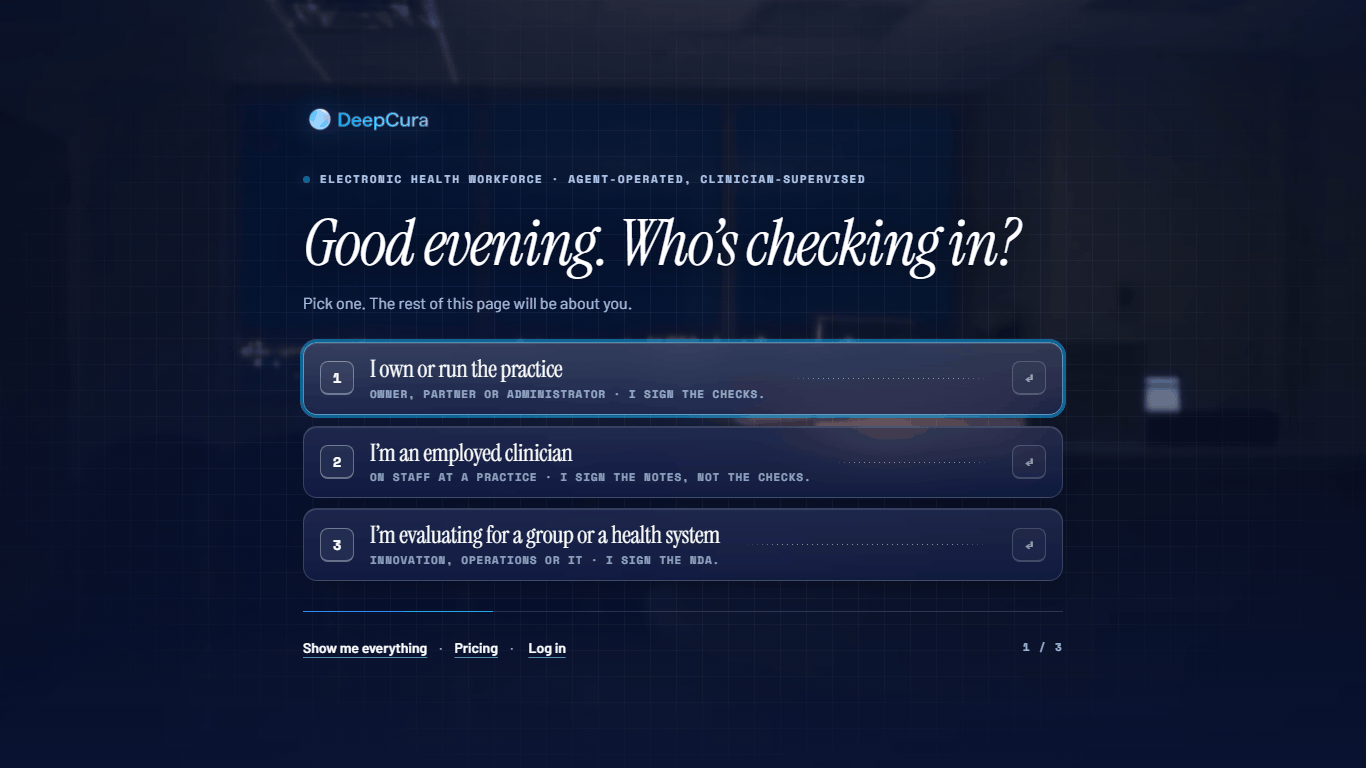
DeepCura is not a pure-play receptionist tool. It is a broader “Electronic Health Workforce” that bundles an AI scribe, an AI receptionist, a unified inbox for fax/email/SMS/phone, intake forms, chart review, and AI billing with E&M and ICD-10 coding under one subscription. The receptionist gets a full dedicated section on the product page, not an afterthought bolted onto the scribe.
At $129 per provider per month, it is the only platform in this roundup with public, per-seat pricing you can see before a sales call. Monthly seats are priced in tiers: seats 1–2 at $129, seats 3–5 at $116, seats 6–10 at $110, and seats 11 and up at $101, so a 10-provider team pays $1,156 a month. The annual plan is a flat $999 per seat per year, and volume discounts apply to monthly plans only. Each seat includes 1,000 monthly AI credits, with an extra 1,000 available for $59 a month. A 10-seat, 90-day prepaid pilot is listed at $3,468, which gives smaller practices a real number to budget against instead of a “contact sales” wall.
Deal-breaker: Because the receptionist ships inside a much larger suite, a practice that only wants call answering and scheduling, without scribing or billing, is paying for capability it may not use. DeepCura is explicit that it is not SOC 2 certified and is not the system of record, the EHR still holds that role.
DoctorConnect (ARIA)
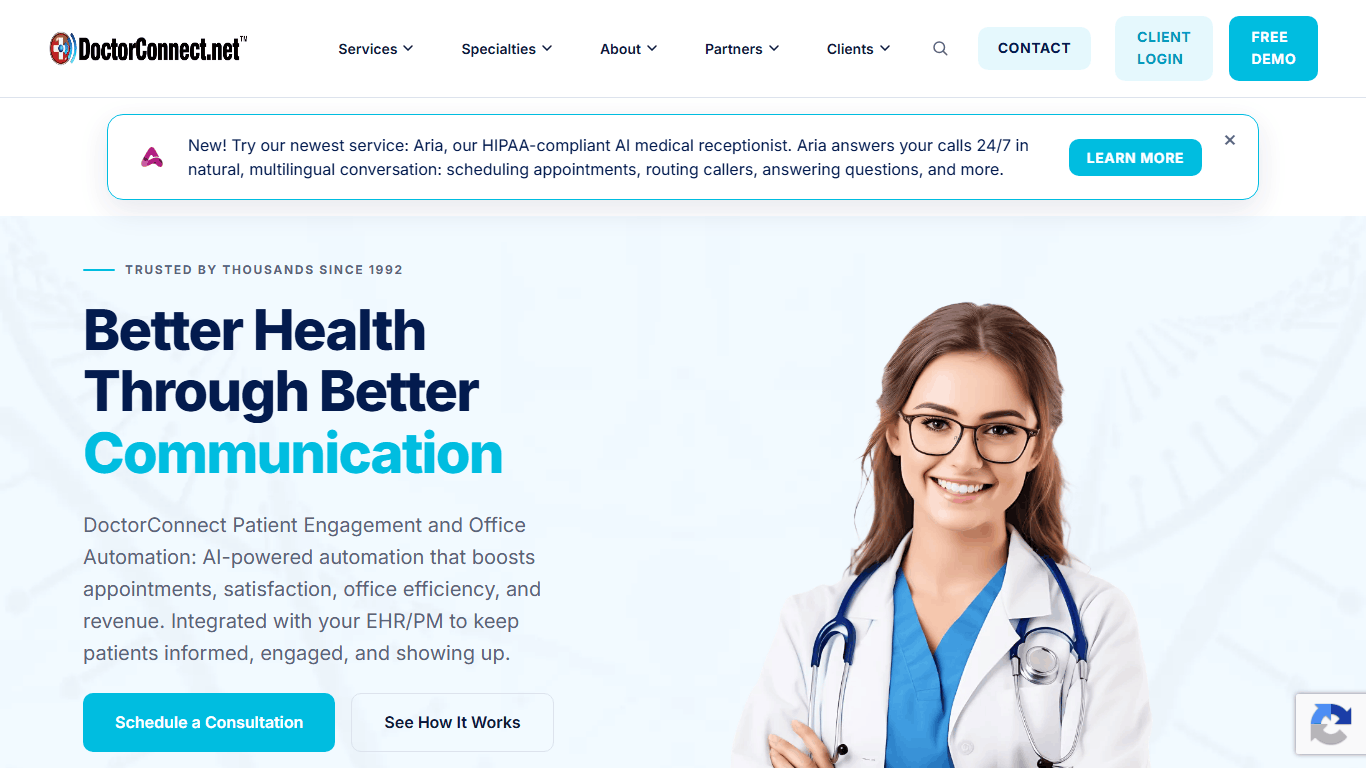
ARIA, described on DoctorConnect’s own site as “Phase 1 of DoctorConnect’s agentic workforce,” is built as a direct replacement for a traditional paid answering service. It answers calls 24/7, draws FAQ answers from a knowledge base the practice writes, routes by department, texts patients links mid-call, and matches caller ID against the practice’s own patient database. It pairs with a companion product, MIRA, to complete appointment booking without staff involvement.
DoctorConnect makes its cost case directly against the alternative: it says traditional medical answering services charge $300 to $400 per location or provider per month plus $1.25 to $2.25 per minute, and claims ARIA cuts that spend by up to 80 percent. It does not publish ARIA’s own price. All call handling and texting is described as meeting HIPAA standards, and DoctorConnect’s HIPAA page says it signs a BAA with every HIPAA covered entity before patient information is exchanged.
Deal-breaker: The page broadly claims integration with “100+ EHR & PM systems” without confirming which of those integrations specifically apply to ARIA versus DoctorConnect’s other products, so confirm your exact EHR is supported for ARIA itself, not just somewhere in DoctorConnect’s wider catalog, before signing.
Greetmate.ai
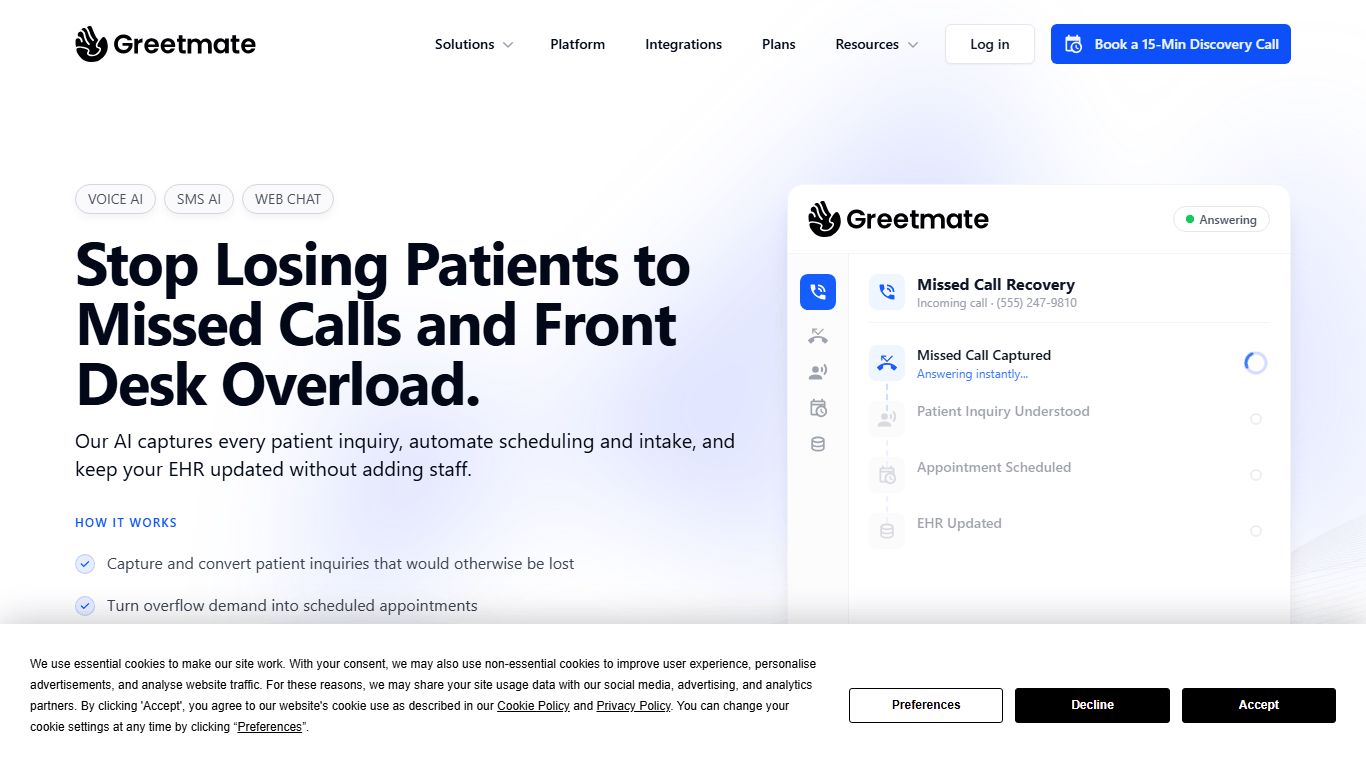
Greetmate.ai answers calls, SMS, and web chat, and writes the results back to the EHR. What sets it apart in this roundup is breadth of named EHR support: Athenahealth, Epic Systems, and Open Dental are called out specifically, alongside a claim of 30-plus supported EHR and scheduling systems and 300-plus app integrations overall.
It markets to a wide range of practice types in its own ROI calculator, including dental, urgent care, behavioral health, and physical therapy/occupational therapy/chiropractic, which makes it one of the more specialty-agnostic options here rather than one built around a single kind of clinic.
Deal-breaker: Individual plan prices still are not published. Greetmate says managed deployments start at $999 to $2,500 a month plus $0.18 per minute above an included allowance, and its plans page says most customers invest $1,000 to $5,000 a month. The single-location Pro plan includes 800 minutes a month, every plan starts with a 90-day pilot commitment, and the activation fee is listed only as variable, so you still need a quote, even for a single-location practice.
Sully.ai
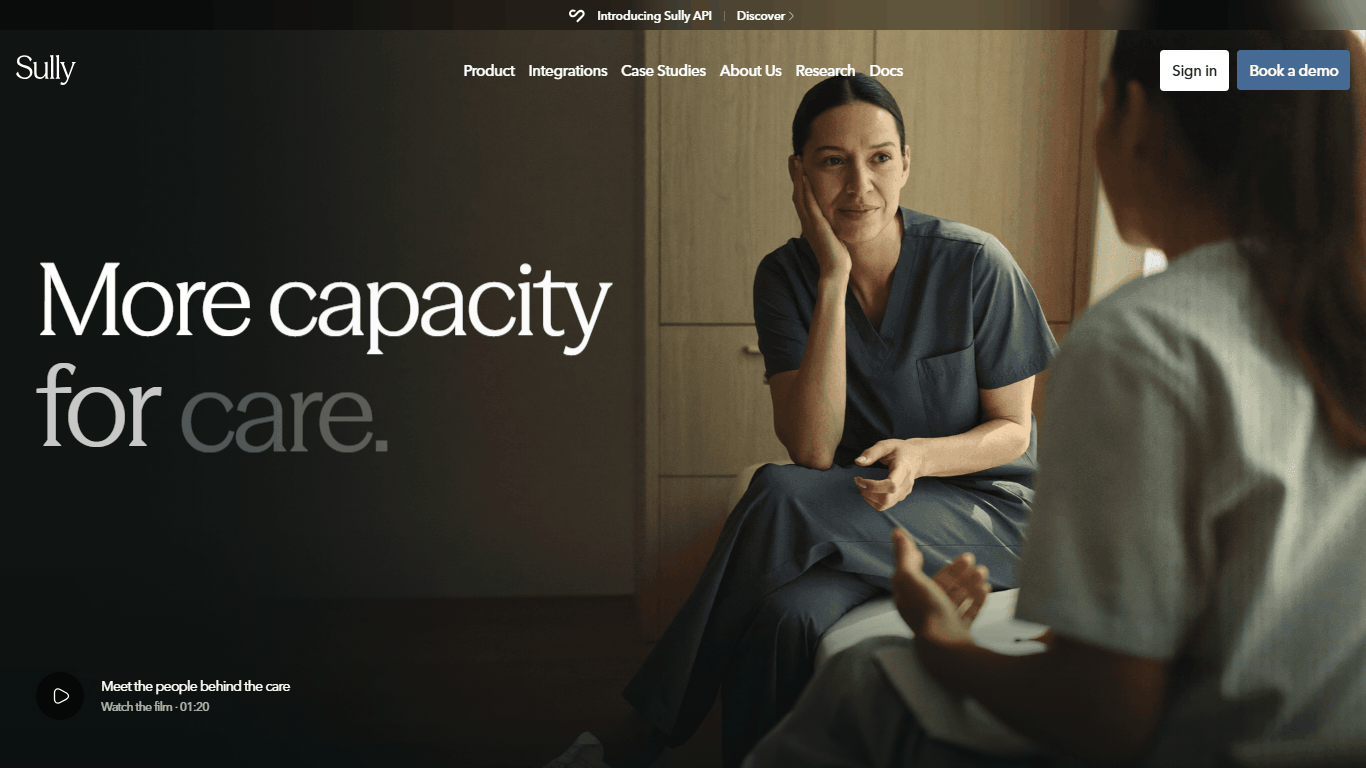
Sully.ai sells four connected agents: Receptionist, Scribe, Medical Coder, and Consultant, positioned to cover the front desk, the visit itself, and post-visit work. The Receptionist specifically answers calls, coordinates appointments, and handles pre-visit scheduling, triage, intake, and insurance verification, with a dashboard view of scheduled, rescheduled, confirmed, and cancelled appointments plus inbound call volume.
The strongest evidence point here is a customer story on Sully’s site: an FQHC with 120 clinicians credits Sully’s patient-access work with saving over $650,000 by reducing abandoned patient calls, a specific vendor-published figure rather than a vague efficiency claim, though we did not independently verify it.
Deal-breaker: The page says Sully reads and writes back patient context, notes, codes, and appointments with “the majority of the major EHRs” without naming which ones, so confirm your exact EHR during a sales call. Sully’s trust page says it executes a BAA with every covered entity; confirm the Receptionist is covered by the agreement you sign.
Assort Health
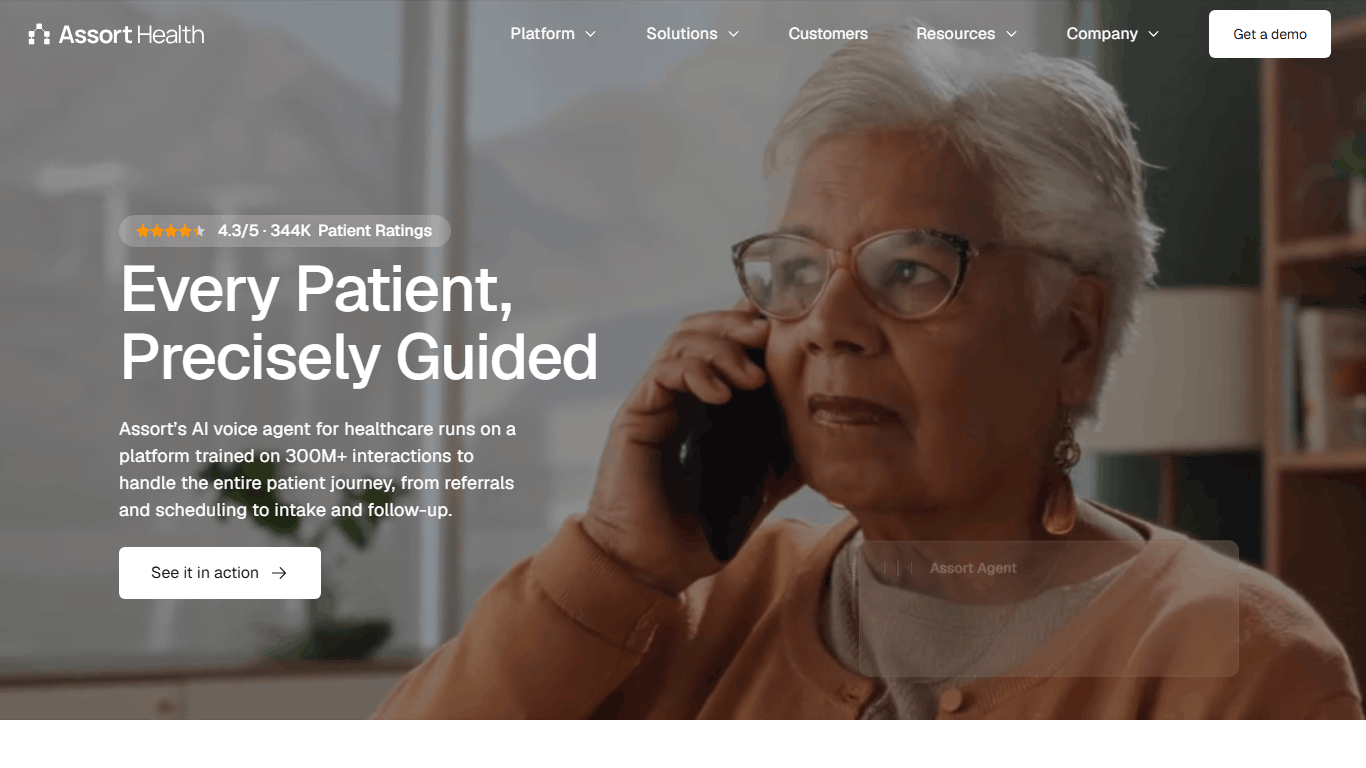
Assort Health’s voice agents answer every call against the practice’s own protocols, offer 24/7 scheduling with waitlist management, and route patients through intelligent triage to the right provider or next step. It states its platform was trained on more than 300 million interactions across 23-plus specialties, and calls out what it describes as the industry’s deepest Athena integration among 15-plus supported platforms.
Insurance and eligibility checking is listed as a capability, and patient intake forms are collected and sent directly to the EHR, which covers a meaningfully wider slice of front-desk work than call answering alone.
Deal-breaker: Pricing is not published, and Assort’s detailed security documents, such as its SOC 2 Type II report and HIPAA attestation, are shared through its Trust Center under NDA. Assort says it is HIPAA compliant and provides a BAA on every engagement, but plan for a security review before a pilot.
Phreesia VoiceAI
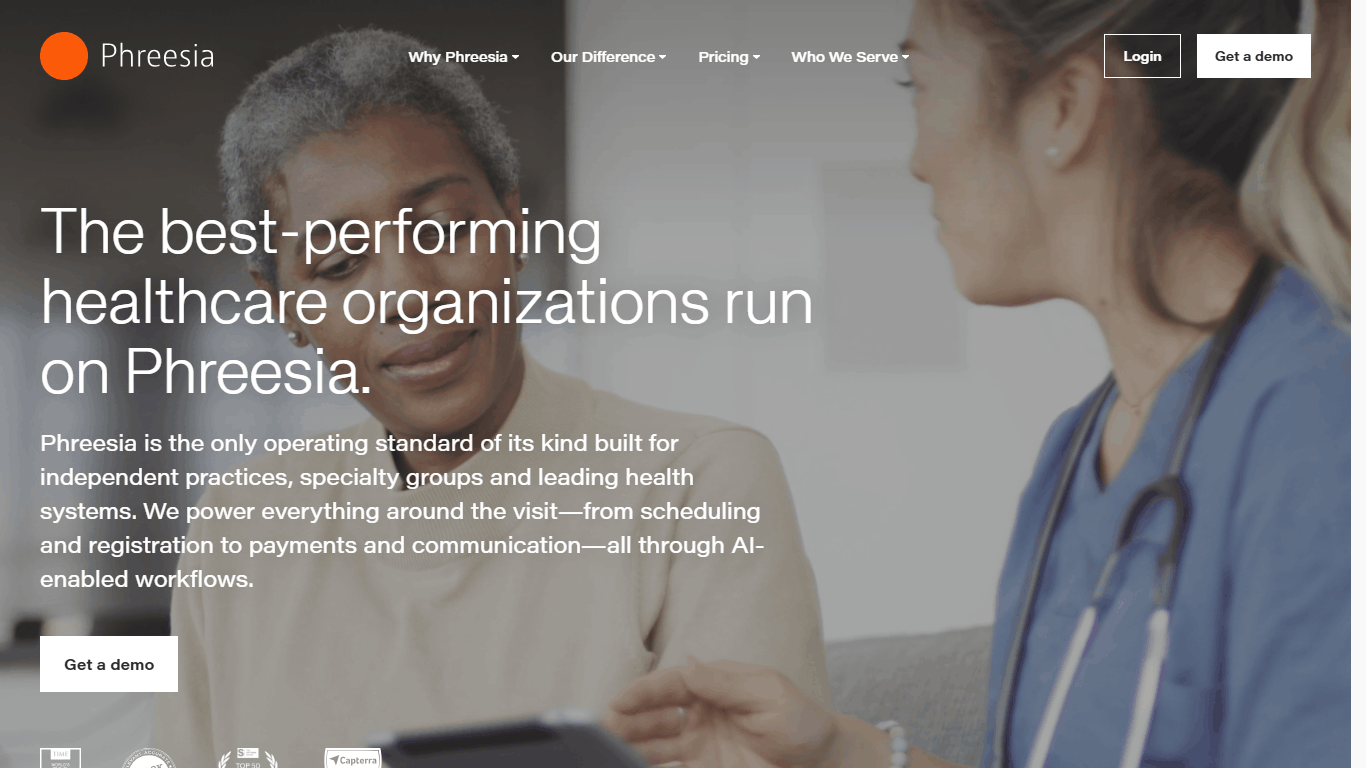
Phreesia is one of the more established names in patient intake, and VoiceAI is one of several “modalities” inside its broader platform, alongside text and email. It answers inbound calls 24/7 in multiple languages with no IVR menus or hold queues, verifies caller identity against existing records by name and date of birth, and resolves or routes based on detected intent. Phreesia says VoiceAI handles 80 percent of calls end to end and can go live in five days; these are vendor figures we did not independently verify.
The feature that stands apart for hospital and urgent-care settings specifically: urgent calls route immediately to the right clinical team or on-call provider, who gets a real-time mobile alert, and every interaction is logged in a time-stamped audit trail. It also runs outbound campaigns for appointment reminders, payment collection, and refill outreach, and the vendor cites $150 saved per provider per month specifically from automating on-call coverage.
Deal-breaker: Phreesia says organizations can start with a single Phreesia product rather than the whole platform, but the VoiceAI page itself doesn’t spell out buying VoiceAI on its own, and its pricing is quoted. Phreesia’s current offer of its Intake platform free until spring 2027 doesn’t say whether VoiceAI is included. On compliance, the VoiceAI page mentions HIPAA only for “HIPAA-compliant two-way texting,” while Phreesia’s privacy policy says it acts as a business associate and signs BAAs whenever it handles patient information for healthcare providers. Confirm in writing that VoiceAI is sold the way you want to buy it and is named in the BAA you sign.
Qure4u
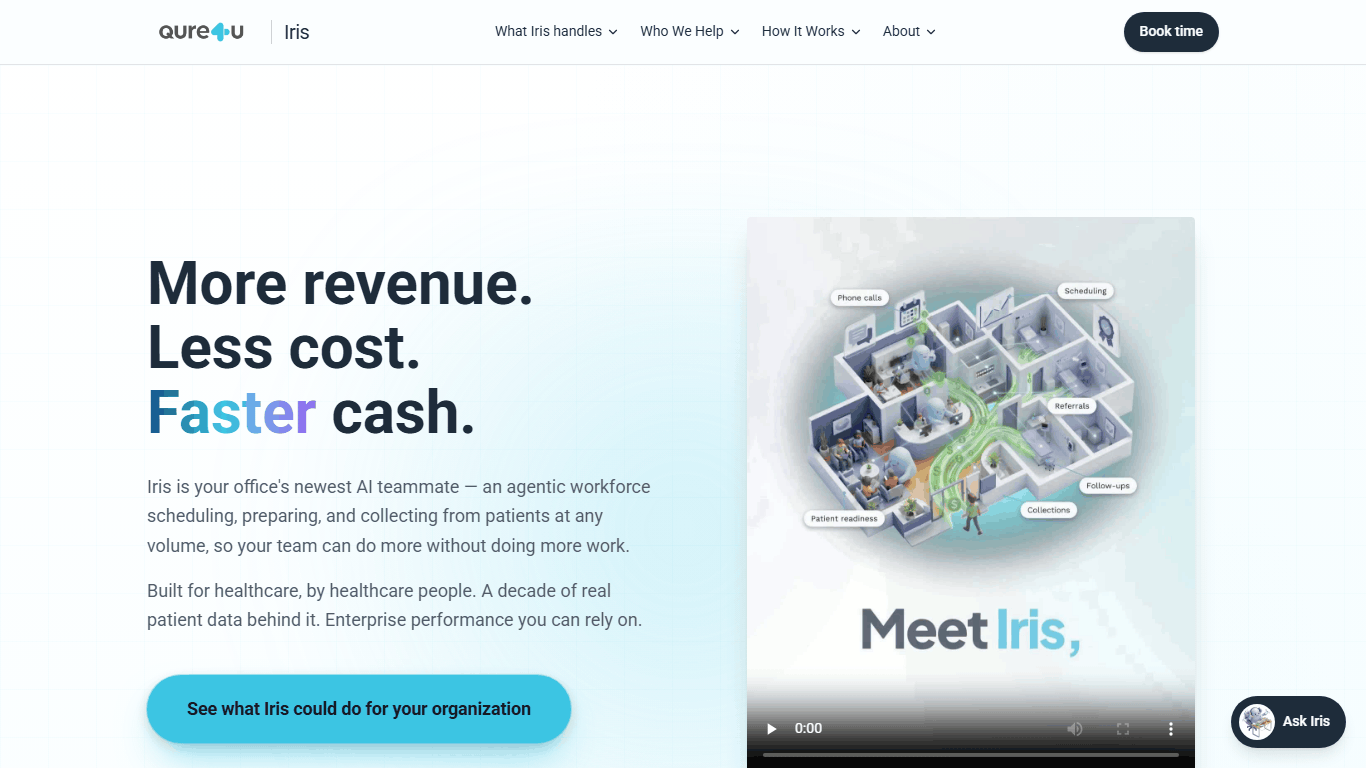
Qure4u’s Iris is explicitly built for “large, advanced healthcare organizations,” and the vendor is specific about scale: its homepage runs a rolling counter of what Iris achieved in the last 30 days, which on November 9, 2026 showed 25,054 calls resolved without staff, 36,241 appointment slots filled, and $4.5 million in payments collected before visits; the numbers change as the counter updates. Qure4u also says Iris resolves 72 percent of routine phone requests without staff. Iris covers six areas: phone calls, scheduling, referrals, collections, patient readiness, and follow-ups, positioning it closer to a revenue-operations platform with a phone-answering front end than a standalone receptionist.
Customer logos span orthopedic, oncology, and urology practices and larger health networks, and the vendor confirms HIPAA compliance, SOC 2 Type II certification, and a signed BAA available before any pilot begins.
Deal-breaker: The page is explicit that its target is organizations with 20-plus locations; it does not describe a path for a single clinic or small practice, so this is not the right starting point for a solo or small-group evaluation regardless of budget.
Luma Health
Luma Health’s AI phone agent is called Navigator, part of a broader platform organized around patient acquisition, access, outreach, and revenue cycle. Navigator handles straightforward calls in English and Spanish and guides patients through scheduling and care journeys; across the platform, Luma reports handling 1.8 million inbound calls with AI annually.
Its EHR list covers the major hospital and health-system platforms: Epic, athenahealth, eClinicalWorks, Oracle Health, MEDITECH, NextGen, Nextech, Greenway Health, and PCC are all named directly, each with its own integration page, and Luma describes its EHR connections as bi-directional. Greetmate.ai names more systems in total, mostly ambulatory and specialty EHRs. Luma states it is trusted by 1,000-plus healthcare organizations across the U.S., Canada, and the U.K., including rural FQHCs, pediatric networks, and orthopedic groups.
Deal-breaker: Luma’s own pages do not use the word “receptionist,” and Navigator sits inside Luma’s outreach suite. Luma does describe it answering after-hours calls, routing calls across a phone tree, and handling voice, chat, and SMS, so confirm how much of your front-desk phone handling it would take over rather than only supplement. Luma’s product pages cite HIPAA compliance, and its HIPAA policy site says it signs BAAs with customers and that its HIPAA program covers its AI-enabled services, but the published BAA template is written for hosting services and doesn’t name Navigator, so ask for a BAA in writing that covers Navigator.
Hyro
Hyro describes itself as a conversational AI platform for health systems that handles voice, chat, and SMS, with integrations it describes as native to Epic, Cerner, and athenahealth, plus Salesforce, so its agents can take scheduling actions rather than only answer questions. Hyro says the platform is HIPAA compliant and SOC 2 certified, with BAAs executed for every customer.
Hyro says its agents are live across 50-plus enterprise health systems, with use cases including scheduling, prescription refills, physician information, and an IT help desk. Its health-systems page cites a 60 to 85 percent agentic resolution rate, and its site cites customer-reported results such as an 85 percent drop in call abandonment and 44 percent of repetitive calls automated at one customer; these are vendor-published figures we did not independently verify.
Deal-breaker: Hyro’s own site has no pricing page and sells through demos; the only price Hyro publishes is on its Salesforce AppExchange listing, which says pricing starts at $100,000 per company per year, with discounts for nonprofits. That puts it out of reach for most single practices, so get a written quote based on your call volume, channels, and the workflows you want automated.
What Does an AI Medical Receptionist Actually Cost in 2026?
Only one vendor in this roundup, DeepCura, publishes a price you can act on without a sales call: $129 per provider per month for the first two seats, tiered down to $101 for seat 11 and beyond (a 10-provider team pays $1,156 a month), with a 10-seat 90-day pilot priced at $3,468. Two vendors publish starting points but still quote the final price: Greetmate.ai says managed deployments start at $999 to $2,500 a month plus $0.18 per minute above an included allowance (its plans page says most customers invest $1,000 to $5,000 a month), and Hyro’s Salesforce AppExchange listing says pricing starts at $100,000 per company per year. Every other platform here, DoctorConnect, Sully.ai, Assort Health, Phreesia VoiceAI, Qure4u, and Luma Health, requires a demo to get a number.
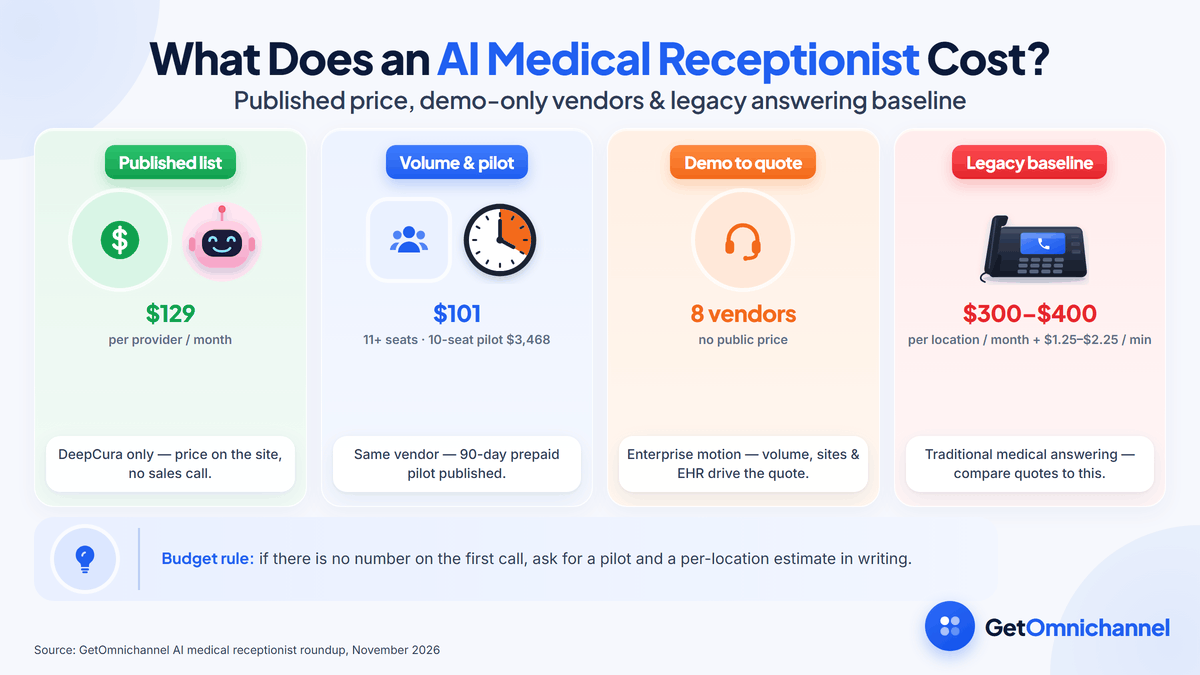
That split is not arbitrary. The quote-only vendors are built around enterprise sales motions because their real customers are multi-location groups and health systems where pricing depends on call volume, location count, and EHR complexity, variables a flat per-seat price can’t absorb. DoctorConnect gives the clearest proxy for what you’re actually saving against: by its figures, traditional medical answering services charge $300 to $400 per location or provider per month plus $1.25 to $2.25 per minute, a baseline worth comparing any quote against directly.
If a vendor can’t tell you a number on the first call, ask for a pilot period and a per-location estimate in writing before moving further, the same way you’d evaluate any other enterprise healthcare purchase.
Three Questions. One Platform. This Quarter.
1. How many locations does your organization operate?
One to a handful of locations: start with DeepCura or DoctorConnect, two platforms here built with smaller practices explicitly in mind, both with a publicly stated BAA and either public pricing or a direct cost comparison to what you’re already paying.
A multi-specialty group across several specialties: Assort Health and Greetmate.ai both name broad specialty and EHR support directly on their sites.
20-plus locations or a hospital system: Qure4u, Luma Health, and Hyro are each explicit about serving that scale; Qure4u and Luma quote every deal, Hyro’s AppExchange listing starts at $100,000 a year, and all three should be expected to go through a security review before a pilot.
2. Do you need after-hours urgent-call escalation to an on-call provider?
Yes: Phreesia VoiceAI is the only platform in this roundup whose own page specifically describes routing urgent calls to an on-call provider via real-time mobile alert, with a full audit trail. DoctorConnect’s ARIA can also transfer calls to an on-call contact you name.
No, routine scheduling and FAQ coverage is enough: most of the other eight platforms cover that baseline adequately.
3. Do you need the receptionist bundled with scribing, coding, or billing, or do you want it standalone?
Bundled AI workforce: DeepCura and Sully.ai both pair the receptionist with scribing, coding, and (for DeepCura) billing under one subscription.
Standalone receptionist only: DoctorConnect, Greetmate.ai, Assort Health, Phreesia VoiceAI, Qure4u, Luma Health, and Hyro are each positioned around call handling, scheduling, and patient access rather than clinical documentation.
Most of the 9 platforms here are built around phone calls. Greetmate.ai, Luma Health, and Hyro also offer web chat, but if patient chat on your own site is a major channel in its own right, compare dedicated tools in our live chat software guide. And if your front desk already runs a broader multi-channel support operation spanning phone, chat, and messaging together, our omnichannel communication platforms guide covers that wider category.
It depends on scale. DeepCura and DoctorConnect are the strongest fit for solo and small practices, both confirming a signed BAA and either public pricing (DeepCura) or a direct cost comparison against traditional answering services (DoctorConnect). Qure4u, Luma Health, and Hyro are built specifically for 20-plus-location networks and health systems, while Assort Health and Greetmate.ai sit in between, covering multi-specialty groups with broad EHR support. DeepCura is the only platform in this roundup with public per-seat pricing: $129 per provider per month for the first two seats, with tiered rates down to $101 for seat 11 and beyond (a 10-provider team pays $1,156 a month). Greetmate.ai says managed deployments start at $999 to $2,500 a month and most customers invest $1,000 to $5,000 a month, and Hyro's Salesforce AppExchange listing says pricing starts at $100,000 per company per year; both still quote the final price. DoctorConnect, Sully.ai, Assort Health, Phreesia VoiceAI, Qure4u, and Luma Health require a demo call for a quote. As a baseline for comparison, DoctorConnect says traditional medical answering services charge $300 to $400 per location or provider per month plus $1.25 to $2.25 per minute. All nine vendors in this roundup publicly say they offer or sign a Business Associate Agreement, as of November 9, 2026. DeepCura, DoctorConnect, Qure4u, Greetmate.ai, Sully.ai, Assort Health, and Hyro say so on their own product, pricing, trust, or HIPAA pages. Phreesia's statement is in its company privacy policy rather than on the VoiceAI page, and Luma Health's is on its separate HIPAA policy site. A public statement is not a signed agreement: ask for the BAA in writing during your first sales conversation and confirm it covers the AI phone product you are buying. It depends on which EHR you run. Greetmate.ai names the longest list, including Athenahealth, Epic Systems, Open Dental, ModMed, and Tebra, alongside a claim of 30-plus supported EHR and scheduling systems. Luma Health names the major hospital and health-system platforms: Epic, athenahealth, eClinicalWorks, Oracle Health, MEDITECH, NextGen, Nextech, Greenway Health, and PCC, and describes its EHR connections as bi-directional. Assort Health highlights deep Athena-specific integration among 15-plus platforms. Confirm your exact EHR and the specific read and write actions with any vendor before signing. Small clinics have real options in this category. DeepCura explicitly supports solo practitioners with public per-seat pricing, and DoctorConnect's ARIA is positioned as a direct, lower-cost replacement for a traditional paid answering service, with a testimonial from a multilingual clinic in New York City on its ARIA page. The quote-only enterprise platforms in this roundup (Qure4u, Luma Health, Hyro) are explicit that their target customer is a 20-plus-location network or health system, so a small practice evaluating this category should start with DeepCura or DoctorConnect first. ARIA is DoctorConnect's own product, described directly on DoctorConnect's site as "Phase 1 of DoctorConnect's agentic workforce." Some third-party comparison articles misattribute ARIA to Luma Health, whose actual AI phone agent is called Navigator. The two products are not the same, and confirming which company you're evaluating matters since their pricing models, target practice sizes, and EHR integration lists differ.Frequently Asked Questions: AI Medical Receptionist Software 2026
What is the best AI medical receptionist software for clinics and hospitals in 2026?
How much does an AI medical receptionist cost?
Do AI medical receptionist platforms sign a BAA?
Which AI medical receptionist integrates with the most EHR systems?
Is an AI medical receptionist only for large hospitals, or can a small clinic use one?
Is ARIA made by DoctorConnect or Luma Health?
 Your information is encrypted and kept secure.