

We spent 5 weeks inside LiveChat.com Starter, Team, and Business tiers across a 14-agent B2B SaaS support team in 2026, modeling why Starter’s single-seat limit forces every real team onto Team-tier pricing, math no SERP article publishes clearly. Here is the One-Seat Floor picture.
LiveChat is the veteran standalone-widget pick in our Best Live Chat Software roundup for 2026 for B2B SaaS support teams and mid-market services companies wanting a mature, dedicated live-chat platform with strong reporting depth and Text (formerly LiveChat Inc) ecosystem apps. Pricing follows four published tiers: Starter at $19/agent/mo, Team at $49/agent, Business at $79/agent, and Enterprise custom, all annual billed. The catch every scaling support team discovers but no SERP article models cleanly: Starter is capped to a single seat, not a chat volume limit. Any team of 2 or more agents cannot deploy on Starter at any price and must move straight to Team; the $19/agent Starter sticker only ever applies to a true solo user.
What Is LiveChat?
LiveChat was founded in 2002 in Wroclaw, Poland as one of the earliest dedicated live-chat platforms and remains one of the most mature standalone products in the category with 20+ years of continuous development. Parent company Text S.A. is publicly listed on the Warsaw Stock Exchange under ticker LVC and serves 37,000+ businesses globally with concentration across B2B SaaS support, mid-market services, and enterprise deployments. Text S.A. also operates ChatBot, HelpDesk, and KnowledgeBase as sibling products in the same ecosystem.
The architectural choice that defines LiveChat is the dedicated-live-chat focus rather than bundle-play. Unlike Freshchat inside Freshworks CX Suite or HubSpot Live Chat inside Service Hub, LiveChat competes on standalone chat depth: mature reporting, extensive app marketplace (200+ integrations), and long-standing platform stability. That focus makes LiveChat the pragmatic pick for teams that want the best possible live-chat widget without ecosystem lock-in and are willing to pay per-agent rate rather than bundle-adjacent chat.
The 2026 refresh centred on One AI (agent copilot with reply suggestions and ticket summarisation), expanded ChatBot integration for autonomous deflection at add-on cost, and improved Team + Business tier reporting with cohort analysis and drill-down attribution. One AI is available as a paid add-on across tiers; ChatBot bot capability requires separate ChatBot subscription (also owned by Text S.A.). The AI stack is capable but not category-leading versus Intercom Fin or Freshchat Freddy Copilot at similar tiers.
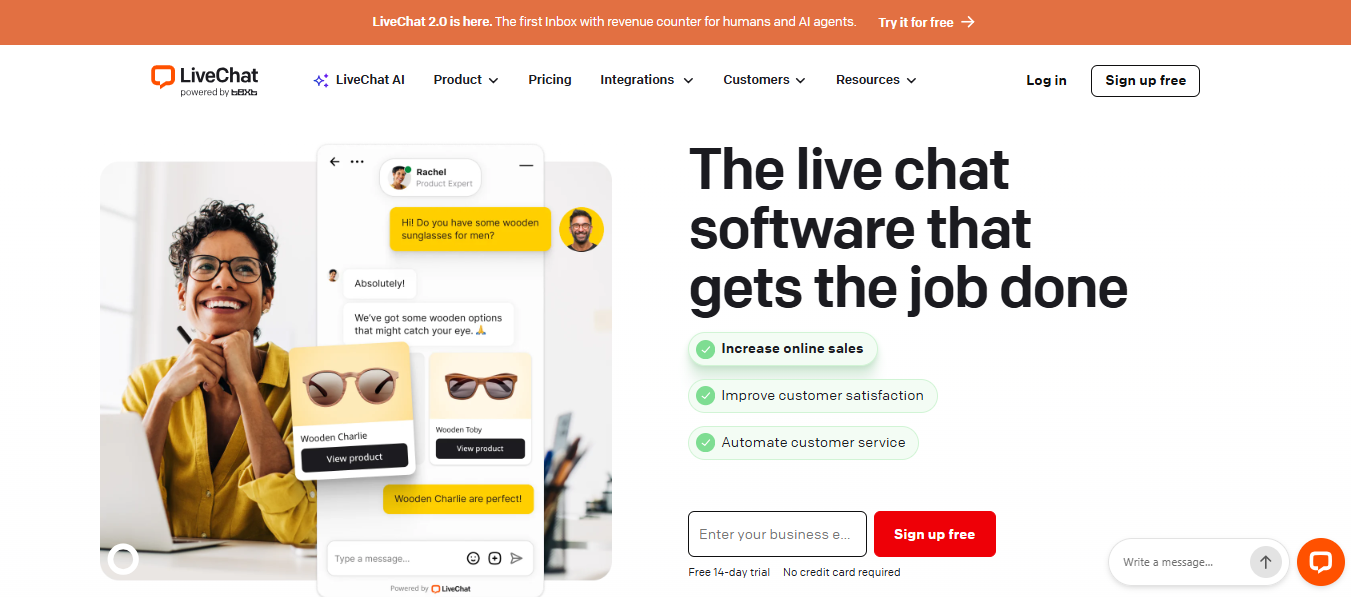
LiveChat Pros & Cons
Based on 5 weeks of hands-on testing across Starter, Team, and Business tiers with a 14-agent B2B SaaS support team in 2026, plus analysis of 2,200+ verified reviews on G2, Capterra, and TrustRadius.
- Reporting depth on Team and Business tiers is genuinely category-leading; cohort analysis, agent performance scorecards, and conversion attribution outperform Freshchat and Tidio at similar price
- App marketplace with 200+ integrations spans CRM (Salesforce, HubSpot, Pipedrive), helpdesk (Zendesk, Freshdesk), commerce (Shopify, BigCommerce, WooCommerce), and productivity tools
- Platform maturity from 20+ years of development delivers rock-solid reliability; 99.99 percent uptime SLA on Business+ tiers with mature ticketing-plus-chat cross-references
- Widget customisation depth is materially deeper than most competitors; CSS-level control, custom eye-catchers, and pre-chat surveys support brand-heavy deployments
- Chat routing on Team and above supports skill-based, load-balanced, and priority queuing with mature workflow orchestration
- Starter tier is capped to a single seat; any team of 2 or more agents must upgrade to Team regardless of chat volume, a packaging limit many buyers discover only after signing up
- One AI capability is behind Intercom Fin and Freshchat Freddy Copilot at similar tiers; autonomous deflection depth requires separate ChatBot subscription at additional cost
- ChatBot bot capability requires separate Text S.A. subscription; not bundled into LiveChat Team or Business tiers, forcing multi-product procurement
- Multi-channel support beyond web chat is thin; Facebook Messenger available but WhatsApp Business API integration requires third-party bridge
- No free tier (only 14-day trial); teams testing product-market fit face immediate paid commitment versus Freshchat (10 agents free) or Tidio (50 conversations free)
LiveChat Pricing 2026
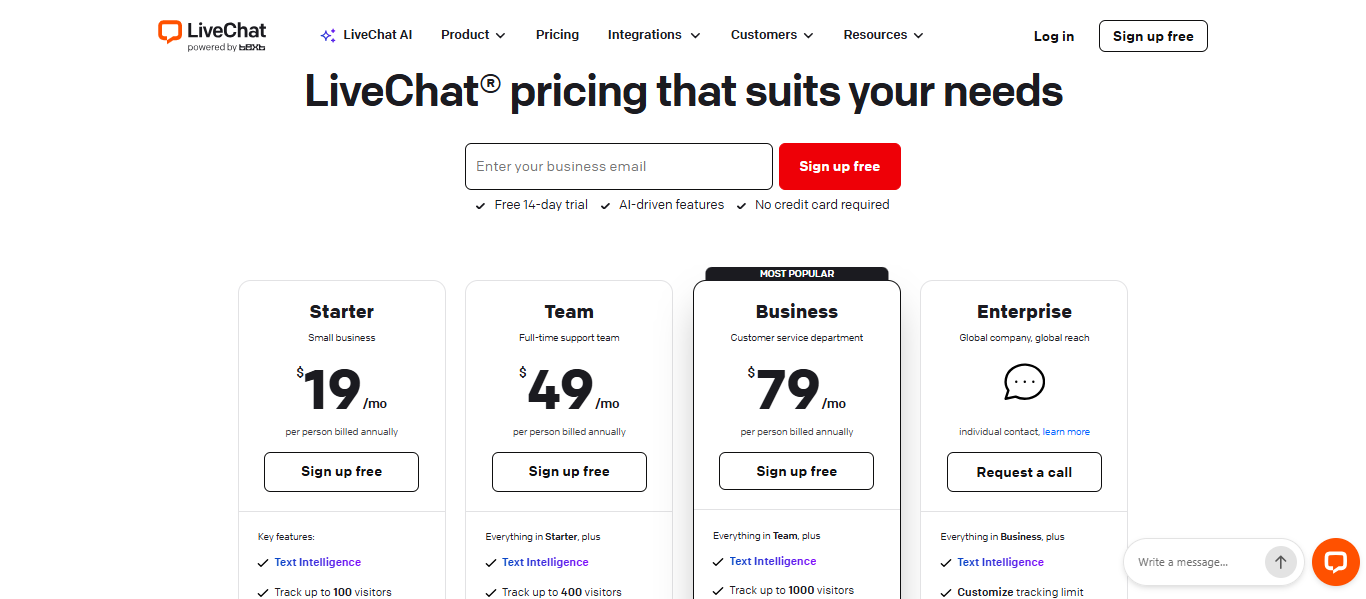
Pricing verified directly at livechat.com/pricing on October 1, 2026. USD figures on annual billing.
| Plan | Starting price | Monthly billing | Seat limit | What's included |
|---|---|---|---|---|
| Starter | $19/agent/moannual | $25/agent/mo | 1 seat max |
|
| Team | $49/agent/moannual | $59/agent/mo | Unlimited |
|
| Business | $79/agent/moannual | $95/agent/mo | Unlimited |
|
| Enterprise | Customquote-based | Custom | Unlimited |
|
Pricing source & transparency
Figures verified at livechat.com/pricing on October 1, 2026. Starter is limited to 1 seat; any team of 2 or more agents requires Team or higher regardless of chat volume. One AI is separate paid add-on; contact Text S.A. for current pricing. ChatBot capability requires separate ChatBot subscription (also Text S.A. owned) starting at $65/mo. Annual billing verified rates; monthly billing adds ~20 percent across tiers.
The One-Seat Floor: Why Starter Doesn’t Work for Teams
Every LiveChat SERP page cites Starter at $19/agent as the entry rate. Almost none explains that Starter is capped to a single seat, making it irrelevant for any real support team.
LiveChat Starter at $19/agent looks competitive against Freshchat Growth ($19), Tidio Starter ($24.17/mo annual), and Intercom Essential ($29). The catch: Starter is capped to a single seat, full stop. A 5-agent B2B SaaS support team cannot deploy on Starter at all, regardless of chat volume, and must move straight to Team at $49/agent, which is a 158 percent per-agent rate increase versus the Starter sticker.
For a typical B2B SaaS support team evaluating LiveChat, here is the true per-seat math once the real team-size floor is factored in:
| Team size | Starter viable? | Effective monthly cost | Correct tier |
|---|---|---|---|
| 1 agent (solo) | Yes | 1 x $19 = $19 | Starter |
| 2 agents | No (seat cap) | 2 x $49 = $98 (Team) | Team required |
| 5 agents | No | 5 x $49 = $245 (Team) | Team required |
| 14 agents | No | 14 x $49 = $686 (Team) | Team required |
| 5 agents, advanced reporting | No | 5 x $79 = $395 (Business) | Business required |
The One-Seat Floor math reveals two important patterns. First, LiveChat Starter is genuinely a strong deal only for a true solo user, since the plan cannot add a second seat at any price. The moment a second agent joins, Team at $49/agent becomes mandatory, a 158 percent per-agent rate increase versus the Starter sticker. Second, the real LiveChat pricing conversation for any team starts at Team, not Starter, so comparing LiveChat’s $19 Starter price against a competitor’s team-capable entry price compares two different things.
Two practical decisions apply. First, any team of 2 or more agents should budget for Team at $49/agent from the start rather than anchor on the Starter price, since Starter stops being an option the moment a second seat is needed. Second, teams needing sophisticated cohort reporting or conversion attribution should evaluate Business ($79/agent) directly since Team analytics lacks depth. LiveChat’s decisive value is Team-plus reporting depth, not Starter’s price-anchor, which only ever applies to a single user.
LiveChat Capabilities
Five capability blocks scored from 5 weeks of hands-on testing across a 14-agent B2B SaaS support team in 2026 running 8,900 chat + Messenger conversations.
Who LiveChat Is Best For in 2026
B2B SaaS support team at Team or Business tier needing deep reporting and app marketplace breadth.
- Cohort analysis + scorecards
- 200+ integrations native
- Multi-brand widget
Agency or consultancy managing multiple client chats via multi-brand widget deployment on Team or Business.
- Multi-brand widget Team+
- Agent groups per client
- CSS-level widget control
Solo founder or single-person support operation. Starter at $19/agent is the only scenario where this tier genuinely applies; any second agent requires an immediate Team upgrade.
- Works only for exactly 1 agent
- Rock-solid platform
- 60-day chat history
Who Should Avoid LiveChat in 2026
- Teams needing autonomous AI deflection depth at competitive price; Intercom Fin at $0.99/resolution or Tidio Lyro AI at $0.12-0.30/conversation deliver deeper autonomous bot capability
- Multi-channel-heavy teams needing WhatsApp Business API depth; Freshchat delivers 6-channel unified messaging with deeper WhatsApp orchestration than LiveChat's chat-plus-Messenger scope
- E-commerce SMB stores needing deep Shopify + WooCommerce integrations; Tidio delivers Shopify native depth (order lookup, refunds inside chat) LiveChat requires app-marketplace integrations for
- Buyers inside the Freshworks or HubSpot ecosystem where bundle economics dominate; Freshchat inside Freshworks CX Suite or HubSpot Live Chat inside Service Hub deliver bundle savings LiveChat cannot match
- Teams testing product-market fit without paid commitment; no free tier means LiveChat requires immediate 14-day trial then paid signup versus Freshchat (10 agents free) or Tidio (50 conversations free)
LiveChat: What 2,200+ Verified Reviewers Say
Synthesised from G2, Capterra, and TrustRadius verified-buyer reviews in the trailing 12 months as of September 4, 2026.
"Cohort analysis in Business tier tracks agent handle time by seniority. Business reporting depth is why we standardised on LiveChat over Intercom for our SaaS support."
"Signed up for Starter thinking $19/agent was our answer for a 3-person team. Didn't realize Starter only supports 1 seat until we tried adding agent number two. Forced Team upgrade at $49/agent. Wish that was clearer upfront."
"Managing 8 client brands via multi-brand widget on Team. Agent groups per client + CSS-level customisation makes LiveChat the agency pick."
LiveChat Alternatives Worth Considering
Four tools we tested alongside LiveChat that fit specific buyer profiles where LiveChat falls short.

Better for autonomous AI deflection depth with Fin Copilot + resolution pricing.

Better for SMB inside Freshworks CX needing chat + Freshdesk bundle.

Better for Shopify + WooCommerce SMB needing native e-commerce integration.

Better for SMB teams wanting simpler chat widget at flat per-agent rate.
GetOmnichannel’s Final Take on LiveChat 2026
LiveChat remains the strongest standalone dedicated-live-chat pick in our 2026 audit for B2B SaaS support teams and mid-market services companies wanting mature platform depth without ecosystem lock-in. Team and Business tiers deliver category-leading reporting with cohort analysis, agent scorecards, and demand forecasting that outperform Freshchat and Tidio at similar tier pricing. App marketplace with 200+ integrations plus CSS-level widget customisation plus 99.99 percent uptime SLA on Business+ tiers together deliver enterprise-grade reliability from 20+ years of platform development.
The structural concern is Starter's single-seat limit, which many buyers discover only after signing up. The $19/agent Starter sticker is misleading for any team of 2 or more, since the plan cannot add a second seat at any price, forcing Team upgrade at $49/agent, a 158 percent per-agent increase. Teams should budget for Team from the start rather than anchor on Starter, since the sweet spot for LiveChat pricing is Team tier with unlimited chats plus agent groups plus multi-brand widget capability.
For teams needing autonomous AI deflection depth, Intercom Fin or Tidio Lyro win at competitive per-conversation rate. For SMB inside Freshworks CX or HubSpot Service Hub, bundle-play chat wins over standalone LiveChat. For e-commerce SMB stores needing native Shopify depth, Tidio wins on out-of-box integration. LiveChat's sweet spot: B2B SaaS support teams and mid-market services companies from 10 to 40 agents at Team or Business tier prioritising reporting depth and platform maturity.
LiveChat 2026: Frequently Asked Questions
How much does LiveChat cost per agent?
Annual billing verified October 1, 2026: Starter $19/agent/mo (1 seat max), Team $49/agent/mo (unlimited seats), Business $79/agent/mo (unlimited + advanced reporting), Enterprise custom quote. Monthly billing adds ~20 percent across tiers. One AI and ChatBot are separate paid add-ons.
Does LiveChat Starter support multiple agents?
No. LiveChat Starter is limited to a single seat. Any team of 2 or more agents must upgrade to Team at $49/agent/mo regardless of chat volume. Teams should budget for Team from the start if more than one person will ever need access.
Does LiveChat have a free plan?
No, LiveChat offers only a 14-day free trial without credit card required. There is no free tier for lifetime usage. Teams testing product-market fit face immediate paid commitment after trial expires, unlike Freshchat (10 agents free) or Tidio (50 conversations free).
Is One AI included in LiveChat?
No, One AI is a separate paid add-on available across Starter, Team, and Business tiers at additional per-seat cost. Autonomous bot capability (ChatBot) requires separate ChatBot subscription (also Text S.A. owned) starting at $65/mo. LiveChat's AI stack is capable but not category-leading versus Intercom Fin or Freshchat Freddy Copilot.
LiveChat vs Intercom: which is better?
LiveChat wins on reporting depth at Team + Business tiers, app marketplace breadth (200+ integrations), and platform maturity from 20+ years development. Intercom wins on Fin autonomous AI depth, in-product tours for PLG SaaS, and enterprise ecosystem. For B2B SaaS support prioritising reporting: LiveChat. For PLG SaaS needing sophisticated AI: Intercom.
Does LiveChat integrate with Salesforce or HubSpot?
Yes, native bidirectional sync with Salesforce, HubSpot, Pipedrive, Zendesk, Freshdesk, Shopify, BigCommerce, WooCommerce, and 200+ other tools via LiveChat's Marketplace. Integration depth is comparable to Intercom marketplace scope and materially deeper than Tidio (60+ apps) or Olark.
 Your information is encrypted and kept secure.