

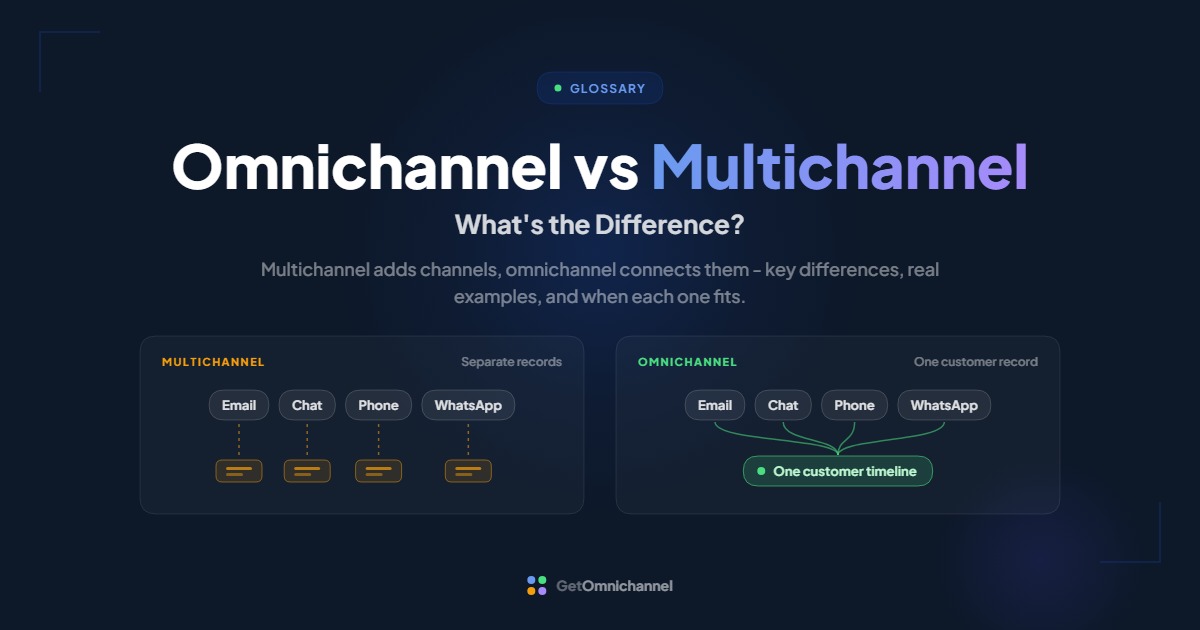
Multichannel means a business uses multiple customer communication channels, while omnichannel connects those channels so customer conversations and context can move between them. A multichannel business can be reached by email, phone, live chat, and WhatsApp. An omnichannel business can be reached the same ways, and it also knows that the person on the phone today is the one who sent a WhatsApp message yesterday.
That one difference changes how agents work, what customers have to repeat, how reports are built, and which software you need. This guide compares omnichannel vs multichannel side by side, walks through real examples, and explains when each approach is the right choice. Omnichannel is not automatically better for every business.
Multichannel lets customers reach you on many channels. Omnichannel connects those channels so the conversation follows the customer.
Compare platforms →Omnichannel vs multichannel at a glance
The short version: both use several channels. Only omnichannel connects them.
| Multichannel | Omnichannel | |
|---|---|---|
| Multiple channels | Yes | Yes |
| Channels connected | Limited | Yes |
| Shared customer context | Usually limited | Centralized |
| Conversation continuity | Limited | Strong |
| Customer journey | Channel-specific | Cross-channel |
| Typical use | Reach customers | Coordinate customer experience |
Read the table from top to bottom and you can see the pattern. The first row is the same for both. Every row after that is about connection. Multichannel answers the question “Can customers reach us?” Omnichannel answers a harder one: “When they reach us again, do we remember them?”
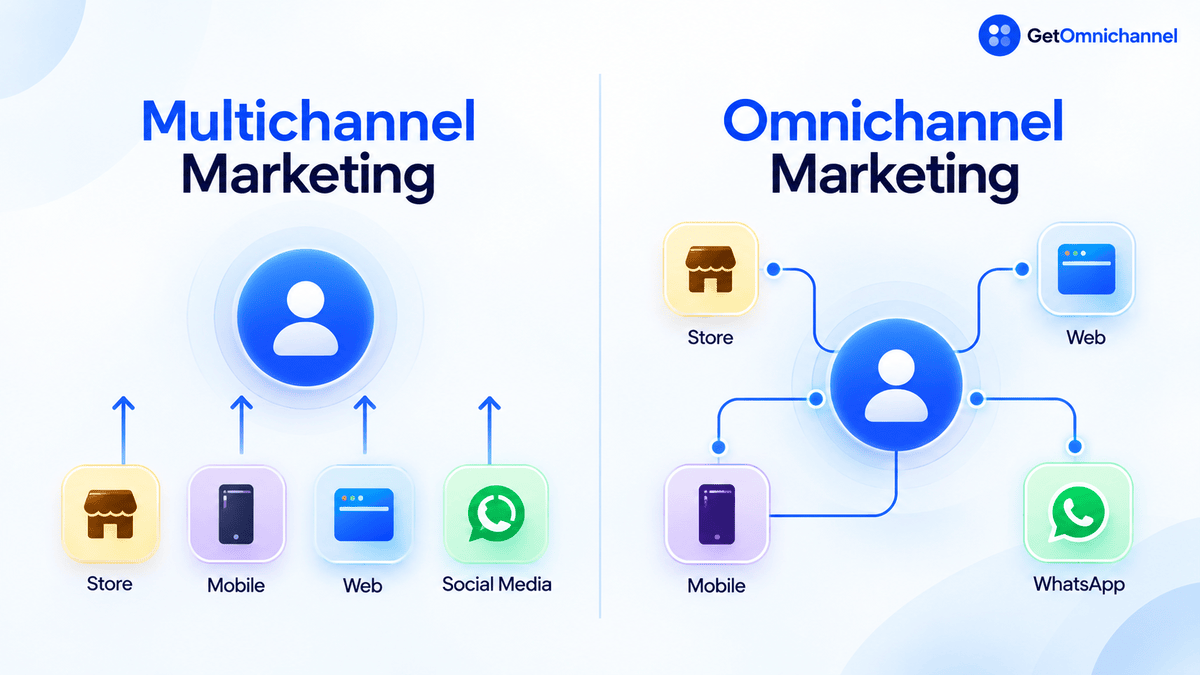
What is multichannel communication?
Multichannel communication means a business offers customers several ways to get in touch, such as email, phone, live chat, SMS, social media, or WhatsApp, and runs each channel on its own. Each channel usually has its own inbox, its own tool or tab, its own history, and often its own team.
In a typical multichannel setup:
- The phone team works in a phone system, the email team in a shared mailbox or helpdesk, and social messages are answered from the social platform’s own inbox.
- Each channel holds its own history. A WhatsApp agent cannot see the email thread unless someone copies it across.
- Customer identity is matched by hand, if it’s matched at all. The same person can appear as an email address in one tool and a phone number in another.
- Reports are per channel. You can see email response times and call volumes, but not how one customer’s issue moved across both.
None of this is a failure. Multichannel is how most businesses start, because each new channel gets added when customers ask for it. It works well while channels rarely overlap. The problems start when the same customer, with the same issue, shows up on two channels and each one treats them as a stranger.
Quick check: are you running multichannel today?
- Do agents switch between separate tools or tabs to answer different channels?
- When a customer says “I already emailed about this,” does the agent have to search another system to find it?
- Is the same customer stored as two or more separate contacts across your tools?
- Can you only report on each channel separately, not on a customer’s full journey?
If you answered yes to two or more, your setup is multichannel, whatever your software’s marketing page calls it.
What is omnichannel communication?
Omnichannel communication connects every customer channel to one shared customer record and one conversation history. Whether the customer writes in on chat, replies to an email, sends a WhatsApp message, or calls, the agent sees the same profile and the full timeline of earlier contact, all in one place.
The key word is continuity. In an omnichannel setup, a customer can start on one channel and finish on another without starting again. The conversation follows the customer, not the channel. For a deeper look at the concept, including its core components and how to build a strategy around it, see our guide to what omnichannel means.
In practice, omnichannel usually depends on three things working together:
- One customer identity. An email address, phone number, and WhatsApp number are recognised as the same person and merged into one profile.
- One timeline. Every interaction appears in a single, ordered history, not in separate inboxes by channel.
- Shared tools for every team. Support, sales, and success teams read from and write to the same record, so a handoff keeps its context.
Why the difference matters: what the research shows
Customers already move between channels, whether or not your systems are connected. According to a Gartner survey of 5,801 customers conducted in early 2025, 51% of customer service journeys now begin on third-party platforms such as Google, YouTube, or ChatGPT, and only 22% of customers start, stay, and resolve their issue entirely within a company’s own channels. Switching channels is the normal journey, not the exception.
The research also shows what happens at the moment of the switch, which is exactly where multichannel and omnichannel differ:
- 62% of customer service channel transitions are "high-effort", meaning the switch did not lead to a resolution. When the transition was seamless, 93% of customers reported high satisfaction. Source: Gartner survey of 1,492 B2B and B2C customers (July 2023).
- 4 minutes of agent time are saved, on average, per customer journey when transitions are seamless, because agents don't have to ask customers to repeat information. Source: Gartner (July 2023).
- 74% of consumers get frustrated when they have to repeat information, and 81% want representatives to pick up where they left off. Source: Zendesk CX Trends 2026, based on more than 11,000 consumers and business leaders across 22 countries.
- 67% of consumers expect brands to tailor support based on their prior interactions, which is only possible when every channel can see that history. Source: Zendesk CX Trends 2026.
Put together, these numbers describe the multichannel gap: customers cross channels all the time, but most handoffs still make them start over. You don’t need to connect every channel at once to close that gap. Fixing the handoffs where your customers switch most often, such as chat to phone or email to chat, is a practical first step.
Key differences between omnichannel and multichannel
The two approaches differ in eight practical areas. For each one, the “What to check” line tells you how to test your own setup or a vendor demo.
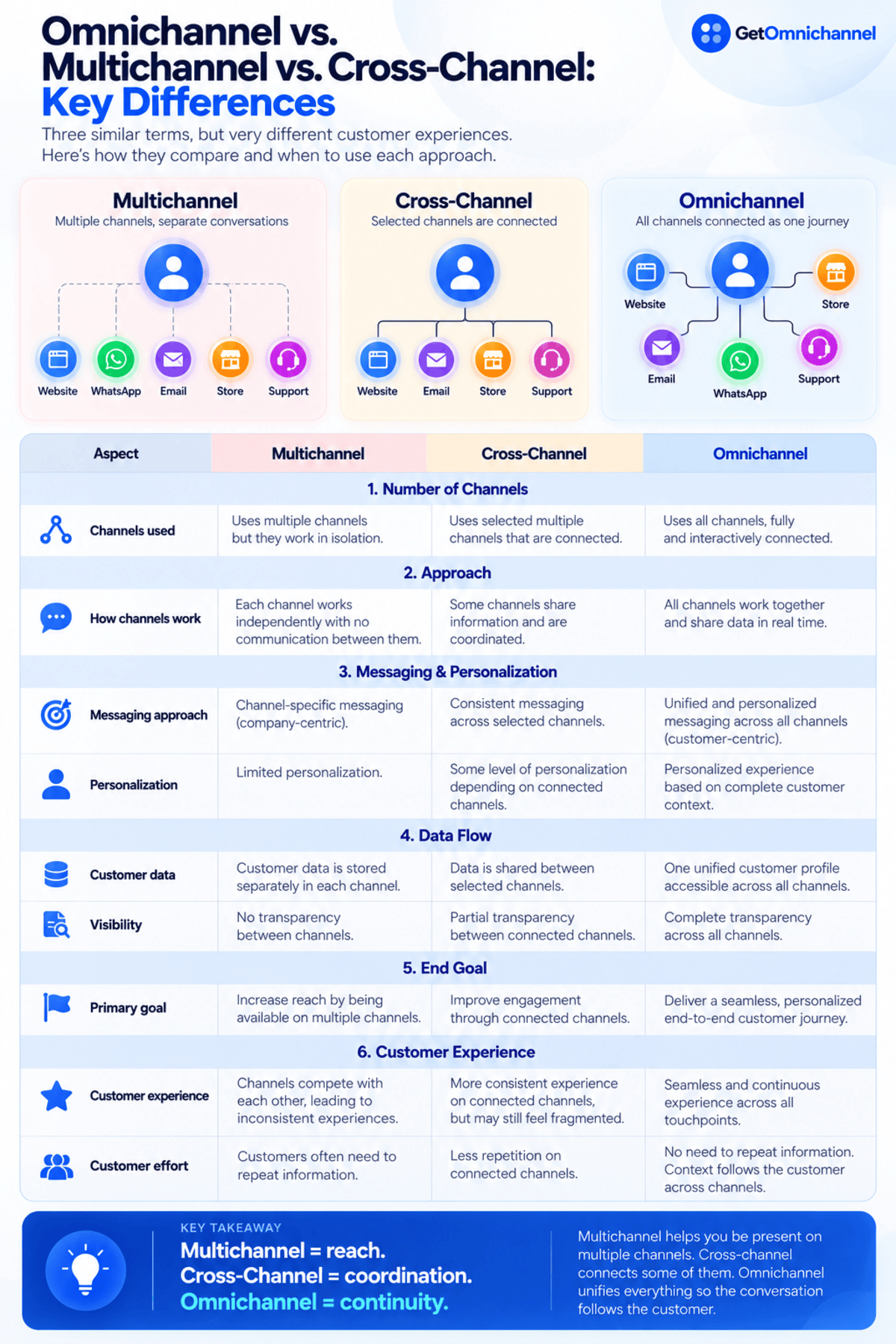
You may also see the term cross-channel. It sits between the two: some channels are connected and share information, but not all of them, so the experience still breaks wherever a channel is left out. The infographic below compares all three.
Channel integration
Multichannel: each channel is set up and managed separately, often in different tools. Omnichannel: channels plug into one platform or a shared data layer, so a message on any channel lands in the same place.
What to check: Can one agent answer chat, email, and WhatsApp from a single screen without switching tools?
Customer data
Multichannel: customer details are scattered, with duplicates across tools. Omnichannel: one profile holds contact details, purchase or account data, and preferences, and every channel reads it.
What to check: When a known customer messages from a new channel, are they matched to their existing profile automatically?
Conversation history
Multichannel: history lives inside each channel, so an agent sees only part of the story. Omnichannel: one timeline shows every earlier interaction, whatever the channel.
What to check: Does the agent see one ordered timeline, or separate tabs per channel? Tabs per channel are still multichannel.
Customer journey
Multichannel: each channel is its own journey with its own start and end. Omnichannel: the journey is designed across channels, for example starting on chat, moving to a call, and closing with an SMS confirmation.
What to check: Can a conversation move from chat to a phone call and stay one case, or does it become two tickets?
Agent workflow
Multichannel: agents switch between tools, copy notes by hand, and ask customers to repeat themselves. Omnichannel: agents work from one workspace, and transfers between people or teams carry the full context with them.
What to check: Count how many tools an agent opens to resolve one cross-channel issue. More than one is a sign of a multichannel workflow.
Personalization
Multichannel: personalization is limited to what each channel knows, so an email campaign may not know about yesterday's complaint. Omnichannel: messages and replies can draw on the full relationship, such as recent orders, open issues, and preferred channel.
What to check: Can you stop a promotional message going to a customer who has an open complaint on another channel?
Reporting
Multichannel: reports show channel metrics such as email response time or call volume, but not what happened between channels. Omnichannel: reporting can follow a customer or an issue across channels, which shows repeat contacts and where handoffs break.
What to check: Can you see how many customers contacted you on a second channel about the same issue?
Automation
Multichannel: chatbots, auto-replies, and routing rules are set up per channel and only know that channel's data. Omnichannel: automation can use the full history, for example sending a returning customer to the agent who handled their last case, or giving a bot the context of an earlier email.
What to check: Do routing rules and AI features use history from other channels, or only the current conversation?
Omnichannel vs multichannel examples
The same customer, the same channels, two very different experiences. The channels never change between the two versions. Only the connection between them does.
Retail: buying a jacket
A customer looks at a jacket on a retailer’s website, asks on WhatsApp whether their size is in stock at a nearby store, buys it in the store, and later contacts support to exchange it.
The WhatsApp agent can see which jacket the customer viewed. The store already has the item set aside from the WhatsApp chat. When the customer asks support for an exchange, the agent sees the in-store purchase and the earlier chat, and can offer a different size without asking for a receipt number.
Every channel works, but none of them knows about the others. The WhatsApp agent asks which product the customer means. The store has no record of the WhatsApp request. Support asks for an order number the customer never received, because the sale happened at the till.
B2B software support: a billing problem
A customer at a software company emails about a failed payment, then opens live chat in the app a day later, and finally calls when the account is about to be suspended.
Multichannel: the email sits in the billing queue, the chat goes to a support agent who can’t see the email, and the phone agent starts from zero. The customer explains the problem three times, and two teams may work on it at once without knowing.
Omnichannel: the chat agent sees the open email case and adds to it rather than opening a new one. The phone agent sees both, knows exactly where the issue stands, and resolves it on the call.
Appointment-based services: rescheduling a visit
A patient or client books online, gets an SMS reminder, replies to that SMS to ask about rescheduling, and then calls the front desk.
Multichannel: the SMS reply goes to an inbox nobody at the front desk checks, so the caller has to explain the request again, and may get two different answers.
Omnichannel: the SMS reply appears on the client’s record, and the receptionist who picks up the phone can see it and confirm the new time straight away.
Is omnichannel better than multichannel?
Not automatically. Omnichannel costs more to set up and run, and it only pays off when customers actually move between channels. For some businesses, a well-run multichannel setup is the right answer. The better question is: how often does the same customer contact you on more than one channel about the same thing?
- Most contacts are one-off questions that end on the first channel.
- Each channel serves a different audience or purpose, such as social for marketing and phone for orders.
- Your team is small enough that one or two people handle every channel and already know your customers.
- Your volume is low and a missed handoff is rare and easy to fix by hand.
- Budget or setup time is tight and you're still learning which channels customers use.
- Customers often follow up on a different channel than the one they started on.
- Several agents or teams share the same customers, so handoffs happen every day.
- You have long relationships, such as subscriptions, accounts, or repeat orders, where history matters.
- Customers often complain about repeating themselves, or you see duplicate tickets for the same issue.
- You need a complete record of every interaction for quality, training, or compliance reviews.
A simple rule: if agents regularly need to ask “Have you contacted us about this before?”, and the honest answer is in another tool, you have outgrown multichannel.
You also don’t have to switch all at once. Many teams start by connecting their two highest-volume channels, often email and live chat, into one shared inbox with one customer record. Then they add phone, SMS, WhatsApp, and social once that first connection is working. That way, the change is driven by where customers actually overlap, not by how many channels a platform advertises.
Multichannel is about being reachable. Omnichannel is about being consistent once you're reached. If your customers rarely cross channels, keep it simple. If they do, every disconnected handoff is a cost you're already paying.
What should businesses look for in an omnichannel platform?
If you’ve decided you need omnichannel, the software you choose decides whether you actually get it. Many tools list a lot of channels but still show them in separate tabs. Use these checks in every demo.
One customer timeline, not a tabbed inbox
Ask the vendor to show one customer who has contacted them on chat, email, and phone. If those contacts appear as one ordered timeline, that's omnichannel. If they appear as three tabs or three tickets, it's multichannel with a shared login.
The channels you need, on the plan you'd buy
Voice, WhatsApp, and social channels are often add-ons or only included on higher plans. Check channel availability against the exact plan you'd buy, not the platform as a whole.
Continuity when a customer switches channel
Test it: start a conversation on chat, continue it by email, and check whether it stays one case with one history, or splits into two.
Routing that uses history
Basic routing assigns by availability. Better routing can send a returning customer to the same agent or team, or prioritise a customer who already contacted you about the same issue on another channel.
Two-way CRM and data sync
Customer context only stays complete if support data flows back into your CRM and order systems. Check whether the sync works both ways natively or needs a paid integration tool in the middle.
Reporting across channels
Look for reports on repeat contacts, channel switches, and resolution across channels, not just separate response times for each channel.
Clear pricing for usage-based channels
WhatsApp and SMS often carry per-message or per-conversation charges on top of the seat price, and some AI features are billed per resolution. Ask for the full monthly cost at your expected volume before you sign.
We apply these same tests, along with pricing and plan comparisons, in our ranking of the best omnichannel communication platforms. Use it to shortlist tools that pass the timeline and continuity checks before you book demos.
How this guide was made
This guide explains general concepts and does not rank or score specific products. It draws on the same evaluation criteria we use in our omnichannel platform comparisons, and statistics are taken from published Gartner and Zendesk research, linked at each figure (checked October 2026).
The difference isn't how many channels you run. It's whether they share one customer and one conversation. Count how often your customers cross channels this month; that number tells you which approach you need.
Frequently asked questions
The bottom line: reach vs continuity
The difference between omnichannel and multichannel is not the number of channels. It’s whether those channels share one customer and one conversation. Multichannel gives customers more ways to reach you. Omnichannel makes sure that, whichever way they choose, you already know who they are and what they need.
Start by checking how often your customers cross channels. If it’s rare, keep your multichannel setup and run it well. If it’s common, connect your busiest channels first, then compare tools using the checklist above.
Next step: See how leading platforms compare on unified timelines, channel coverage, and real pricing in our guide to the best omnichannel communication platforms.
 Your information is encrypted and kept secure.