

Live Chat Scripts: 40 Canned Response Templates for Support Teams

Live Chat Scripts: 40 Canned Response Templates for Support Teams

A live chat script is a pre-written reply that agents insert into a chat and adjust before sending. Chat tools call these canned responses, macros, or snippets. Good scripts cover the moments that repeat in every chat, such as greetings, holds, transfers, and closing, and leave a gap for the part only a person can answer.

Below are 40 templates grouped by the stage of the chat where you need them. Words in [brackets] are the parts to fill in. After the templates, you’ll find how to save them as shortcuts in six common chat tools, and how to stop a script library from going out of date. For tone and style rules for every reply, see our guide to live chat support.

Key takeaway
Script the frame, write the middle

Save replies for greetings, holds, transfers, policies, and closing. Write the answer to the customer's actual problem yourself.

Compare live chat tools →

What is a live chat script?

A live chat script is a saved message an agent can insert with a shortcut instead of typing it each time. It keeps answers consistent and fast, but the agent still edits it to fit the question. UK government guidance describes scripted responses as a way to help advisors “deliver consistent advice to users” while leaving “the option to tailor their responses” (GOV.UK).

The terms overlap, and each vendor uses its own:

  • Script. The general term for planned wording, whether it lives in a document, a training guide, or the chat tool.
  • Canned response. A saved message you insert into the reply box. LiveChat and Freshchat use this name.
  • Macro. A saved reply that can also take actions, such as tagging or assigning the conversation. Intercom, Zendesk, and Tidio use this name.
  • Snippet. HubSpot’s name for a reusable block of text.

The rest of this guide uses “script” for the wording and “canned response” for the saved version in your tool.

When should you use a chat script?

Use a script when the wording should be the same every time: greetings, holds, transfers, policies, and closing. Write freely when the customer is upset, the problem is unusual, or the answer depends on details only you can see. Scripts handle the frame of a chat, and you write the middle.
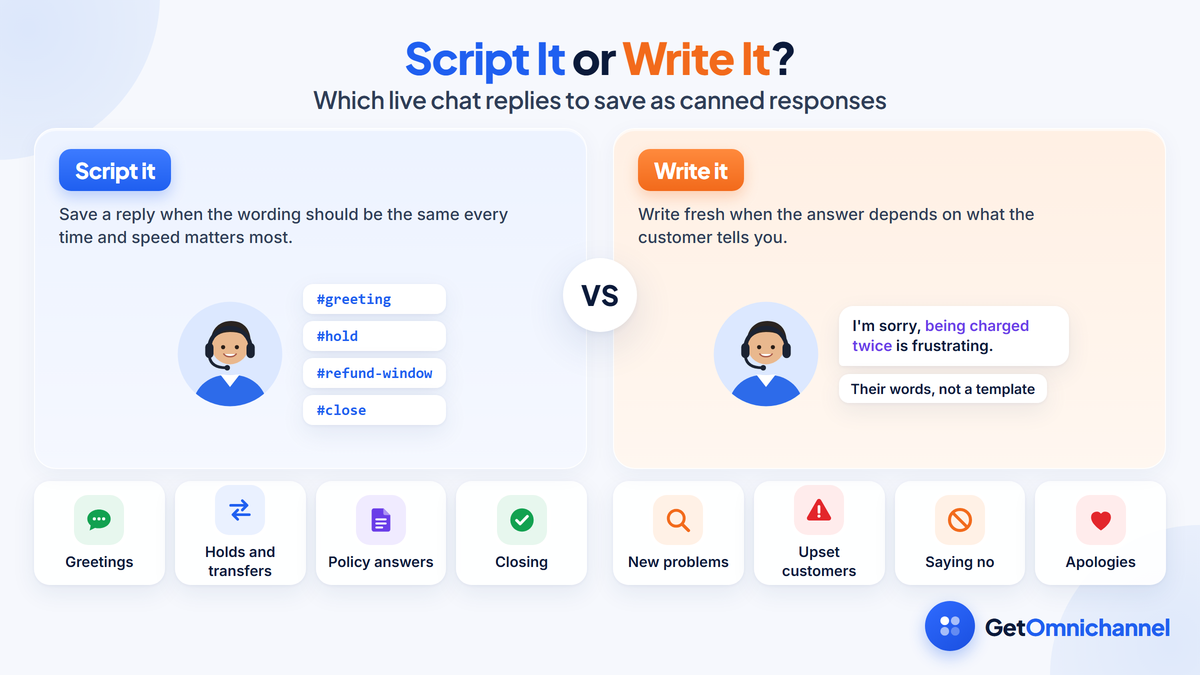
Script it or write it: save a canned response when the wording should be the same every time, such as greetings, holds and transfers, policy answers, and closing, inserted with shortcuts like #greeting, #hold, #refund-window, and #close; write fresh when the answer depends on what the customer tells you, such as new problems, upset customers, saying no, and apologies that repeat the customer's own words.
Save the replies that never change. Write the ones that depend on what the customer just said.

Script it or write it? A starting rule; adjust it to your team
Swipe to see all columns →
Moment in the chatUse a script?Why
Greeting, hold, transfer, closingYesSame purpose every time; speed matters most
Policy answers: returns, shipping, billing datesYes, from the policy pageWording must match what you've published
How-to stepsYes, with a help article linkSteps are fixed; the link keeps the reply short
Saying no, apologisingUse the structure, write the wordsA pasted apology reads as no apology
Troubleshooting a new problemNoThe answer depends on what the customer tells you
An angry or upset customerNo, beyond the opening lineThey will notice wording that doesn't match their words

How do you write a canned response that doesn’t sound canned?

Lead with the answer, keep it to two or three short sentences, give one next step, and build in a slot the agent must fill, such as the customer’s name or order detail. A reply that responds to the customer’s own words doesn’t read as canned, even if most of it was saved.
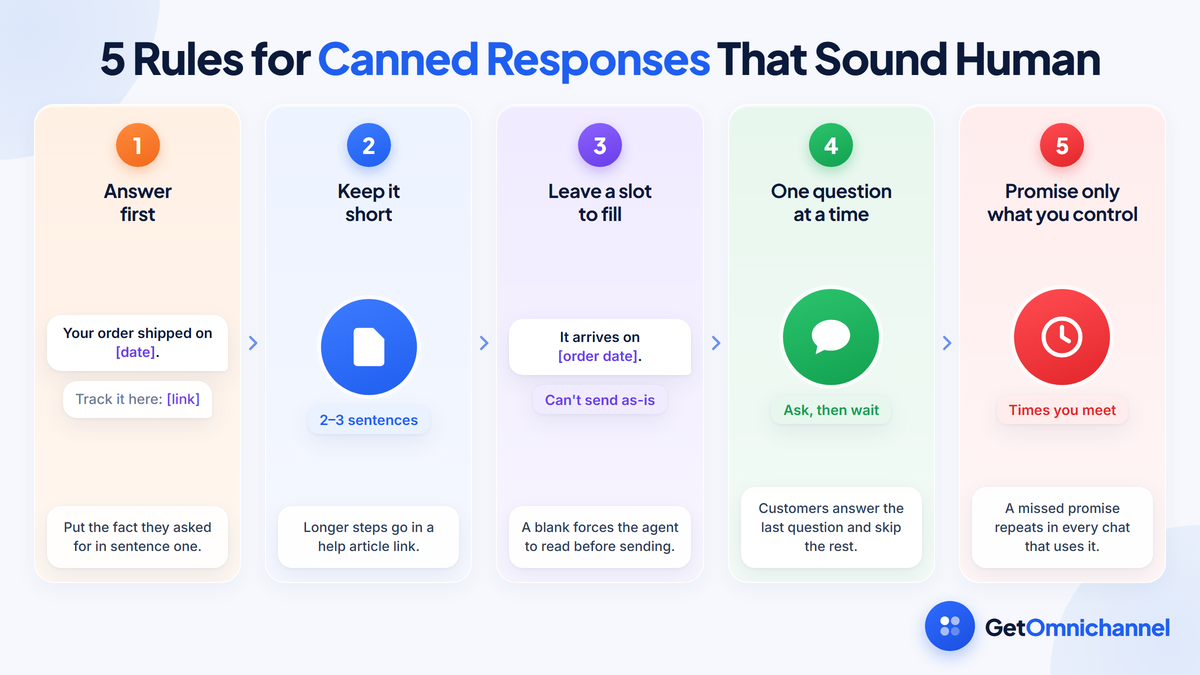
Five rules for canned responses that sound human: 1, answer first, putting the fact the customer asked for in sentence one; 2, keep it short, two to three sentences, with longer steps in a help article link; 3, leave a slot to fill, such as [order date], so the reply can't be sent as-is; 4, ask one question at a time, then wait; 5, promise only what you control, using times your team meets.
A bracketed slot is the simplest guard against sending the wrong saved reply.

1

Answer first

Put the fact the customer asked for in the first sentence. Context and policy come after, if at all.

2

Keep it short enough for a chat window

GOV.UK's guidance for webchat and chatbots recommends "keeping text simple, concise and easy to follow." If a reply needs more than three sentences, send the steps as a link to a help article.

3

Leave a slot that forces an edit

A bracketed field such as [order date] can't be sent as-is, so the agent has to read the reply before sending it. That one check catches most mismatched answers.

4

Ask one question at a time

Customers tend to answer the last question in a message and skip the rest. One question, then wait.

5

Promise only what you control

"Within 2 business days" belongs in a script only if your team meets it. A missed promise in a saved reply is repeated in every chat that uses it.

40 live chat scripts by stage of the conversation

These templates follow a chat from start to finish. Each one has a fill-in slot and a short note on when to use it. Copy them into your tool, then rewrite the wording to match your brand’s voice and your actual policies.
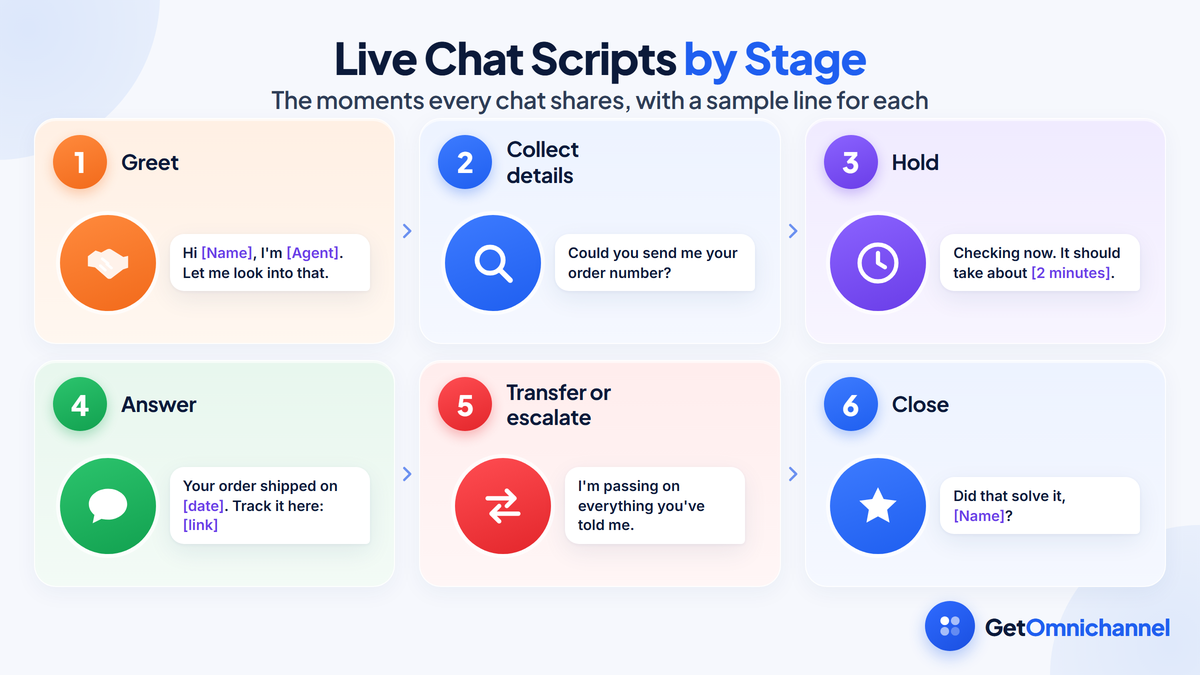
Live chat scripts by stage, with a sample line for each: 1, greet: Hi [Name], I'm [Agent]. Let me look into that; 2, collect details: Could you send me your order number?; 3, hold: Checking now. It should take about [2 minutes]; 4, answer: Your order shipped on [date]. Track it here: [link]; 5, transfer or escalate: I'm passing on everything you've told me; 6, close: Did that solve it, [Name]?
Six moments repeat in almost every chat. Those are the ones worth scripting first.

Greetings

Opening the chatTemplates 1–5
01Reply to a new chat
Hi [Name], I'm [Agent] from [Company]. Thanks for getting in touch. Let me look into that for you now.
Use when the customer's first message already says what they need.
02When the question is unclear
Hi [Name], thanks for reaching out. So I can point you to the right place, is this about an existing order or something new?
Use when the first message is just "hi" or "help". Offer two choices, not an open question.
03Proactive: pricing page
Hi there. Comparing plans? Tell me how many people will use [Product] and I'll tell you which plan fits.
Use as an automatic message on the pricing page. Ask for one detail you can act on.
04Proactive: checkout
Hi. If anything is holding up your order, like delivery dates or shipping costs, I can answer it here.
Name the two or three questions that stop people at your checkout. Check your chat history to find them.
05Returning customer
Welcome back, [Name]. I can see we last spoke about [topic]. Is this about the same thing, or something new?
Use only when the earlier chat is visible to you. Customers dislike repeating themselves.

Collecting details

Getting what you need to helpTemplates 6–9
06Order number
Could you send me your order number? It starts with [#] and is in your confirmation email from [sender address].
Tell the customer where to find it. That saves a second round of questions.
07Account check
Before I make changes to the account, I need to confirm it's yours. Could you tell me the email address on the account?
Follow your own verification policy. Explain why you're asking so it doesn't feel like suspicion.
08Security reminder
Please don't send your password or full card number in this chat. We'll never ask for them here.
Send it the moment a customer starts typing sensitive details, then remove them from the transcript if your tool allows.
09Screenshot
Could you send a screenshot of what you're seeing? You can attach it with the [paperclip] icon next to the message box.
Name the actual icon in your widget. A screenshot often replaces three or four questions.

Holding and waiting

Keeping the customer informedTemplates 10–13
10Short hold
Thanks, [Name]. I'm checking this with our [team] now. It should take about [2 minutes].
Always give a time. "One moment" with no estimate is when customers leave.
11Hold update
Still on it, [Name]. I'm waiting on [system or team] and will update you again in [2 minutes].
Send it before the time you promised runs out, not after.
12Longer than expected
This is taking longer than I expected. I can stay on chat with you, or email the answer to [email] by [time]. Which would you prefer?
Let the customer choose. Nobody wants to watch a chat window for ten minutes.
13Queue message
All our agents are helping other customers right now. You're number [X] in line, and someone will reply here as soon as they're free. Prefer email? Leave your address and we'll reply there.
Use as an automatic message. Show queue position only if your tool reports it accurately.

Why hold scripts matter

LiveChat reports that queued customers wait 4 minutes 18 seconds on average, and 27.4% leave before an agent replies (LiveChat Customer Service Report, data last updated 2024). A clear wait time and an email option give those customers a reason to stay or a way to be helped later.

Transfers and escalation

Passing the chat onTemplates 14–16
14Transfer to another team
Our [billing] team is best placed to sort this out. I'm transferring you to [Agent] now and passing on everything you've told me, so you won't need to repeat it.
Add an internal note with the summary before you transfer, so the promise is true.
15Escalate to a ticket
I've opened a ticket, [#12345], for our [technical] team. They'll email you at [email] within [timeframe]. You can reply to that email with any updates.
Give the reference number, the channel, and the time. All three.
16Taking over from a chatbot
Hi [Name], I'm [Agent]. I've read your conversation with our assistant, so you don't need to repeat anything. Let's pick up from [topic].
Read the bot transcript first. See chatbot vs live chat for when a bot should hand over.

Common questions

Answers you give every dayTemplates 17–22
17Order status
Your order [#] shipped on [date] with [carrier]. You can track it here: [link]. It's due to arrive on [date].
Answer first, link second. No greeting needed if you've already said hello.
18Delivery delay
I'm sorry, your order is running late. [Carrier] now shows it arriving on [date]. If it hasn't arrived by [date], reply here and I'll [send a replacement or refund it].
Give a fallback date and a clear remedy. Only offer remedies your policy allows.
19Returns
You can return it within [X] days of delivery. Start the return here: [link]. Once we receive it, your refund takes [X] business days.
Copy the numbers from your published returns page, and update this reply when that page changes.
20Password reset
You can reset your password here: [link]. The email comes from [sender address] and the link works for [X minutes]. If you don't see it, check your spam folder.
Naming the sender address answers the follow-up question before it's asked.
21Pricing question
Our [Plan] costs [price] per [user] per month, billed [annually or monthly]. Here's the full comparison: [link]. How many people on your team would use it?
End with a question that moves the sale forward.
22Feature you don't have
[Product] doesn't support [feature] right now. Some customers use [workaround] instead. I can also pass your request to our product team. Would you like me to?
Be direct about the "no". Offer a workaround only if it really works.

Saying no and handling complaints

Hard conversationsTemplates 23–27
23Request outside policy
I've checked, and this order is outside our [30]-day return window, so I can't refund it. What I can do is [store credit, repair, or other option]. Would that help?
State the reason once, then move to what you can do.
24Can't do what they asked
I understand why you'd want that. I can't [action] because [one-line reason]. Here's what I can do instead: [alternative].
Use this as a structure, and write the reason in your own words each time.
25Acknowledge a complaint
I'm sorry, [Name]. [Being charged twice] is frustrating, and I'm going to fix it now.
Repeat their problem in their words in the slot. A general "sorry for any inconvenience" reads as a script.
26Take ownership
That was our mistake, not yours. Here's what I'm doing: [step 1], then [step 2]. You'll see [result] by [date].
Use only when it really was your mistake. List concrete steps and a date.
27Asked for a manager
Of course. I'm bringing in [Manager], who can [authority they have]. I'll pass on everything we've covered so they can pick up straight away.
Don't argue or delay. Say what the manager can do that you can't.

Sales and pre-sales

Helping someone decideTemplates 28–30
28Find the need
Happy to help you choose. What's the main thing you want [Product] to do for your team?
One open question. The answer tells you which plan or feature to talk about.
29Offer a demo
From what you've described, a short demo would answer most of this. You can pick a time here: [booking link].
Offer it after you understand the need, not as the first reply.
30Discount request
We don't have a discount code running right now. Annual billing works out at [X%] less than paying monthly. Want me to show you the difference for your team?
Only mention savings your pricing page actually shows.

Technical support

TroubleshootingTemplates 31–32
31Step-by-step fix
Let's try this: 1. [Step one]. 2. [Step two]. Tell me what you see after step 2.
Two steps per message, then check in. Longer lists get skimmed.
32Confirmed bug
Thanks for the detail. I can reproduce this, so it's a problem on our side. I've reported it as [#ID] and will email you at [email] when it's fixed. Until then, [workaround].
Say "on our side" only once you've confirmed it.

Offline and after hours

When no one is availableTemplates 33–34
33Outside opening hours
We're offline right now. Our team is back at [time and time zone]. Leave your question and email below, and we'll reply by [time].
Give a reply time you'll meet. "As soon as possible" tells the customer nothing.
34Holiday closure
Our chat is closed for [holiday] until [date]. To track an order, use [link]. For anything else, leave a message and we'll reply when we're back.
Point to self-service for the questions you get most.

Idle customers

When the customer goes quietTemplates 35–36
35First nudge
Are you still there, [Name]? No rush. I'll keep this chat open for a few more minutes.
Customers often step away to find an order number or check an email.
36Closing an idle chat
I haven't heard back, so I'll close this chat for now. If you still need help, start a new chat and mention [topic or reference], and we'll pick it up from there.
Give them something to quote so the next agent can find the history.

Closing the chat

Ending wellTemplates 37–40
37Check it worked
Did that solve it, [Name]?
Ask this before any "anything else?" question. Confirm the fix first.
38Friendly close
Glad that's sorted. If anything else comes up, we're here [hours]. Have a good [day or evening].
Keep it short. The customer already has what they came for.
39Ask for a rating
Before you go, could you rate this chat? It takes one click and helps us improve.
Send it only after the problem is solved, not after a "no" you couldn't change.
40Promised follow-up
I'll email you at [email] by [date] with [what you'll send]. Your reference is [#]. Thanks for your patience, [Name].
Set a reminder for yourself in the same minute you send this.

How to save scripts as shortcuts in your chat tool

Most chat tools let agents insert a saved reply by typing a trigger character, usually # or /, followed by a shortcut name. Personalisation variables, such as the customer’s first name, work differently in each tool, so test them in a real chat before you rely on them.

Canned responses in six chat tools From each vendor's help documentation, checked November 2026
Swipe to see all columns →
ToolCalledInsert withPersonalisation and limits
LiveChatCanned responses# + shortcut, e.g. #thanksVariables such as %customer-name% and %agent-name%. Available on Team, Business, and Enterprise plans.
IntercomMacros\, or # + a word from the macro nameFill-in fields; actions such as tagging run when you send
ZendeskMacros and chat shortcuts/ in the composer (Agent Workspace)Placeholders such as {{ticket.requester.first_name}}
FreshchatCanned responses/ + shortcodePlaceholders with fallback text if a value is missing
HubSpotSnippets# + shortcut3 snippets on free accounts, up to 5,000 on paid; 2,500 characters each
TidioMacros/ + name; # filters by labelSee Tidio's help center for current options

Sources: LiveChat, Intercom, Zendesk, Freshchat, HubSpot, and Tidio, checked November 2026.

Three things to check before you rely on variables

  • Where the data comes from. LiveChat fills customer details from pre-chat forms or other data you collect, so if a visitor skipped the form, there’s no name to insert.
  • Where the variable works. HubSpot says personalisation tokens in snippets “will only populate when you use the snippet on the Email tab” of a record. In a live chat, write the name yourself.
  • What shows when it’s empty. Freshchat lets you set fallback text for a placeholder. Where your tool doesn’t, write templates that still read well without the name.

Name shortcuts so agents can guess them

Use one pattern for every shortcut, topic first and then the action, such as refund-window, refund-start, ship-delay, and ship-track. In Intercom, macro search matches the title, so put the topic word in the macro title too. Agents should find the right reply by typing the first word they think of.

How to keep a canned response library accurate

Give each group of replies an owner, link every policy reply to the page it comes from, and review the library whenever a policy or price changes. Track which replies get used and remove the ones nobody uses. A stale canned response repeats the same wrong answer in every chat.

1

Start with your most common questions

Pull the last month of chat transcripts and list the questions that come up most often. Script those first, then add new replies only when a question keeps repeating.

2

Separate shared and personal replies

LiveChat, Freshchat, and Intercom all let agents keep private replies alongside the team's shared ones. Keep policy answers shared and owned by a lead, and let agents keep personal replies for their own phrasing.

3

Tie policy replies to their source

Put the help article or policy URL in each reply that quotes a number, such as return windows, refund times, or prices. When that page changes, search the library for the URL and update every reply that uses it.

4

Measure usage

LiveChat can tag a chat automatically when a canned response is used. It applies the tags even if the agent edited the reply, as long as at least 10% of the original text remains. Usage counts like these show which replies earn their place.

5

Review every quarter

Delete replies nobody used, merge near-duplicates, and read a sample of chats where scripts were sent to see whether customers had to ask again.

Share answers with your bot

If you also run a chatbot, it should answer from the same approved wording as your agents. Two versions of the returns policy, one in the bot and one in the canned responses, will eventually disagree, and customers will see both.

Common live chat script mistakes

The most common mistakes are sending a reply that doesn’t match the question, leaving a placeholder unfilled, stacking several canned messages in a row, and keeping replies after the policy behind them has changed.

  • Answering the wrong question. A saved reply that covers half of what the customer asked reads as a bot, even when a person sent it.
  • Unfilled placeholders. “Hi [Name]” or an empty variable tells the customer exactly how the reply was made. Bracketed slots that block sending are safer than silent variables.
  • Message stacking. Three canned replies in a row push the customer’s question out of view in a small chat window. Combine them or cut two.
  • Out-of-date numbers. Prices, return windows, and delivery times change. A reply that still says the old number creates a dispute you’ll have to honour or argue about.
  • Over-scripted apologies. “We apologise for any inconvenience caused” is a stock phrase that names no problem at all. Name the actual problem instead.

📝

How this guide was made

Researched and written by Kinjal Trivedi, SaaS & Technology Writer at GetOmnichannel. Tool details come from each vendor's help documentation (LiveChat, Intercom, Zendesk, Freshchat, HubSpot, and Tidio), queue benchmarks from LiveChat's Customer Service Report (data last updated 2024), and guidance on scripted replies from GOV.UK, all linked at each claim and checked in November 2026. The 40 templates, the script-or-write table, and the library process are editorial guidance written for this page, not wording taken from any vendor.

Bottom line

Script the parts of a chat that never change, such as greetings, holds, transfers, policies, and closing, and write the rest yourself. Build a slot into every template that forces an edit, save the replies under shortcuts agents can guess, and review them whenever a policy changes. A good script saves typing, not thinking.

Frequently asked questions

A live chat script is a pre-written reply that an agent inserts into a chat, usually with a keyboard shortcut, and edits before sending. Scripts keep common answers such as greetings, policies, and closing lines fast and consistent. Chat tools call them canned responses, macros, or snippets.
A canned response inserts saved text into the reply box. A macro can insert text and also take actions on the conversation, such as adding a tag, assigning it, or closing it. Intercom and Zendesk macros, for example, can change the conversation as well as fill in the reply.
They do when they're sent unedited or don't match the question. Keep templates to two or three short sentences, lead with the answer, and include a slot the agent must fill, such as the order date or the customer's own words. That forces a read-through before each send.
Start with the questions you answer most often, found in your last month of chat transcripts, plus the stages every chat shares: greeting, hold, transfer, and closing. Add new replies only when a question keeps repeating, and delete replies nobody uses at each quarterly review.
Use your tool's variable or placeholder, such as %customer-name% in LiveChat or {{ticket.requester.first_name}} in Zendesk. Check where the name comes from and what shows if it's missing. HubSpot, for example, says snippet tokens only fill in on a record's Email tab, not in chat.
Its answers should come from the same approved wording, especially for policies and prices. If the bot and your agents describe the returns policy differently, customers who see both will notice. Keep one source for each answer and update both when it changes.

Conclusion: script the frame, write the middle

Live chat scripts work best for the parts of a conversation that repeat in every chat: opening, waiting, transferring, explaining a policy, and closing. They make those parts faster and more consistent, and leave agents free to spend their attention on the part that’s different every time.

Start with the templates above, rewrite them in your own voice, and save them under shortcuts that follow one naming pattern. Then treat the library like any other help content, with an owner, a source for every number, and a regular review.

Next step: Compare chat tools by how well they handle canned responses, shortcuts, and handoffs in our guide to the best live chat software.

Related guides & comparisons