

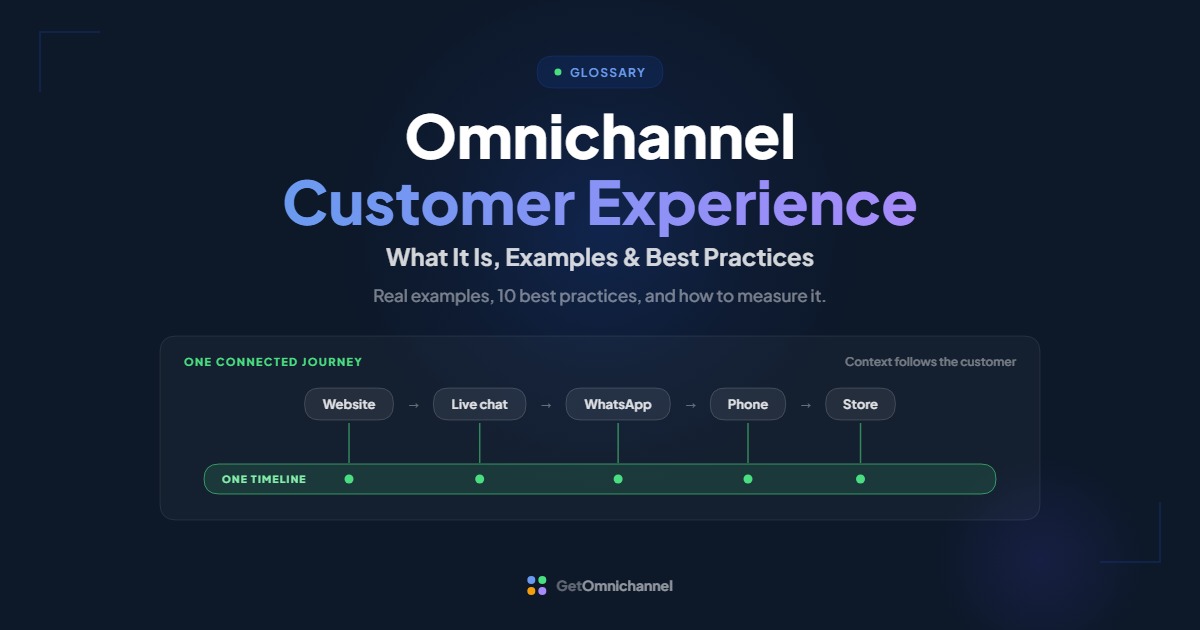
Omnichannel customer experience is a connected experience across every channel a customer uses, from website and live chat to email, phone, WhatsApp, and in-store, where the business recognizes the customer and keeps the full context of their journey, so they never have to start over when they switch channels.
Most businesses already offer several channels. The experience customers remember is what happens between them: whether the agent on the phone knows about yesterday’s chat, whether the store sees the online order, whether the follow-up email matches what support promised. This guide explains what omnichannel customer experience means, shows how real companies deliver it, and gives you 10 best practices to build one, including how to measure whether it’s working.
A great omnichannel customer experience lets people move between channels without repeating themselves, because every channel shares the same customer and the same history.
Compare platforms →What is omnichannel customer experience?
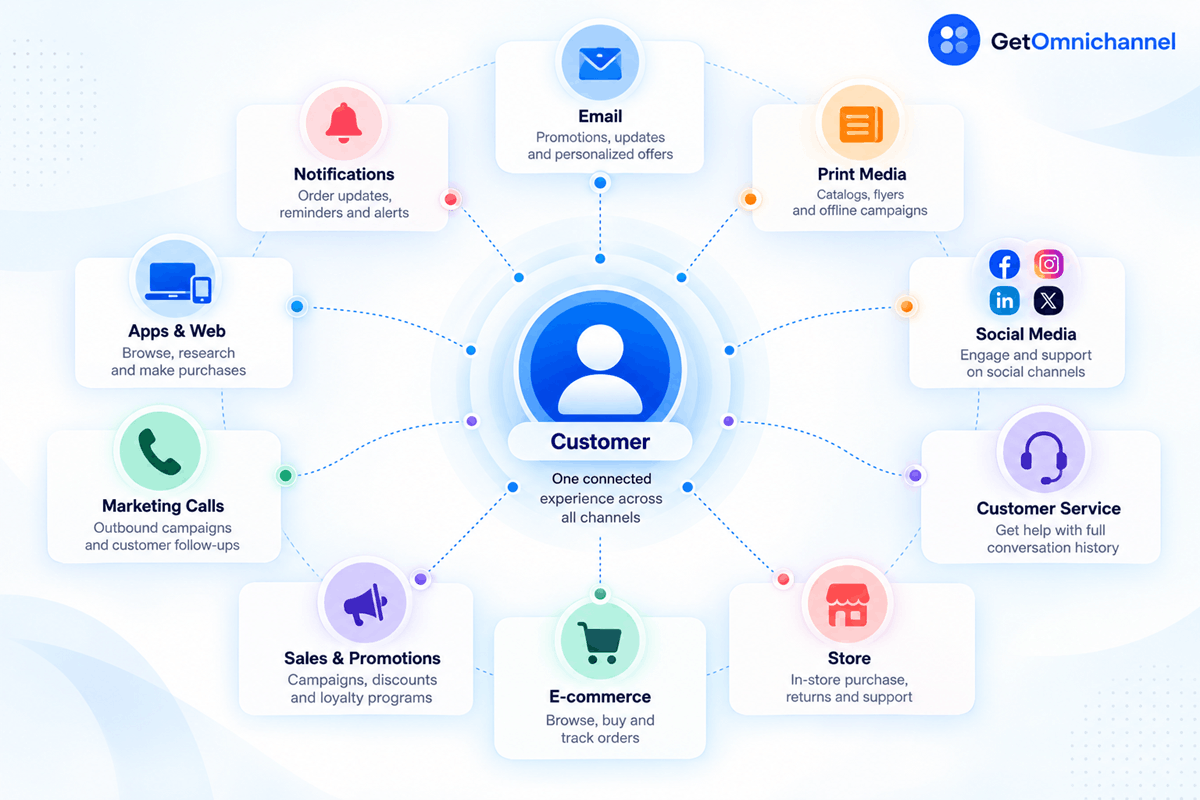
Omnichannel customer experience (omnichannel CX) is the total experience a customer has with your business across all channels, designed as one continuous journey rather than a set of separate touchpoints. The customer can start on one channel, continue on another, and finish on a third, and every step builds on the last.
It rests on one idea: the journey belongs to the customer, not to the channel. For a deeper explanation of the underlying concept, see our guide to what omnichannel means.
The term is often mixed up with two related ones:
| Omnichannel customer experience | Omnichannel customer service | Omnichannel marketing | |
|---|---|---|---|
| Scope | Every interaction, before and after purchase | Support and issue resolution | Campaigns, promotions, and acquisition |
| Main owner | CX leadership, shared across teams | Support or contact center | Marketing |
| Main question | Is the whole journey easy and consistent? | Can we resolve issues without the customer repeating themselves? | Is the message consistent and relevant on every channel? |
| Typical metrics | Customer effort, retention, NPS | First-contact resolution, repeat contacts, CSAT | Engagement, conversion, campaign ROI |
Omnichannel customer service and marketing are parts of the customer experience. When each team connects only its own channels, the customer still feels the gaps between teams.
Omnichannel vs multichannel customer experience
A multichannel experience offers several channels that work independently. An omnichannel experience connects them, so customer context moves with the customer. Both can look the same from the outside: the same website, the same phone number, the same chat widget. The difference shows up the second time a customer gets in touch. We compare the two side by side, with examples, in omnichannel vs multichannel: what’s the difference.
Why omnichannel customer experience matters
Customers judge the experience as a whole, and their expectations are rising faster than most channel setups:
- 71% of consumers expect companies to deliver personalized interactions, and 76% get frustrated when that doesn't happen. Companies that grow faster drive 40% more of their revenue from personalization than slower-growing peers. Source: McKinsey, Next in Personalization 2021.
- 85% of CX leaders say customers will drop brands that can't resolve issues on first contact. Source: Zendesk CX Trends 2026, based on more than 11,000 consumers and business leaders across 22 countries.
- 76% of consumers would choose a company that lets them use text, voice, and visuals in one conversation. Source: Zendesk CX Trends 2026.
Personalization and first-contact resolution both depend on the same thing: knowing what already happened with this customer, on any channel. That’s what an omnichannel customer experience provides, and what a disconnected one can’t.
Benefits of an omnichannel customer experience
- Less customer effort. Customers explain their issue once, which removes one of the most common frustrations in customer service: having to repeat themselves.
- Faster resolution. Agents start with the full history instead of rebuilding it, so more issues are resolved on the first contact.
- Personalization that’s actually relevant. Offers, replies, and recommendations can reflect recent orders, open issues, and preferences, not just the data one channel happens to hold.
- More productive agents. One workspace and one timeline mean fewer tools, fewer copy-pasted notes, and less time searching.
- Better insight. When every interaction lives in one record, you can see where journeys break, not just how each channel performs on its own.
- Stronger retention. Customers stay with companies that feel easy to deal with, and an experience that remembers them is easier by design.
Be realistic about the trade-off: these benefits grow with how often your customers cross channels. A business where most contacts start and end in one place will see smaller gains.
The 5 building blocks of a great omnichannel customer experience
From the customer’s side, a connected experience comes down to five things working together:
One customer identity
Email address, phone number, chat session, and social or WhatsApp handle are recognized as the same person.
One shared history
Every interaction appears on a single timeline that any team can see.
Smart handoffs
When a conversation moves to another channel, team, or a human agent, the context moves with it.
Consistent answers
Every channel draws on the same knowledge base, policies, and offers, so the answer doesn't depend on where the customer asked.
A feedback loop
Customer feedback and journey data are collected across channels and used to fix the points where journeys break.
Omnichannel customer experience examples
Here are three examples of omnichannel customer experience: one in banking, one in retail, and one from a B2B support team. Each one ends with a lesson you can apply to your own setup.
Bank of America: digital and AI as part of one relationship
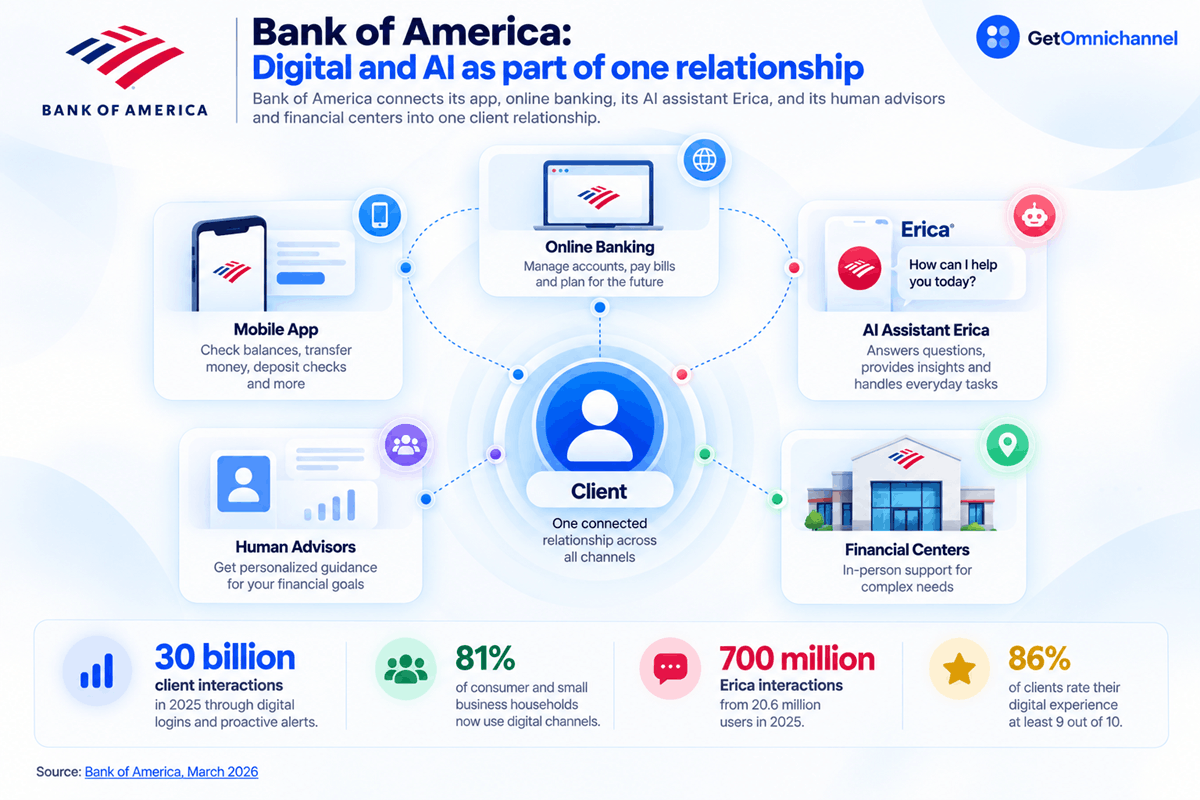
Bank of America connects its app, online banking, its AI assistant Erica, and its human advisors and financial centers into one client relationship. According to the bank, clients connected with their finances about 30 billion times in 2025 through digital logins and proactive alerts, and 81% of consumer and small business households now use its digital channels. Erica alone handled nearly 700 million interactions from 20.6 million users in 2025, and 86% of clients rate their digital experience at least 9 out of 10. Source: Bank of America, March 2026.
What you can learn: Proactive messages are part of the experience, not just replies. Alerts and AI help resolve routine needs early, so human advisors spend their time on the conversations that need them.
Target: stores and digital as one fulfillment network
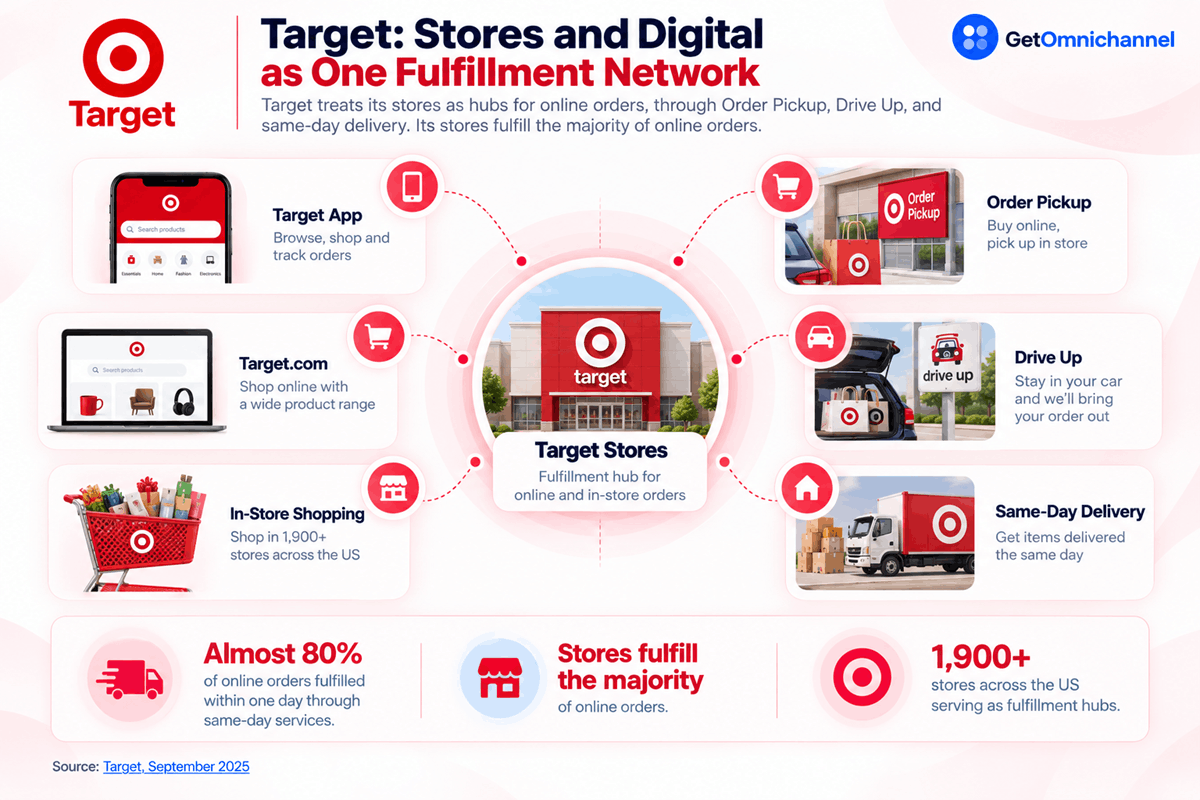
Target treats its stores as hubs for online orders, through Order Pickup, Drive Up, and same-day delivery. The company says it fulfilled almost 80% of online orders within one day through these same-day services, and that its stores will continue to fulfill the majority of online orders. Source: Target, September 2025.
What you can learn: The best omnichannel experiences remove the line between "online" and "in-store." A customer shouldn't need to know which system holds their order.
A B2B support team: one case across chat, email, and phone
This is a typical example rather than a named company. A software customer reports a bug in live chat. The chat agent logs it on the customer's record and promises an update by email. Two days later the customer calls. The phone agent sees the chat, the email update, and the engineering ticket on one timeline, confirms the fix is scheduled, and the customer never repeats a detail.
What you can learn: Omnichannel customer experience isn't only for retail giants. For support teams, the core is simple: one case that follows the customer from channel to channel.
How to build an omnichannel customer experience strategy
Use these six steps to move from separate channels to one connected experience:
Map real customer journeys
Pick your three most common reasons for contact and trace how customers actually move through channels for each. Mark every point where context is lost.
Choose channels by customer, not trend
Support the channels your customers already use, well, before adding new ones. A channel you can't staff or connect makes the experience worse.
Unify identity and history
Connect your channels to one customer record, usually through an omnichannel platform, a CRM, or a helpdesk with native integrations.
Design the handoffs
Decide how conversations move between bot and human, between channels, and between teams, and make sure the history moves too.
Equip your team
Give agents one workspace, one knowledge base, and training on how to use the shared record in daily work.
Measure, then improve
Track cross-channel metrics (see below), review where journeys still break, and fix the biggest gap first.
10 omnichannel customer experience best practices
These practices separate a connected experience from a set of connected tools:
Design around journeys, not channels
Start from what the customer is trying to do, such as return an item or fix a billing issue, and design the path across channels.
Let customers switch without starting over
Any channel change should carry the conversation history with it, automatically.
Always offer a clear path to a human
87% of customers say it is essential for companies using GenAI for service to provide an option to reach a human agent. Source: Gartner, August 2026, survey of 3,566 B2B and B2C customers.
Use AI to gather context, not to block
Only 27% of customers say they would try a chatbot again after a negative experience, and while 49% were willing to use one, only 7% did in their most recent interaction. Source: Gartner, September 2026.
Let AI collect details and resolve simple requests, then hand off with the context intact.
Keep answers consistent
Run every channel from one knowledge base and one set of policies.
Personalize with history, and respect consent
Use past interactions to tailor support, but only collect and use data customers have agreed to share, in line with privacy rules such as GDPR.
Be proactive
Send order updates, appointment reminders, and outage notices before customers have to ask.
Don't launch channels you can't support
A slow WhatsApp reply damages the experience more than not offering WhatsApp.
Close the feedback loop
Collect feedback across channels and share what you learn with the teams who can fix the cause.
Measure the journey, not just the channel
Channel metrics can look healthy while the journey between them fails.
Who should own omnichannel customer experience?
Omnichannel CX crosses support, sales, marketing, and operations, so it fails when no one owns it, and when one team owns it alone. The model that tends to work: one accountable leader (often a Head of CX or customer operations) who owns the journey metrics, plus a small cross-functional group from each customer-facing team that meets regularly to review where journeys break. Technology choices should follow this group’s priorities, not lead them.
Common challenges and how to handle them
| Challenge | Why it happens | What helps |
|---|---|---|
| Data silos | Each channel was added with its own tool | Connect your top two channels first, then expand |
| Cost and complexity | Integrations, licenses, and migration take budget and time | Prefer platforms with native channels; calculate cost per agent at your real volume |
| Privacy and compliance | More connected data means more responsibility | Collect only what you need, record consent, and check regional rules |
| Team habits | Agents keep using old tools and side notes | Train on the shared record and make it the only place work happens |
| Too many channels | Adding channels faster than you can staff them | Retire or pause channels you can't answer quickly |
How to measure omnichannel customer experience
Measure the whole journey, not each channel on its own. These metrics show whether customers are getting help without starting over:
| Metric | What it tells you | How to track it |
|---|---|---|
| Customer Effort Score (CES) | How easy it was to get help | Short survey after resolution |
| First-contact resolution (FCR) | Whether issues are solved without follow-ups | Helpdesk reporting |
| Repeat contact rate | How often customers come back about the same issue | Cases reopened or linked within 7 days |
| Channel-switch rate | How often customers change channel mid-issue | Cross-channel journey reports |
| CSAT by journey | Satisfaction for the whole issue, not one touchpoint | Survey tied to the case, not the channel |
| Average handle time (AHT) | Time agents spend per issue | Should fall as context improves |
| Retention or churn | Whether a better experience keeps customers | CRM or billing data |
Start with three: effort, first-contact resolution, and repeat contact rate. Together they show whether customers are getting help without having to start over.
Omnichannel customer experience for small businesses
You don’t need an enterprise budget. A practical starting plan:
- Start with two channels. Most small teams begin with email and live chat in one shared inbox.
- Use one customer record. Pick a helpdesk or CRM where every conversation attaches to the same contact.
- Add channels one at a time. Add phone, SMS, WhatsApp, or social only when you can answer them as quickly as your existing channels.
- Track three numbers. Effort, first-contact resolution, and repeat contacts tell you whether it’s working.
Choosing software for omnichannel customer experience
The right platform should give agents one customer timeline (not tabs per channel), include the channels you need on the plan you’d buy, keep history when customers switch channels, route using that history, and report across channels. Compare options in our guide to the best omnichannel communication platforms.
How this guide was made
Researched and written by Kinjal Trivedi, SaaS & Technology Writer at GetOmnichannel, who covers customer support, omnichannel, helpdesk, and CRM software. This guide explains general concepts and does not rank or score specific products. Statistics and brand figures are taken from the published sources linked at each figure (checked October 2026).
An omnichannel customer experience is measured by one thing: whether customers can move between channels without starting over. Map one real journey this week and fix the first place the context gets lost.
Frequently asked questions
Conclusion: make the journey, not the channel, the product
An omnichannel customer experience isn’t defined by how many channels you offer. It’s defined by whether those channels act like one business that remembers the customer. The companies that do it well connect identity and history, design their handoffs, keep a human within reach, and measure the journey rather than each channel on its own.
Start small: map one common journey, find where context is lost, and connect those two channels first.
Next step: Compare platforms that deliver one customer timeline across channels in our guide to the best omnichannel communication platforms.
 Your information is encrypted and kept secure.