

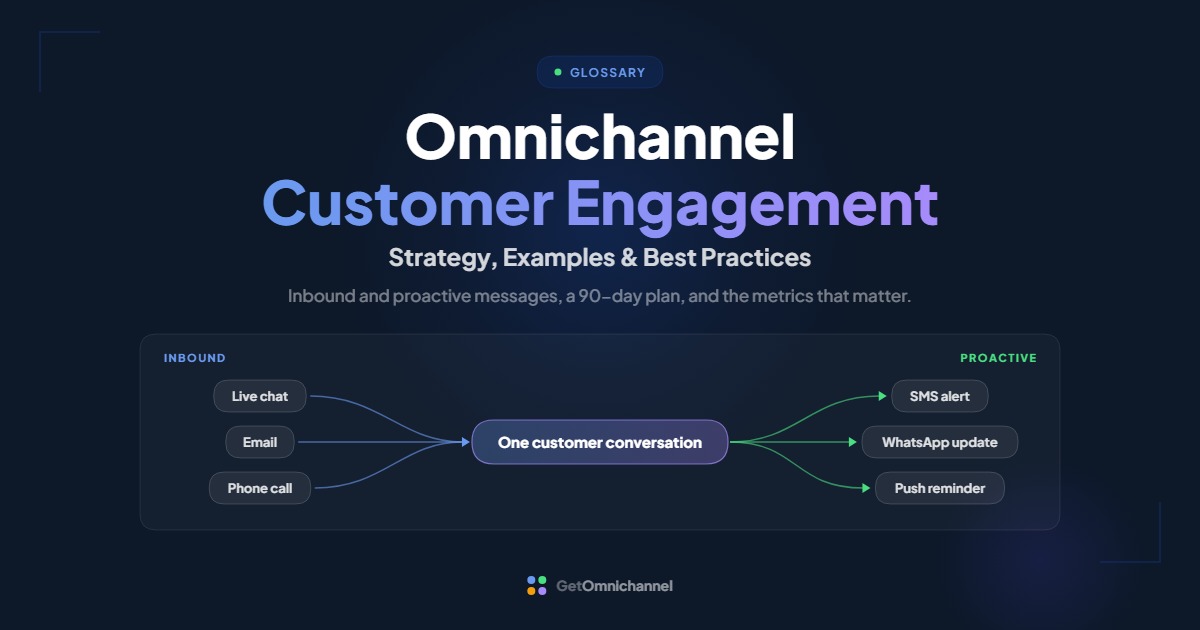
Omnichannel customer engagement is the way a business talks with customers across every channel, including email, SMS, WhatsApp, live chat, phone, social, and in-app, as one connected conversation. Every message, whether the customer starts it or the business does, uses the same customer history, so the conversation continues across channels instead of starting over.
Engagement covers both directions: the questions customers send you, and the updates, reminders, and offers you send them. When those messages come from separate tools that don’t share context, customers get repeated questions, mismatched offers, and alerts they can’t act on. This guide explains how omnichannel customer engagement works, how to plan it channel by channel, and how to roll it out and measure it.
Inbound questions and proactive updates should share one customer history, so customers can reply on any channel and never start over.
Compare platforms →What is omnichannel customer engagement?
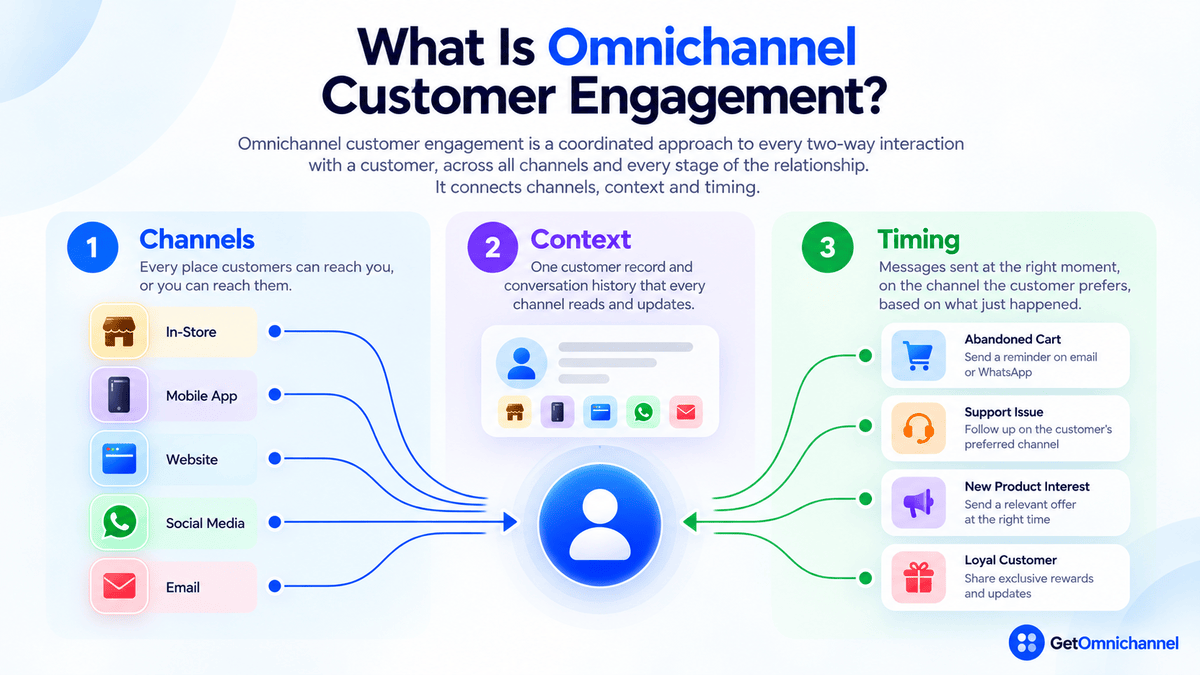
Omnichannel customer engagement is a coordinated approach to every two-way interaction with a customer, across all channels and every stage of the relationship. It connects three things:
- Channels: every place customers can reach you, or you can reach them.
- Context: one customer record and conversation history that every channel reads and updates.
- Timing: messages sent at the right moment, on the channel the customer prefers, based on what just happened.
It builds on the idea of connected channels, explained in our guide to what omnichannel means. If you’re still deciding between separate and connected channels, start with omnichannel vs multichannel.
Engagement vs experience: what’s the difference?
Customer engagement is the set of conversations and interactions you have with customers. Customer experience is how customers feel about your business as a result of all of them. Engagement is one of the main levers you control to improve the experience. For the bigger picture, see our guide to omnichannel customer experience.
Omnichannel engagement across the customer lifecycle
| Stage | Common channels | What connected engagement looks like |
|---|---|---|
| Discovery | Website, social, search, live chat | A chat visitor's questions are saved, so a later sales email doesn't repeat them |
| Purchase and onboarding | Email, in-app, SMS | Welcome messages adapt to what the customer has already set up or bought |
| Support | Chat, email, phone, WhatsApp | Agents see every earlier message, whichever channel it came from |
| Retention | Email, push, SMS, account manager | Renewal or reorder reminders pause automatically while a support issue is open |
| Win-back | Email, SMS, retargeting | Offers reflect why the customer left, based on their history and feedback |
Why omnichannel customer engagement matters
Customers expect relevant, timely conversations, and most say they aren’t getting them:
- Only 45% of consumers feel understood by the brands they interact with, and 71% will walk away from purchases if the experience doesn't feel relevant. Source: Twilio State of Customer Engagement Report 2025, based on 7,640 consumers and 637 business leaders across 18 countries.
- 88% of consumers are more likely to buy when engagement is personalized in real time, but only 44% of brands say they're executing at that level. Source: Twilio, 2025.
- 98% of U.S. adults own a cellphone and 91% own a smartphone, so mobile channels such as SMS, push, and WhatsApp reach almost everyone. Source: Pew Research Center, 2025.
The gap is rarely about channels. Most businesses already have enough of them. It’s about whether each message knows what the customer did a minute ago on another channel.
Inbound vs proactive engagement
Omnichannel engagement has two directions, and most guides only cover the first:
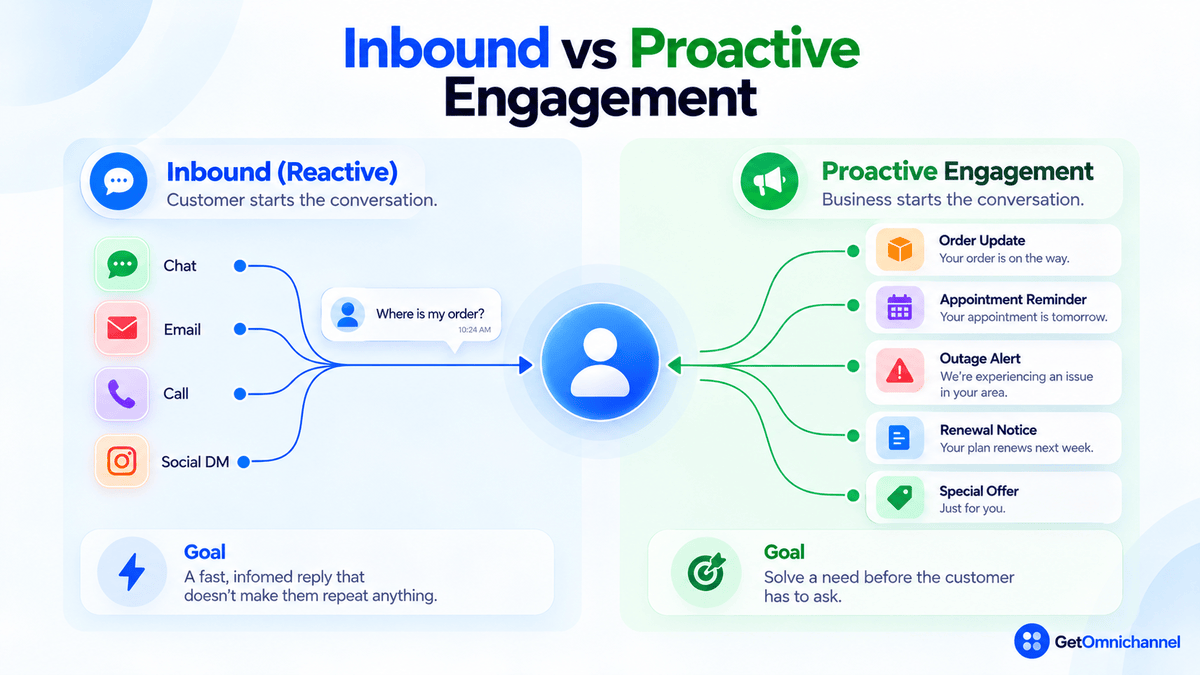
- Inbound (reactive) engagement: the customer starts the conversation, through chat, email, a call, or a DM. The goal is a fast, informed reply that doesn’t make them repeat anything.
- Proactive engagement: the business starts the conversation, with order updates, appointment reminders, outage alerts, renewal notices, or offers. The goal is to solve a need before the customer has to ask.
Proactive engagement works, but only when it’s clear. Gartner found that two-thirds of customers contact customer service after receiving proactive outreach, 66% of B2C and 82% of B2B customers, often because they needed more information or confirmation. 10% of B2C and 24% of B2B customers followed up just to confirm the message wasn’t a scam. Source: Gartner survey of more than 4,800 customers (April 2022).
That’s why proactive messages need to be connected to the rest of your channels. When a customer replies to an outage alert or calls about a delivery text, the agent should see the message they received.
- Comes from a channel and sender the customer recognizes.
- Says exactly what happened and what, if anything, the customer needs to do.
- Includes a clear way to reply or get help, which lands in the same conversation history.
- Is sent only for things the customer would want to know about.
Benefits of omnichannel customer engagement
- Fewer repeated questions. Every channel sees the same history, so customers explain things once.
- Higher response and conversion rates. Messages sent on the customer’s preferred channel, at the right moment, are more likely to get a reply.
- Fewer unnecessary contacts. Clear, connected proactive updates answer “where is my order?” and “is my appointment confirmed?” before customers ask.
- More relevant offers. Marketing messages can respect what’s happening in support, so nobody gets a promotion in the middle of a complaint.
- A single view of the relationship. Sales, support, and marketing work from the same record instead of separate lists.
- Better data on what works. You can see which channel and message actually moved the customer, not just which one they clicked.
Choosing channels: how to use each one
Pick channels based on what your customers use and what each channel does well. Every channel also comes with its own consent rules.
| Channel | Best for | Watch out for |
|---|---|---|
| Detailed updates, receipts, onboarding, newsletters | Marketing emails need a working unsubscribe option (CAN-SPAM in the U.S.) | |
| SMS | Time-sensitive alerts, reminders, delivery updates | U.S. marketing texts need prior express written consent under the TCPA; keep messages short |
| Two-way conversations, order updates, support in markets where it's widely used | Customers must opt in; outside the 24-hour service window you can only send approved message templates | |
| Live chat and in-app | Real-time help while customers are on your site or product | Needs staffing or a bot with a clear handoff to a person |
| Phone | Complex, urgent, or sensitive issues | Agents need the full history before they answer |
| Social DMs | Public-facing brands, quick questions | Move sensitive details into a private, secure channel |
| Push notifications | App users: order status, account alerts | Requires OS permission; too many alerts get notifications switched off |
Consent and privacy rules vary by country and industry, including GDPR in the EU. Check the rules that apply to you before launching marketing messages on any channel.
How to build an omnichannel customer engagement strategy
Use these seven steps to turn separate channels into one connected conversation:
Find out where your customers are
Look at which channels customers already use to contact you, and ask new customers how they prefer to hear from you.
Map your key journeys
Pick three common journeys, such as onboarding, an order problem, and renewal, and list every message sent and received along the way.
Connect conversations to one customer record
Use an omnichannel inbox, CRM, or engagement platform where every channel writes to the same timeline.
Set consent and preferences centrally
Store opt-ins, opt-outs, and channel preferences in one place, so every team respects them.
Design proactive triggers
Decide which events, like a delayed order, a failed payment, or an upcoming appointment, should send a message, on which channel, and what the reply path is.
Give agents the full picture
Agents should see outbound messages as well as inbound ones, so they know what the customer was told.
Measure, then adjust
Track the engagement metrics below and review them monthly.
A 90-day rollout plan
| Phase | Focus | What to do |
|---|---|---|
| Days 1–30 | Connect | Bring your two busiest channels, usually email and live chat, into one shared inbox with one customer record. Centralize consent and preferences. |
| Days 31–60 | Expand | Add a third channel, such as SMS or WhatsApp, for one proactive use case, like order or appointment updates. Make sure replies land in the same thread. |
| Days 61–90 | Optimize | Review opt-out rates, reply rates, and contacts after outreach. Fix confusing messages, set frequency limits, and plan the next channel. |
Start smaller than you think. One well-connected proactive message, such as a delivery update customers can reply to, teaches you more than five new channels launched at once.
Omnichannel customer engagement examples
Here are three examples of omnichannel customer engagement: two consumer brands and one B2B software company. Each one ends with a lesson you can apply to your own setup.
Chipotle: one rewards program across app, online, and restaurant
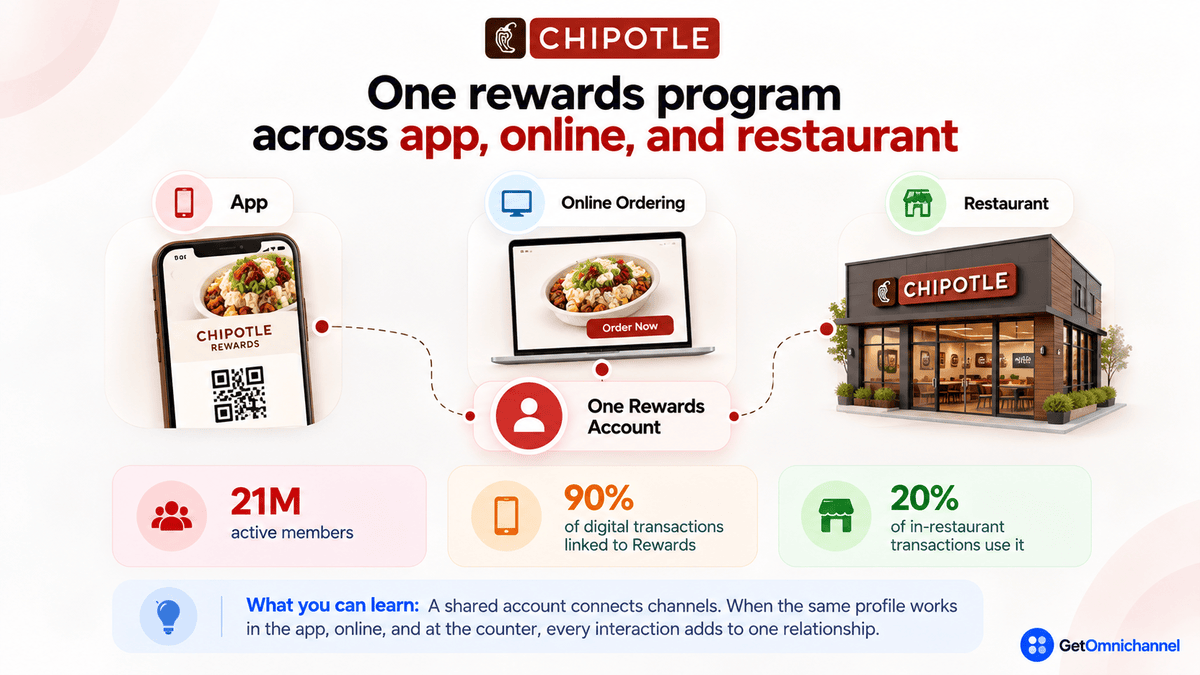
Chipotle's rewards program works across its mobile app, online ordering, and restaurants. In April 2026, Chipotle said it had 21 million active members, that nearly 90% of digital transactions are linked to Rewards, and that about 20% of in-restaurant transactions use the program. Source: Chipotle, April 2026.
Digital sales made up 38.3% of food and beverage revenue in the second quarter of 2026. Source: Chipotle Q2 2026 results.
What you can learn: A shared account is what connects channels. When the same profile works in the app, online, and at the counter, every interaction adds to one relationship.
Domino's: digital ordering as the main conversation
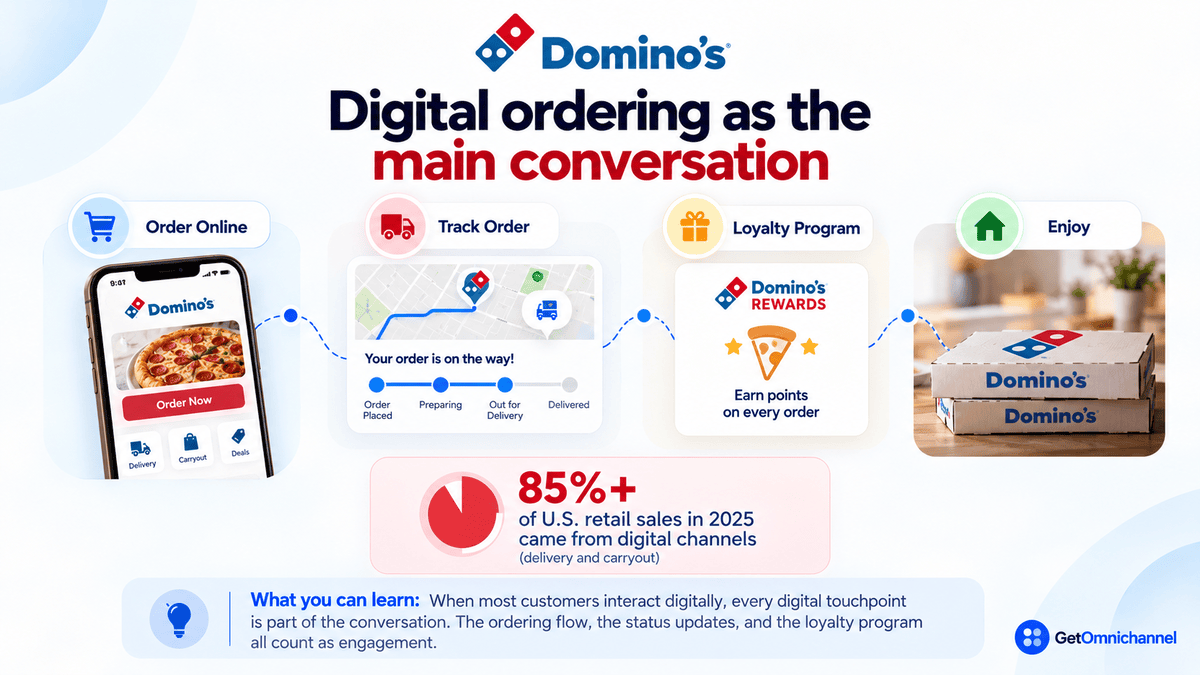
Domino's generated more than 85% of its U.S. retail sales in 2025 through digital channels, across delivery and carryout. Source: Domino's Q2 2026 results (SEC filing).
What you can learn: When most customers interact digitally, every digital touchpoint is part of the conversation. The ordering flow, the status updates, and the loyalty program all count as engagement.
A B2B SaaS company: onboarding that follows the customer
This is a typical example rather than a named company. A new customer signs up and gets a welcome email. When they stall on setup, an in-app message offers a guide. They reply to it with a question, and a support agent answers in the same thread, seeing exactly which onboarding messages the customer already received. A week later, the account manager's check-in call starts with that full history.
What you can learn: B2B engagement is a sequence, not a single message. Connecting marketing, product, and support messages keeps every touchpoint informed by the last one.
Omnichannel customer engagement best practices
Ask for consent first, and make it easy to change
84% of consumers want control over their personalization settings. Source: Twilio, 2025.
Keep one thread per customer
Replies to any message, on any channel, should land in the same conversation history.
Make proactive messages easy to trust
Use recognizable senders, avoid suspicious-looking links, and tell customers how to verify a message.
Give every proactive message a clear next step
If customers have to call to understand an alert, the message wasn't finished.
Set frequency limits across channels
Count email, SMS, push, and WhatsApp together, not separately, so customers aren't flooded.
Pause marketing during open issues
Hold promotions for customers with an unresolved support case.
Be clear when customers are talking to AI
54% of consumers want to know when they're talking to AI rather than a human. Source: Twilio, 2025. Always offer a way to reach a person.
Use the channel the customer chose
If someone emailed you, don't reply with a text unless they've asked for that.
How to measure omnichannel customer engagement
| Metric | What it tells you | Watch for |
|---|---|---|
| Opt-in rate | How many customers agree to hear from you on each channel | Low opt-in may mean unclear value or a bad moment to ask |
| Opt-out or unsubscribe rate | Whether messages are wanted | A rise after a campaign or a new trigger |
| Reply or response rate | Whether messages start real conversations | Channels where customers can't reply at all |
| Contact after outreach | How often proactive messages create extra calls or chats | A high rate means the message was unclear |
| Conversion from engagement | Purchases, renewals, or bookings after a message | Attribute across channels, not just last click |
| Repeat contact rate | Whether issues are resolved without follow-ups | Customers contacting you again on another channel |
| CSAT or effort score | How customers feel about the interaction | Compare proactive and inbound journeys |
| Retention or repeat purchase | Whether engagement keeps customers | Trends by segment and channel mix |
Start with three: opt-out rate, reply rate, and contact after outreach. Together they show whether your messages are wanted, useful, and clear.
Common omnichannel engagement mistakes
- Treating each channel as its own campaign. Customers get the same offer three times, or conflicting messages.
- Sending alerts nobody can reply to. “No-reply” messages push customers to call instead.
- Ignoring consent. Texting or messaging customers without permission damages trust and can break the law.
- Hiding outbound messages from agents. Agents can’t help if they don’t know what the customer was told.
- Launching every channel at once. New channels without staff or connected history make engagement worse.
Tools for omnichannel customer engagement
Most teams combine a few categories:
- Omnichannel inbox or contact center software: brings chat, email, phone, SMS, WhatsApp, and social into one agent workspace.
- CRM or customer data platform: holds the customer record, preferences, and consent.
- Messaging and marketing automation: sends proactive and campaign messages based on triggers.
- Knowledge base and self-service: keeps answers consistent across every channel.
The key test for any tool: do outbound and inbound messages end up on the same customer timeline? Compare platforms that pass it in our guide to the best omnichannel communication platforms. For channel-specific tools, see our guides to SMS marketing software and live chat software.
How this guide was made
Researched and written by Kinjal Trivedi, SaaS & Technology Writer at GetOmnichannel, who covers customer support, omnichannel, helpdesk, and CRM software. This guide explains general concepts and does not rank or score specific products. Statistics and brand figures are taken from the published sources linked at each figure (checked October 2026). Notes on consent rules are general guidance, not legal advice.
Omnichannel customer engagement works when every message, sent or received, is part of one conversation. Connect your two busiest channels first, add one proactive message customers can reply to, and measure whether it reduces contacts or creates them.
Frequently asked questions
Conclusion
Omnichannel customer engagement isn’t about being on more channels. It’s about making every message, inbound or proactive, part of one conversation that knows what came before. Start with consent and one shared customer record, connect your busiest channels, add proactive messages customers can reply to, and measure whether each message is wanted and clear.
Next step: Compare platforms that put inbound and outbound conversations on one timeline in our guide to the best omnichannel communication platforms.
 Your information is encrypted and kept secure.